Civil Rights
Movements, leaders, victories and the continuing fight for equality.

Explore the people, places, events, achievements, struggles and stories that shaped our journey.
Movements, leaders, victories and the continuing fight for equality.
Innovation, patents, science, technology and world-changing contributions.
Pioneers, champions, Negro Leagues, records, activism and excellence.
Meet the people whose lives, choices and achievements shaped the journey.
Black towns, communities, institutions and places where history happened.
Moments that changed communities, movements, institutions and the nation.
Wilmington, North Carolina once had a thriving Black middle class and an elected interracial government. In 1898 white supremacists used violence to overthrow that government, kill Black residents and drive many others from the city.
MORE →Reflects the personal views, recollections, and perspective of the author, Mike Davis.
This is a personal recollection on the Move fire on May 13, 1985
In mathematical logic and computer science, a general recursive function, partial recursive function, or μ-recursive function is a partial function from natural numbers to natural numbers that is "computable" in an intuitive sense – as well as in a formal one. If the function is total, it is also called a total recursive function (sometimes shortened to recursive function).[1] In computability theory, it is shown that the μ-recursive functions are precisely the functions that can be computed by Turing machines[2][4] (this is one of the theorems that supports the Church–Turing thesis). The μ-recursive functions are closely related to primitive recursive functions, and their inductive definition (below) builds upon that of the primitive recursive functions. However, not every total recursive function is a primitive recursive function—the most famous example is the Ackermann function.
Other equivalent classes of functions are the functions of lambda calculus and the functions that can be computed by Markov algorithms.
The subset of all total recursive functions with values in {0,1} (that is, solving decision problems) is known in computational complexity theory as the complexity class R.
The μ-recursive functions (or general recursive functions) are partial functions that take finite tuples of natural numbers and return a single natural number. They are the smallest class of partial functions that includes the initial functions and is closed under composition, primitive recursion, and the minimization operator μ.
The smallest class of functions including the initial functions and closed under composition and primitive recursion (i.e. without minimisation) is the class of primitive recursive functions. While all primitive recursive functions are total, this is not true of partial recursive functions; for example, the minimisation of the successor function is undefined. The primitive recursive functions are a subset of the total recursive functions, which are a subset of the partial recursive functions. For example, the Ackermann function can be proven to be total recursive, and to be non-primitive.
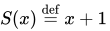
Primitive or "basic" functions:
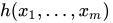
Operators (the domain of a function defined by an operator is the set of the values of the arguments such that every function application that must be done during the computation provides a well-defined result):
Intuitively, minimisation seeks—beginning the search from 0 and proceeding upwards—the smallest argument that causes the function to return zero; if there is no such argument, or if one encounters an argument for which f is not defined, then the search never terminates, and is not defined for the argument
While some textbooks use the μ-operator as defined here,[5][6] others[7][8] demand that the μ-operator is applied to total functions f only. Although this restricts the μ-operator as compared to the definition given here, the class of μ-recursive functions remains the same, which follows from Kleene's normal form theorem (see below).[5][6] The only difference is, that it becomes undecidable whether a specific function definition defines a μ-recursive function, as it is undecidable whether a computable (i.e. μ-recursive) function is total.[7]
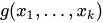
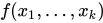
The strong equality relation can be used to compare partial μ-recursive functions. This is defined for all partial functions f and g so that
holds if and only if for any choice of arguments either both functions are defined and their values are equal or both functions are undefined.
Examples not involving the minimization operator can be found at Primitive recursive function#Examples.
The following examples are intended just to demonstrate the use of the minimization operator; they could also be defined without it, albeit in a more complicated way, since they are all primitive recursive.
The following examples define general recursive functions that are not primitive recursive; hence they cannot avoid using the minimization operator.
A general recursive function is called total recursive function if it is defined for every input, or, equivalently, if it can be computed by a total Turing machine. There is no way to computably tell if a given general recursive function is total—see Halting problem.
![[icon]](viewer.php?source=wikipedia&q=File%3AWiki%20letter%20w%20cropped.svg&result=0#selected-result) | This section needs expansion. You can help by adding missing information. (February 2010) |
In the equivalence of models of computability, a parallel is drawn between Turing machines that do not terminate for certain inputs and an undefined result for that input in the corresponding partial recursive function. The unbounded search operator is not definable by the rules of primitive recursion as those do not provide a mechanism for "infinite loops" (undefined values).
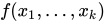
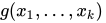
A normal form theorem due to Kleene says that for each k there are primitive recursive functions and such that for any μ-recursive function with k free variables there is an e such that
The number e is called an index or Gödel number for the function f.[10]: 52–53 A consequence of this result is that any μ-recursive function can be defined using a single instance of the μ operator applied to a (total) primitive recursive function.
Minsky observes the defined above is in essence the μ-recursive equivalent of the universal Turing machine:
To construct U is to write down the definition of a general-recursive function U(n, x) that correctly interprets the number n and computes the appropriate function of x. to construct U directly would involve essentially the same amount of effort, and essentially the same ideas, as we have invested in constructing the universal Turing machine [11]
A number of different symbolisms are used in the literature. An advantage to using the symbolism is a derivation of a function by "nesting" of the operators one inside the other is easier to write in a compact form. In the following the string of parameters is abbreviated as :
Example: Kleene gives an example of how to perform the recursive derivation of (notice reversal of variables and ). He starts with initial functions
He arrives at:
Source: Wikipedia. Article content is retrieved live through the MediaWiki API.
In mathematical logic and computer science, a general recursive function, partial recursive function, or μ-recursive function is a partial function from natural numbers to natural numbers that is "computable" in an intuitive sense – as well as in a formal one. If the function is total, it is also called a total recursive function (sometimes shortened to recursive function). In computability theory, it is shown that the μ-recursive functions are precisely the functions that can be computed by Turing machines (this is one of the theorems that supports the Church–Turing thesis). The μ-recursive functions are closely related to primitive recursive functions, and their inductive definition (below) builds upon that of the primitive recursive functions. However, not every total recursive function is a primitive recursive function—the most famous example is the Ackermann function. Other equivalent classes of functions are the functions of lambda calculus and the functions that can be computed by Markov algorithms. The subset of all total recursive functions with values in {0,1} (that is, solving decision problems) is known in computational complexity theory as the complexity class R.

In mathematics, computable numbers are the real numbers that can be computed to within any desired precision by a finite, terminating algorithm. They are also known as the recursive numbers, effective numbers, computable reals, or recursive reals. The concept of a computable real number was introduced by Émile Borel in 1912, using the intuitive notion of computability available at the time. Equivalent definitions can be given using μ-recursive functions, Turing machines, or λ-calculus as the formal representation of algorithms. The set of computable numbers is sometimes denoted by 𝕂. The idea of computable numbers can be further extended to computable complex numbers(or gaussian computable numbers) - whose both real and imaginary components are computable. The computable numbers form a real closed field and can be used in the place of real numbers for many, but not all, mathematical purposes.
Computability is the ability to solve a problem by an effective procedure. It is a key topic of the field of computability theory within mathematical logic and the theory of computation within computer science. The computability of a problem is closely linked to the existence of an algorithm to solve the problem. The most widely studied models of computability are the Turing-computable and μ-recursive functions, and the lambda calculus, all of which have computationally equivalent power. Other forms of computability are studied as well: computability notions weaker than Turing machines are studied in automata theory, while computability notions stronger than Turing machines are studied in the field of hypercomputation.
Minimisation or minimization may refer to: Minimisation (psychology), downplaying the significance of an event or emotion Minimisation (clinical trials) Minimisation (code) or Minification, removing unnecessary characters from source code Structural risk minimization Boolean minimization, a technique for optimizing combinational digital circuits Cost-minimization analysis, in pharmacoeconomics Expenditure minimization problem, in microeconomics Waste minimisation Harm reduction Maxima and minima, in mathematical analysis Minimal element of a partial order, in mathematics Minimax approximation algorithm Minimisation operator ("μ operator"), the add-on to primitive recursion to obtain μ-recursive functions in computer science
Before the 1921 destruction of Tulsa’s Greenwood District, Black residents had created a remarkable center of business and community life. The district included stores, professional offices, entertainment venues and homes owned by Black citizens. Understanding Greenwood means learning what was built—not only what was burned.
MORE →Joe Louis.