Civil Rights
Movements, leaders, victories and the continuing fight for equality.

Explore the people, places, events, achievements, struggles and stories that shaped our journey.
Movements, leaders, victories and the continuing fight for equality.
Innovation, patents, science, technology and world-changing contributions.
Pioneers, champions, Negro Leagues, records, activism and excellence.
Meet the people whose lives, choices and achievements shaped the journey.
Black towns, communities, institutions and places where history happened.
Moments that changed communities, movements, institutions and the nation.
In August 1908, a white mob attacked Springfield, Illinois’s Black community, destroying homes and businesses and lynching two Black men. National outrage over the violence helped spur the movement that created the NAACP the following year.
MORE →Reflects the personal views, recollections, and perspective of the author, Mike Davis.
This is a personal recollection on the Move fire on May 13, 1985


In geometry, a barycentric coordinate system is a coordinate system in which the location of a point is specified by reference to a simplex (a triangle for points in a plane, a tetrahedron for points in three-dimensional space, etc.). The barycentric coordinates of a point can be interpreted as point masses placed at the vertices of the simplex, such that the point is the center of mass (or barycenter) of these masses. These masses can be zero or negative; they are all positive if and only if the point is strictly inside the simplex.
Every point has barycentric coordinates, and their sum is never zero. Two tuples of barycentric coordinates specify the same point if and only if they are proportional; that is to say, if one tuple can be obtained by multiplying the elements of the other tuple by the same non-zero number. Therefore, barycentric coordinates are either considered to be defined up to multiplication by a nonzero constant, or normalized for summing to unity.
Barycentric coordinates were introduced by August Möbius in 1827.[1][2][3] They are special homogeneous coordinates. Barycentric coordinates are strongly related with Cartesian coordinates and, more generally, to affine coordinates ().
Barycentric coordinates are particularly useful in triangle geometry for studying properties that do not depend on the angles of the triangle, such as Ceva's theorem, Routh's theorem, and Menelaus's theorem. In computer-aided design, they are useful for defining some kinds of Bézier surfaces.[4][5]
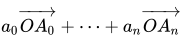
Let be n + 1 points in a Euclidean space, a flat or an affine space of dimension n that are affinely independent; this means that there is no affine subspace of dimension n − 1 that contains all the points,[6] or, equivalently that the points define a simplex. Given any point there are scalars that are not all zero, such that for any point O. (As usual, the notation represents the translation vector or free vector that maps the point A to the point B.)
The elements of a (n + 1) tuple that satisfies this equation are called barycentric coordinates of P with respect to The use of colons in the notation of the tuple means that barycentric coordinates are a sort of homogeneous coordinates, that is, the point is not changed if all coordinates are multiplied by the same nonzero constant. Moreover, the barycentric coordinates are also not changed if the auxiliary point O, the origin, is changed.
The barycentric coordinates of a point are unique up to a scaling. That is, two tuples and are barycentric coordinates of the same point if and only if there is a nonzero scalar such that for every i.
In some contexts, it is useful to constrain the barycentric coordinates of a point so that they are unique. This is usually achieved by imposing the condition or equivalently by dividing every by the sum of all These specific barycentric coordinates are called normalized or absolute barycentric coordinates.[7] Sometimes, they are also called affine coordinates, although this term refers commonly to a slightly different concept.
Sometimes, it is the normalized barycentric coordinates that are called barycentric coordinates. In this case the above defined coordinates are called homogeneous barycentric coordinates.
With above notation, the homogeneous barycentric coordinates of Ai are all zero, except the one of index i. When working over the real numbers (the above definition is also used for affine spaces over an arbitrary field), the points whose all normalized barycentric coordinates are nonnegative form the convex hull of which is the simplex that has these points as its vertices.
With above notation, a tuple such that does not define any point, but the vector is independent from the origin O. As the direction of this vector is not changed if all are multiplied by the same scalar, the homogeneous tuple defines a direction of lines, that is a point at infinity. See below for more details.
Barycentric coordinates are strongly related to Cartesian coordinates and, more generally, affine coordinates. For a space of dimension n, these coordinate systems are defined relative to a point O, the origin, whose coordinates are zero, and n points whose coordinates are zero except that of index i that equals one.
A point has coordinates for such a coordinate system if and only if its normalized barycentric coordinates are relatively to the points
The main advantage of barycentric coordinate systems is to be symmetric with respect to the n + 1 defining points. They are therefore often useful for studying properties that are symmetric with respect to n + 1 points. On the other hand, distances and angles are difficult to express in general barycentric coordinate systems, and when they are involved, it is generally simpler to use a Cartesian coordinate system.
Homogeneous barycentric coordinates are also strongly related with some projective coordinates. However this relationship is more subtle than in the case of affine coordinates, and, for being clearly understood, requires a coordinate-free definition of the projective completion of an affine space, and a definition of a projective frame.
The projective completion of an affine space of dimension n is a projective space of the same dimension that contains the affine space as the complement of a hyperplane. The projective completion is unique up to an isomorphism. The hyperplane is called the hyperplane at infinity, and its points are the points at infinity of the affine space.[8]
Given a projective space of dimension n, a projective frame is an ordered set of n + 2 points that are not contained in the same hyperplane. A projective frame defines a projective coordinate system such that the coordinates of the (n + 2)th point of the frame are all equal, and, otherwise, all coordinates of the ith point are zero, except the ith one.[8]
When constructing the projective completion from an affine coordinate system, one commonly defines it with respect to a projective frame consisting of the intersections with the hyperplane at infinity of the coordinate axes, the origin of the affine space, and the point that has all its affine coordinates equal to one. This implies that the points at infinity have their last coordinate equal to zero, and that the projective coordinates of a point of the affine space are obtained by completing its affine coordinates by one as (n + 1)th coordinate.
When one has n + 1 points in an affine space that define a barycentric coordinate system, this is another projective frame of the projective completion that is convenient to choose. This frame consists of these points and their centroid, that is the point that has all its barycentric coordinates equal. In this case, the homogeneous barycentric coordinates of a point in the affine space are the same as the projective coordinates of this point. A point is at infinity if and only if the sum of its coordinates is zero. This point is in the direction of the vector defined at the end of § Definition.
In the context of a triangle, barycentric coordinates are also known as area coordinates or areal coordinates, because the coordinates of with respect to triangle are equivalent to the (signed) ratios of the areas of , and to the area of the reference triangle . Areal and trilinear coordinates are used for similar purposes in geometry.
Barycentric or areal coordinates are extremely useful in engineering applications involving triangular subdomains. These make analytic integrals often easier to evaluate, and Gaussian quadrature tables are often presented in terms of area coordinates.
Consider a triangle with vertices , , in the -plane, . One may regard points in as vectors, so it makes sense to add or subtract them and multiply them by scalars.
Each triangle has a signed area or sarea, which is plus or minus its area: The sign is plus if the path from to to then back to goes around the triangle in a counterclockwise direction. The sign is minus if the path goes around in a clockwise direction.
Let be a point in the plane, and let be its normalized barycentric coordinates with respect to the triangle , so and
Normalized barycentric coordinates are also called areal coordinates because they represent ratios of signed areas of triangles:
One may prove these ratio formulas based on the facts that a triangle is half of a parallelogram, and the area of a parallelogram is easy to compute using a determinant.
Specifically, let is a parallelogram because its pairs of opposite sides, represented by the pairs of displacement vectors , and , are parallel and congruent.
Triangle is half of the parallelogram , so twice its signed area is equal to the signed area of the parallelogram, which is given by the determinant whose columns are the displacement vectors and :
Expanding the determinant, using its alternating and multilinear properties, one obtains so Similarly, To obtain the ratio of these signed areas, express in the second formula in terms of its barycentric coordinates: The barycentric coordinates are normalized so , hence . Plug that into the previous line to obtain Therefore
Similar calculations prove the other two formulas
Trilinear coordinates of are signed distances from to the lines , , and , respectively. The sign of is positive if and lie on the same side of , negative otherwise. The signs of and are assigned similarly. Let , , . Then where, as above, sarea stands for signed area. All three signs are plus if triangle is positively oriented, minus otherwise. The relations between trilinear and barycentric coordinates are obtained by substituting these formulas into the above formulas that express barycentric coordinates as ratios of areas.
Switching back and forth between the barycentric coordinates and other coordinate systems makes some problems much easier to solve.
Given a point in a triangle's plane one can obtain the barycentric coordinates , and from the Cartesian coordinates or vice versa.
We can write the Cartesian coordinates of the point in terms of the Cartesian components of the triangle vertices , , where and in terms of the barycentric coordinates of as
That is, the Cartesian coordinates of any point are a weighted average of the Cartesian coordinates of the triangle's vertices, with the weights being the point's barycentric coordinates summing to unity.
To find the reverse transformation, from Cartesian coordinates to barycentric coordinates, we first substitute into the above to obtain
Rearranging, this is
This linear transformation may be written more succinctly as where is the vector of the first two barycentric coordinates, is the vector of Cartesian coordinates, and is a matrix given by
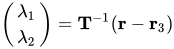
Now the matrix is invertible, since and are linearly independent (if this were not the case, then , , and would be collinear and would not form a triangle). Thus, we can rearrange the above equation to get
Finding the barycentric coordinates has thus been reduced to finding the 2×2 inverse matrix of , an easy problem.
Explicitly, the formulae for the barycentric coordinates of point in terms of its Cartesian coordinates (x, y) and in terms of the Cartesian coordinates of the triangle's vertices are: When understanding the last line of equation, note the identity
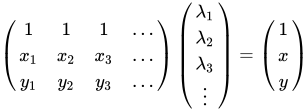
Another way to solve the conversion from Cartesian to barycentric coordinates is to write the relation in the matrix form with and i.e.To get the unique normalized solution we need to add the condition . The barycentric coordinates are thus the solution of the linear systemwhich iswhere is twice the signed area of the triangle. The area interpretation of the barycentric coordinates can be recovered by applying Cramer's rule to this linear system.
A point with trilinear coordinates has barycentric coordinates where , , are the side lengths of the triangle. Conversely, a point with barycentrics has trilinears
The three sides , , respectively have equations[9]
The equation of a triangle's Euler line is[9]
Using the previously given conversion between barycentric and trilinear coordinates, the various other equations given in Trilinear coordinates#Formulas can be rewritten in terms of barycentric coordinates.
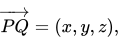
The displacement vector of two normalized points and is[10]
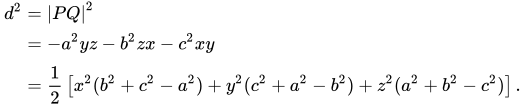
The distance d between P and Q, or the length of the displacement vector is where , , are the sidelengths of the triangle. The equivalence of the last two expressions follows from which holds because
The barycentric coordinates of a point can be calculated based on distances to the three triangle vertices by solving the equation

Although barycentric coordinates are most commonly used to handle points inside a triangle, they can also be used to describe a point outside the triangle. If the point is not inside the triangle, then we can still use the formulas above to compute the barycentric coordinates. However, since the point is outside the triangle, at least one of the coordinates will violate our original assumption that . In fact, given any point in cartesian coordinates, we can use this fact to determine where this point is with respect to a triangle.
If a point lies in the interior of the triangle, all of the Barycentric coordinates lie in the open interval If a point lies on an edge of the triangle but not at a vertex, one of the area coordinates (the one associated with the opposite vertex) is zero, while the other two lie in the open interval If the point lies on a vertex, the coordinate associated with that vertex equals 1 and the others equal zero. Finally, if the point lies outside the triangle at least one coordinate is negative.
Summarizing,
In particular, if a point lies on the far side of a line the barycentric coordinate of the point in the triangle that is not on the line will have a negative value.

If are known quantities, but the values of f inside the triangle defined by is unknown, they can be approximated using linear interpolation. Barycentric coordinates provide a convenient way to compute this interpolation. If is a point inside the triangle with barycentric coordinates , , , then
In general, given any unstructured grid or polygon mesh, this kind of technique can be used to approximate the value of f at all points, as long as the function's value is known at all vertices of the mesh. In this case, we have many triangles, each corresponding to a different part of the space. To interpolate a function f at a point , first a triangle must be found that contains . To do so, is transformed into the barycentric coordinates of each triangle. If some triangle is found such that the coordinates satisfy , then the point lies in that triangle or on its edge (explained in the previous section). Then the value of can be interpolated as described above.
These methods have many applications, such as the finite element method (FEM).
The integral of a function over the domain of the triangle can be annoying to compute in a cartesian coordinate system. One generally has to split the triangle up into two halves, and great messiness follows. Instead, it is often easier to make a change of variables to any two barycentric coordinates, e.g. . Under this change of variables, where A is the area of the triangle. This result follows from the fact that a rectangle in barycentric coordinates corresponds to a quadrilateral in cartesian coordinates, and the ratio of the areas of the corresponding shapes in the corresponding coordinate systems is given by . Similarly, for integration over a tetrahedron, instead of breaking up the integral into two or three separate pieces, one could switch to 3D tetrahedral coordinates under the change of variables where V is the volume of the tetrahedron.
This approach can be generalized to higher dimensions, to integrate over any n-dimensional simplex.
In the homogeneous barycentric coordinate system defined with respect to a triangle , the following statements about special points of hold.
Normalizing coordinates at vertices, the three vertices A, B, and C have coordinates:[9]
If a, b, c are the edge lengths , , respectively, , , are the angle measures , , and respectively, and s is the semiperimeter of , then the following statements about special points of hold in addition.
The circumcenter has coordinates[9][10][11][12]
The orthocenter has coordinates[9][10]
The incenter has coordinates [10][13]
The excenters have coordinates[13]
The nine-point center has coordinates[9][13]
The Gergonne point has coordinates .
The Nagel point has coordinates .
The symmedian point has coordinates .[12]
Barycentric coordinates may be easily extended to three dimensions. The 3D simplex is a tetrahedron, a polyhedron having four triangular faces and four vertices. Once again, the four barycentric coordinates are defined so that the first vertex maps to barycentric coordinates , , etc.
This is again a linear transformation, and we may extend the above procedure for triangles to find the barycentric coordinates of a point with respect to a tetrahedron: where is now a 3×3 matrix: and with the corresponding Cartesian coordinates:Once again, the problem of finding the barycentric coordinates has been reduced to inverting a 3×3 matrix.
3D barycentric coordinates may be used to decide if a point lies inside a tetrahedral volume, and to interpolate a function within a tetrahedral mesh, in an analogous manner to the 2D procedure. Tetrahedral meshes are often used in finite element analysis because the use of barycentric coordinates can greatly simplify 3D interpolation.
Barycentric coordinates of a point that are defined with respect to a finite set of points instead of a simplex are called generalized barycentric coordinates. For these, the equation is still required to hold.[14] Usually one uses normalized coordinates, . As for the case of a simplex, the points with nonnegative normalized generalized coordinates () form the convex hull of x1, ..., xn. If there are more points than in a full simplex () the generalized barycentric coordinates of a point are not unique, as the defining linear system (here for )is underdetermined. The simplest example is a quadrilateral in the plane. Various kinds of additional restrictions can be used to define unique barycentric coordinates.[15]
More abstractly, generalized barycentric coordinates express a convex polytope with vertices, regardless of dimension, as the image of the standard -simplex, which has vertices – the map is onto: The map is one-to-one if and only if the polytope is a simplex, in which case the map is an isomorphism; this corresponds to a point not having unique generalized barycentric coordinates except when is a simplex.
Dual to generalized barycentric coordinates are slack variables, which measure by how much margin a point satisfies the linear constraints, and gives an embedding into the -orthant, where is the number of faces (dual to the vertices). This map is one-to-one (slack variables are uniquely determined) but not onto (not all combinations can be realized).
This use of the standard -simplex and -orthant as standard objects that map to a polytope or that a polytope maps into should be contrasted with the use of the standard vector space as the standard object for vector spaces, and the standard affine hyperplane as the standard object for affine spaces, where in each case choosing a linear basis or affine basis provides an isomorphism, allowing all vector spaces and affine spaces to be thought of in terms of these standard spaces, rather than an onto or one-to-one map (not every polytope is a simplex). Further, the -orthant is the standard object that maps to cones.

Generalized barycentric coordinates have applications in computer graphics and more specifically in geometric modelling.[16] Often, a three-dimensional model can be approximated by a polyhedron such that the generalized barycentric coordinates with respect to that polyhedron have a geometric meaning. In this way, the processing of the model can be simplified by using these meaningful coordinates. Barycentric coordinates are also used in geophysics.[17]
Source: Wikipedia. Article content is retrieved live through the MediaWiki API.

In geometry, a barycentric coordinate system is a coordinate system in which the location of a point is specified by reference to a simplex (a triangle for points in a plane, a tetrahedron for points in three-dimensional space, etc.). The barycentric coordinates of a point can be interpreted as point masses placed at the vertices of the simplex, such that the point is the center of mass (or barycenter) of these masses. These masses can be zero or negative; they are all positive if and only if the point is strictly inside the simplex. Every point has barycentric coordinates, and their sum is never zero. Two tuples of barycentric coordinates specify the same point if and only if they are proportional; that is to say, if one tuple can be obtained by multiplying the elements of the other tuple by the same non-zero number. Therefore, barycentric coordinates are either considered to be defined up to multiplication by a nonzero constant, or normalized for summing to unity. Barycentric coordinates were introduced by August Möbius in 1827. They are special homogeneous coordinates. Barycentric coordinates are strongly related with Cartesian coordinates and, more generally, to affine coordinates (see Affine space § Relationship between barycentric and affine coordinates). Barycentric coordinates are particularly useful in triangle geometry for studying properties that do not depend on the angles of the triangle, such as Ceva's theorem, Routh's theorem, and Menelaus's theorem. In computer-aided design, they are useful for defining some kinds of Bézier surfaces.

In mathematics, an affine space is a geometric structure that generalizes some of the properties of Euclidean spaces in such a way that these are independent of the concepts of distance and measure of angles, keeping only the properties related to parallelism and ratio of lengths for parallel line segments. Affine space is the setting for affine geometry. As in Euclidean space, the fundamental objects in an affine space are called points, which can be thought of as locations in the space without any size or shape: zero-dimensional. Through any pair of points an infinite straight line can be drawn, a one-dimensional set of points; through any three points that are not collinear, a two-dimensional plane can be drawn; and, in general, through k + 1 points in general position, a k-dimensional flat or affine subspace can be drawn. Affine space is characterized by a notion of pairs of parallel lines that lie within the same plane but never meet each other (non-parallel lines within the same plane intersect in a point). Given any line, a line parallel to it can be drawn through any point in the space, and the equivalence class of parallel lines are said to share a direction. Unlike for vectors in a vector space, in an affine space there is no distinguished point that serves as an origin. There is no predefined concept of adding or multiplying points together, or multiplying a point by a scalar number. However, for any affine space, an associated vector space can be constructed from the differences between start and end points, which are called free vectors, displacement vectors, translation vectors or simply translations. Likewise, it makes sense to add a displacement vector to a point of an affine space, resulting in a new point (of the same affine space) translated from the starting point by that vector. While points cannot be arbitrarily added together, it is meaningful to take affine combinations of points: weighted sums with numerical coefficients summing to 1, resulting in another point. These coefficients define a barycentric coordinate system for the flat through the points. Any vector space may be viewed as an affine space; this amounts to "forgetting" the special role played by the zero vector. In this case, elements of the vector space may be viewed either as points of the affine space or as displacement vectors or translations. When considered as a point, the zero vector is called the origin. Adding a fixed vector to the elements of a linear subspace (vector subspace) of a vector space produces an affine subspace of the vector space. One commonly says that this affine subspace has been obtained by translating (away from the origin) the linear subspace by the translation vector (the vector added to all the elements of the linear subspace). In finite dimensions, such an affine subspace is the solution set of an inhomogeneous linear system. The displacement vectors for that affine space are the solutions of the corresponding homogeneous linear system, which is a linear subspace. Linear subspaces, in contrast, always contain the origin of the vector space. The dimension of an affine space is defined as the dimension of the vector space of its translations. An affine space of dimension one is an affine line. An affine space of dimension 2 is an affine plane. An affine subspace of dimension n – 1 in an affine space or a vector space of dimension n is an affine hyperplane.

In mathematics, the real coordinate space of dimension n, denoted Rn or R n {\displaystyle \mathbb {R} ^{n}} , is the set of all n-tuples of real numbers, that is, all ordered lists of n real numbers. Special cases include the real line R1, the real coordinate plane R2, and the real coordinate three-dimensional space R3. An element of Rn has the form x = (x1, x2, ..., xn) consisting of real numbers x1, ..., xn called the coordinates of x. While elements of Rn need not be given any additional algebraic or geometrical structure, they are often supplied with component-wise addition and scalar multiplication, forming a real vector space whose elements are coordinate vectors. Given any affine space over a finite-dimensional real vector space, a specific choice of origin point and basis associates every point in the space with a coordinate tuple. In particular, the Cartesian coordinates of the points of a Euclidean space, under a Cartesian coordinate system, form a real coordinate space. These one to one correspondences between coordinate tuples, vectors, and points explain the names coordinate space and coordinate vector. This approach to relating algebra and geometry, called analytic geometry, was introduced by Pierre de Fermat and René Descartes in the 17th century.
In differential geometry, normal coordinates at a point p in a differentiable manifold equipped with a symmetric affine connection are a local coordinate system in a neighborhood of p obtained by applying the exponential map to the tangent space at p. In a normal coordinate system, the Christoffel symbols of the connection vanish at the point p, thus often simplifying local calculations. In normal coordinates associated to the Levi-Civita connection of a Riemannian manifold, one can additionally arrange that the metric tensor is the Kronecker delta at the point p, and that the first partial derivatives of the metric at p vanish. A basic result of differential geometry states that normal coordinates at a point always exist on a manifold with a symmetric affine connection. In such coordinates the covariant derivative reduces to a partial derivative (at p only), and the geodesics through p are locally linear functions of t (the affine parameter). This idea was implemented in a fundamental way by Albert Einstein in the general theory of relativity: the equivalence principle uses normal coordinates via inertial frames. Normal coordinates always exist for the Levi-Civita connection of a Riemannian or Pseudo-Riemannian manifold. By contrast, in general there is no way to define normal coordinates for Finsler manifolds in a way that the exponential map are twice-differentiable (Busemann 1955).
Before the 1921 destruction of Tulsa’s Greenwood District, Black residents had created a remarkable center of business and community life. The district included stores, professional offices, entertainment venues and homes owned by Black citizens. Understanding Greenwood means learning what was built—not only what was burned.
MORE →Mae Jemison, aboard Space Shuttle Endeavour in 1992.