Civil Rights
Movements, leaders, victories and the continuing fight for equality.

Explore the people, places, events, achievements, struggles and stories that shaped our journey.
Movements, leaders, victories and the continuing fight for equality.
Innovation, patents, science, technology and world-changing contributions.
Pioneers, champions, Negro Leagues, records, activism and excellence.
Meet the people whose lives, choices and achievements shaped the journey.
Black towns, communities, institutions and places where history happened.
Moments that changed communities, movements, institutions and the nation.
Mansa Musa was the ruler of the Mali Empire in West Africa. Details recorded here should be sourced; unknown information is left blank.
MORE →Reflects the personal views, recollections, and perspective of the author, Mike Davis.
This is a personal recollection on the Move fire on May 13, 1985
In functional analysis, a branch of mathematics, the algebraic interior or radial kernel of a subset of a vector space is a refinement of the concept of the interior.
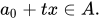
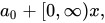
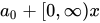
Assume that is a subset of a vector space The algebraic interior (or radial kernel) of with respect to is the set of all points at which is a radial set. A point is called an internal point of [1][2] and is said to be radial at if for every there exists a real number such that for every This last condition can also be written as where the set is the line segment (or closed interval) starting at and ending at this line segment is a subset of which is the ray emanating from in the direction of (that is, parallel to/a translation of ). Thus geometrically, an interior point of a subset is a point with the property that in every possible direction (vector) contains some (non-degenerate) line segment starting at and heading in that direction (i.e. a subset of the ray ). The algebraic interior of (with respect to ) is the set of all such points. That is to say, it is the subset of points contained in a given set with respect to which it is radial points of the set.[3]
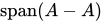
If is a linear subspace of and then this definition can be generalized to the algebraic interior of with respect to is:[4] where always holds and if then where is the affine hull of (which is equal to ).
Algebraic closure
A point is said to be linearly accessible from a subset if there exists some such that the line segment is contained in [5] The algebraic closure of with respect to , denoted by consists of ( and) all points in that are linearly accessible from [5]
In the special case where the set is called the algebraic interior or core of and it is denoted by or Formally, if is a vector space then the algebraic interior of is[6]
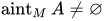
We call A algebraically open in X if
If is non-empty, then these additional subsets are also useful for the statements of many theorems in convex functional analysis (such as the Ursescu theorem):
If is a Fréchet space, is convex, and is closed in then but in general it is possible to have while is not empty.
If then but and
Suppose
Both the core and the algebraic closure of a convex set are again convex.[5] If is convex, and then the line segment is contained in [5]
Let be a topological vector space, denote the interior operator, and then:
If then the set is denoted by and it is called the relative algebraic interior of [7] This name stems from the fact that if and only if and (where if and only if ).
If is a subset of a topological vector space then the relative interior of is the set That is, it is the topological interior of A in which is the smallest affine linear subspace of containing The following set is also useful:
If is a subset of a topological vector space then the quasi relative interior of is the set
In a Hausdorff finite dimensional topological vector space,
| Spaces |
| ||||
|---|---|---|---|---|---|
| Theorems | |||||
| Operators | |||||
| Algebras | |||||
| Open problems | |||||
| Applications | |||||
| Advanced topics | |||||
Topological vector spaces (TVSs) | |
|---|---|
| Basic concepts | |
| Main results | |
| Maps | |
| Types of sets | |
| Set operations | |
| Types of TVSs |
|
Source: Wikipedia. Article content is retrieved live through the MediaWiki API.
In functional analysis, a branch of mathematics, the algebraic interior or radial kernel of a subset of a vector space is a refinement of the concept of the interior.
In abstract algebra, an interior algebra is a certain type of algebraic structure that encodes the idea of the topological interior of a set. Interior algebras are to topology and the modal logic S4 what Boolean algebras are to set theory and ordinary propositional logic. Interior algebras form a variety of modal algebras.
In mathematical logic, algebraic semantics is a formal semantics based on algebras studied as part of algebraic logic. For example, the modal logic S4 is characterized by the class of topological boolean algebras—that is, boolean algebras with an interior operator. Other modal logics are characterized by various other algebras with operators. The class of boolean algebras characterizes classical propositional logic, and the class of Heyting algebras propositional intuitionistic logic. MV-algebras are the algebraic semantics of Łukasiewicz logic.

In mathematics, specifically in topology, the interior of a subset S of a topological space X is the union of all subsets of S that are open in X. A point that is in the interior of S is an interior point of S. The interior of S is the complement of the closure of the complement of S. In this sense interior and closure are dual notions. The exterior of a set S is the complement of the closure of S; it consists of the points that are in neither the set nor its boundary. The interior, boundary, and exterior of a subset together partition the whole space into three blocks (or fewer when one or more of these is empty).
Before the 1921 destruction of Tulsa’s Greenwood District, Black residents had created a remarkable center of business and community life. The district included stores, professional offices, entertainment venues and homes owned by Black citizens. Understanding Greenwood means learning what was built—not only what was burned.
MORE →Shirley Chisholm, elected in 1968.


![{\displaystyle t\in [0,t_{x}],}](https://wikimedia.org/api/rest_v1/media/math/render/svg/16747de8b50f297e31f0faf306bcf29f99e1c6de)
![{\displaystyle a_{0}+[0,t_{x}]x\subseteq A}](https://wikimedia.org/api/rest_v1/media/math/render/svg/7d323d0ede0d16ed6bc6a2f9ed7d85d98f74ceec)
![{\displaystyle a_{0}+[0,t_{x}]x~:=~\left\{a_{0}+tx:t\in [0,t_{x}]\right\}}](https://wikimedia.org/api/rest_v1/media/math/render/svg/358073de6ecb8ba88644038fc85a7285175a7939)





![{\displaystyle \operatorname {aint} _{M}A:=\left\{a\in X:{\text{ for all }}m\in M,{\text{ there exists some }}t_{m}>0{\text{ such that }}a+\left[0,t_{m}\right]\cdot m\subseteq A\right\}.}](https://wikimedia.org/api/rest_v1/media/math/render/svg/be7d7d28ade91c5aa4bd325442fb718c38360cc6)






![{\displaystyle \operatorname {aint} _{X}A:=\operatorname {core} (A):=\left\{a\in A:{\text{ for all }}x\in X,{\text{ there exists some }}t_{x}>0,{\text{ such that for all }}t\in \left[0,t_{x}\right],a+tx\in A\right\}.}](https://wikimedia.org/api/rest_v1/media/math/render/svg/1f0b62d222e43648babc5681d1080467daae7f1d)




































