Civil Rights
Movements, leaders, victories and the continuing fight for equality.

Explore the people, places, events, achievements, struggles and stories that shaped our journey.
Movements, leaders, victories and the continuing fight for equality.
Innovation, patents, science, technology and world-changing contributions.
Pioneers, champions, Negro Leagues, records, activism and excellence.
Meet the people whose lives, choices and achievements shaped the journey.
Black towns, communities, institutions and places where history happened.
Moments that changed communities, movements, institutions and the nation.
Wilmington, North Carolina once had a thriving Black middle class and an elected interracial government. In 1898 white supremacists used violence to overthrow that government, kill Black residents and drive many others from the city.
MORE →Reflects the personal views, recollections, and perspective of the author, Mike Davis.
This is a personal recollection on the Move fire on May 13, 1985
 | This article includes a list of references, related reading, or external links, but its sources remain unclear because it lacks inline citations. (September 2021) |
In mathematics, a field F is algebraically closed if every non-constant polynomial with coefficients in F has a root in F. In other words, a field is algebraically closed if the fundamental theorem of algebra holds for it. For example, the field of real numbers is not algebraically closed because the polynomial has no real roots, while the field of complex numbers is algebraically closed.
Every field is contained in an algebraically closed field and the roots in of the polynomials with coefficients in form an algebraically closed field called an algebraic closure of Given two algebraic closures of there are isomorphisms between them that fix the elements of
Algebraically closed fields appear in the following chain of class inclusions:
As a non-example, the field of real numbers is not algebraically closed, because the polynomial equation has no solution in real numbers, even though all its coefficients (1 and 0) are real. The same argument proves that no subfield of the real field is algebraically closed; in particular, the field of rational numbers is not algebraically closed. By contrast, the fundamental theorem of algebra states that the field of complex numbers is algebraically closed. Another example of an algebraically closed field is the field of (complex) algebraic numbers.
No finite field F is algebraically closed, because if a1, a2, ..., an are the elements of F, then the polynomial (x − a1)(x − a2) ⋯ (x − an) + 1 has no zero in F. However, the union of all finite fields of a fixed characteristic p (p prime) is an algebraically closed field, which is, in fact, the algebraic closure of the field with p elements.
The field of rational functions with complex coefficients is not closed; for example, the polynomial has roots , which are not elements of .
Given a field F, the assertion "F is algebraically closed" is equivalent to other assertions:
The field F is algebraically closed if and only if the only irreducible polynomials in the polynomial ring F[x] are those of degree one.
The assertion "the polynomials of degree one are irreducible" is trivially true for any field. If F is algebraically closed and p(x) is an irreducible polynomial of F[x], then it has some root a and therefore p(x) is a multiple of x − a. Since p(x) is irreducible, this means that p(x) = k(x − a), for some k ∈ F \ {0} . On the other hand, if F is not algebraically closed, then there is some non-constant polynomial p(x) in F[x] without roots in F. Let q(x) be some irreducible factor of p(x). Since p(x) has no roots in F, q(x) also has no roots in F. Therefore, q(x) has degree greater than one, since every first degree polynomial has one root in F.
The field F is algebraically closed if and only if every polynomial p(x) of degree n ≥ 1, with coefficients in F, splits into linear factors. In other words, there are elements k, x1, x2, ..., xn of the field F such that p(x) = k(x − x1)(x − x2) ⋯ (x − xn).
If F has this property, then clearly every non-constant polynomial in F[x] has some root in F; in other words, F is algebraically closed. On the other hand, that the property stated here holds for F if F is algebraically closed follows from the previous property together with the fact that, for any field K, any polynomial in K[x] can be written as a product of irreducible polynomials.
If every polynomial over F of prime degree has a root in F, then every non-constant polynomial has a root in F.[1] It follows that a field is algebraically closed if and only if every polynomial over F of prime degree has a root in F.
The field F is algebraically closed if and only if it has no proper algebraic extension.
If F has no proper algebraic extension, let p(x) be some irreducible polynomial in F[x]. Then the quotient of F[x] modulo the ideal generated by p(x) is an algebraic extension of F whose degree is equal to the degree of p(x). Since it is not a proper extension, its degree is 1 and therefore the degree of p(x) is 1.
On the other hand, if F has some proper algebraic extension K, then the minimal polynomial of an element in K \ F is irreducible and its degree is greater than 1.
The field F is algebraically closed if and only if it has no proper finite extension because if, within the previous proof, the term "algebraic extension" is replaced by the term "finite extension", then the proof is still valid. (Finite extensions are necessarily algebraic.)
The field F is algebraically closed if and only if, for each natural number n, every linear map from Fn into itself has some eigenvector.
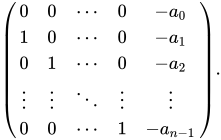
An endomorphism of Fn has an eigenvector if and only if its characteristic polynomial has some root. Therefore, when F is algebraically closed, every endomorphism of Fn has some eigenvector. On the other hand, if every endomorphism of Fn has an eigenvector, let p(x) be an element of F[x]. Dividing by its leading coefficient, we get another polynomial q(x) which has roots if and only if p(x) has roots. But if q(x) = xn + an − 1 xn − 1 + ⋯ + a0, then q(x) is the characteristic polynomial of the n×n companion matrix
The field F is algebraically closed if and only if every rational function in one variable x, with coefficients in F, can be written as the sum of a polynomial function with rational functions of the form a/(x − b)n, where n is a natural number, and a and b are elements of F.
If F is algebraically closed then, since the irreducible polynomials in F[x] are all of degree 1, the property stated above holds by the theorem on partial fraction decomposition.
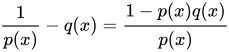
On the other hand, suppose that the property stated above holds for the field F. Let p(x) be an irreducible element in F[x]. Then the rational function 1/p can be written as the sum of a polynomial function q with rational functions of the form a/(x – b)n. Therefore, the rational expression
can be written as a quotient of two polynomials in which the denominator is a product of first degree polynomials. Since p(x) is irreducible, it must divide this product and, therefore, it must also be a first degree polynomial.
For any field F, if two polynomials p(x), q(x) ∈ F[x] are relatively prime then they do not have a common root, for if a ∈ F was a common root, then p(x) and q(x) would both be multiples of x − a and therefore they would not be relatively prime. The fields for which the reverse implication holds (that is, the fields such that whenever two polynomials have no common root then they are relatively prime) are precisely the algebraically closed fields.
If the field F is algebraically closed, let p(x) and q(x) be two polynomials which are not relatively prime and let r(x) be their greatest common divisor. Then, since r(x) is not constant, it will have some root a, which will be then a common root of p(x) and q(x).
If F is not algebraically closed, let p(x) be a polynomial whose degree is at least 1 without roots. Then p(x) and p(x) are not relatively prime, but they have no common roots (since none of them has roots).
If F is an algebraically closed field and n is a natural number, then F contains all nth roots of unity, because these are (by definition) the n (not necessarily distinct) zeroes of the polynomial xn − 1. A field extension that is contained in an extension generated by the roots of unity is a cyclotomic extension, and the extension of a field generated by all roots of unity is sometimes called its cyclotomic closure. Thus algebraically closed fields are cyclotomically closed. The converse is not true. Even assuming that every polynomial of the form xn − a splits into linear factors is not enough to assure that the field is algebraically closed.
If a proposition which can be expressed in the language of first-order logic is true for an algebraically closed field, then it is true for every algebraically closed field with the same characteristic. Furthermore, if such a proposition is valid for an algebraically closed field with characteristic 0, then not only is it valid for all other algebraically closed fields with characteristic 0, but there is some natural number N such that the proposition is valid for every algebraically closed field with characteristic p when p > N.[2]
Every field F has some extension which is algebraically closed. Such an extension is called an algebraically closed extension. Among all such extensions there is one and only one (up to isomorphism, but not unique isomorphism) which is an algebraic extension of F;[3] it is called the algebraic closure of F.
The theory of algebraically closed fields has quantifier elimination.
There is no algebraically closed finite field: if there were such a field, with underlying set for some , then the polynomial would never vanish for any value of .
Source: Wikipedia. Article content is retrieved live through the MediaWiki API.
In mathematics, a field F is algebraically closed if every non-constant polynomial with coefficients in F has a root in F. In other words, a field is algebraically closed if the fundamental theorem of algebra holds for it. For example, the field of real numbers is not algebraically closed because the polynomial x 2 + 1 {\displaystyle x^{2}+1} has no real roots, while the field of complex numbers is algebraically closed. Every field K {\displaystyle K} is contained in an algebraically closed field C , {\displaystyle C,} and the roots in C {\displaystyle C} of the polynomials with coefficients in K {\displaystyle K} form an algebraically closed field called an algebraic closure of K . {\displaystyle K.} Given two algebraic closures of K {\displaystyle K} there are isomorphisms between them that fix the elements of K . {\displaystyle K.} Algebraically closed fields appear in the following chain of class inclusions: rngs ⊃ rings ⊃ commutative rings ⊃ integral domains ⊃ integrally closed domains ⊃ GCD domains ⊃ unique factorization domains ⊃ principal ideal domains ⊃ Euclidean domains ⊃ fields ⊃ algebraically closed fields
In mathematics, a field F is called quasi-algebraically closed (or C1) if every non-constant homogeneous polynomial P over F has a non-trivial zero provided the number of its variables is more than its degree. The idea of quasi-algebraically closed fields was investigated by C. C. Tsen, a student of Emmy Noether, in a 1936 paper (Tsen 1936); and later by Serge Lang in his 1951 Princeton University dissertation and in his 1952 paper (Lang 1952). The idea itself is attributed to Lang's advisor Emil Artin. Formally, if P is a non-constant homogeneous polynomial in variables X1, ..., XN, and of degree d satisfying d < N then it has a non-trivial zero over F; that is, for some xi in F, not all 0, we have P(x1, ..., xN) = 0. In geometric language, the hypersurface defined by P, in projective space of degree N − 2, then has a point over F.
In mathematics, a field K {\displaystyle K} is pseudo algebraically closed if it satisfies certain properties which hold for algebraically closed fields. The concept was introduced by James Ax in 1967.
In group theory, a group A {\displaystyle A\ } is algebraically closed if any finite set of equations and inequations that are applicable to A {\displaystyle A\ } have a solution in A {\displaystyle A\ } without needing a group extension. This notion will be made precise later in the article in § Formal definition.
Before the 1921 destruction of Tulsa’s Greenwood District, Black residents had created a remarkable center of business and community life. The district included stores, professional offices, entertainment venues and homes owned by Black citizens. Understanding Greenwood means learning what was built—not only what was burned.
MORE →Shirley Chisholm, elected in 1968.