Civil Rights
Movements, leaders, victories and the continuing fight for equality.

Explore the people, places, events, achievements, struggles and stories that shaped our journey.
Movements, leaders, victories and the continuing fight for equality.
Innovation, patents, science, technology and world-changing contributions.
Pioneers, champions, Negro Leagues, records, activism and excellence.
Meet the people whose lives, choices and achievements shaped the journey.
Black towns, communities, institutions and places where history happened.
Moments that changed communities, movements, institutions and the nation.
In 1968 Shirley Chisholm became the first Black woman elected to the United States Congress. In 1972 she launched a campaign for the Democratic presidential nomination, breaking another political barrier.
MORE →Reflects the personal views, recollections, and perspective of the author, Mike Davis.
This is a personal recollection on the Move fire on May 13, 1985
In mathematics, particularly matrix theory, a band matrix or banded matrix is a sparse matrix whose non-zero entries are confined to a diagonal band, comprising the main diagonal and zero or more diagonals on either side.
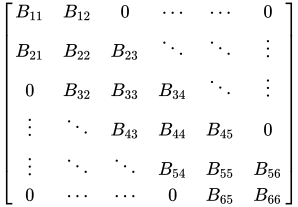
Formally, consider an n×n matrix A=(ai,j ). If all matrix elements are zero outside a diagonally bordered band whose range is determined by constants k1 and k2:
then the quantities k1 and k2 are called the lower bandwidth and upper bandwidth, respectively.[1] The bandwidth of the matrix is the maximum of k1 and k2; in other words, it is the number k such that if .[2]
In numerical analysis, matrices from finite element or finite difference problems are often banded. Such matrices can be viewed as descriptions of the coupling between the problem variables; the banded property corresponds to the fact that variables are not coupled over arbitrarily large distances. Such matrices can be further divided – for instance, banded matrices exist where every element in the band is nonzero.
Problems in higher dimensions also lead to banded matrices, in which case the band itself also tends to be sparse. For instance, a partial differential equation on a square domain (using central differences) will yield a matrix with a bandwidth equal to the square root of the matrix dimension, but inside the band only 5 diagonals are nonzero. Unfortunately, applying Gaussian elimination (or equivalently an LU decomposition) to such a matrix results in the band being filled in by many non-zero elements.
Band matrices are usually stored by storing the diagonals in the band; the rest is implicitly zero.
For example, a tridiagonal matrix has bandwidth 1. The 6-by-6 matrix
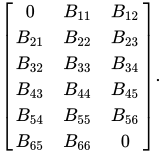
is stored as the 6-by-3 matrix
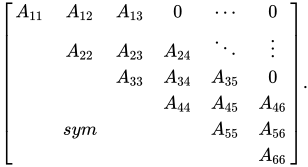
A further saving is possible when the matrix is symmetric. For example, consider a symmetric 6-by-6 matrix with an upper bandwidth of 2:
This matrix is stored as the 6-by-3 matrix:
From a computational point of view, working with band matrices is always preferential to working with similarly dimensioned square matrices. A band matrix can be likened in complexity to a rectangular matrix whose row dimension is equal to the bandwidth of the band matrix. Thus the work involved in performing operations such as multiplication falls significantly, often leading to huge savings in terms of calculation time and complexity.
As sparse matrices lend themselves to more efficient computation than dense matrices, as well as in more efficient utilization of computer storage, there has been much research focused on finding ways to minimise the bandwidth (or directly minimise the fill-in) by applying permutations to the matrix, or other such equivalence or similarity transformations.[3]
The Cuthill–McKee algorithm can be used to reduce the bandwidth of a sparse symmetric matrix. There are, however, matrices for which the reverse Cuthill–McKee algorithm performs better. There are many other methods in use.
The problem of finding a representation of a matrix with minimal bandwidth by means of permutations of rows and columns is NP-hard.[4]
Source: Wikipedia. Article content is retrieved live through the MediaWiki API.
In mathematics, particularly matrix theory, a band matrix or banded matrix is a sparse matrix whose non-zero entries are confined to a diagonal band, comprising the main diagonal and zero or more diagonals on either side.
Random band matrices are random matrices that are also band matrices, meaning that their non-zero entries are confined to a diagonal band, comprising the main diagonal and zero or more diagonals on each side. They can be used to roughly model systems of interacting particles arranged roughly in a grid such that each particle is only allowed to interact with its neighbors, which is an improvement on the mean field model, corresponding to random Gaussian matrices, where no entries are necessarily zero and every particle interacts with every other. In one dimension, this means that H i j = 0 {\textstyle H_{ij}=0} if | i − j | > W {\textstyle |i-j|>W} , where W is the band width. Physically, this means that the amount by which particles i and j interact is 0 if their separation is over W. In more than one dimension, i and j are no longer integers but nd vectors with integer components, and H i j = 0 {\textstyle H_{ij}=0} if | i − j | L 1 {\displaystyle |i-j|_{L^{1}}} , where | ⋅ | L 1 {\displaystyle |\cdot |_{L^{1}}} indicates the taxicab distance between the two locations.
Matrix is a jazz fusion group from Appleton, Wisconsin, that started in 1974, noted for tight brass ensemble lines and complex musical themes inspired by literary works, the American Indian, and other significant programmatic themes. Matrix made its biggest impact on the music scene in the 1970s, including appearances at the Monterey Jazz Festival in 1976 and 1977 and the Newport Jazz Festival in 1977. The group re-formed in 1992, 2000, 2002, and 2009. Albums include Matrix IX (also the original name of the band), Wizard, Tale of the Whale, Harvest and Proud Flesh.

In scientific computing, skyline matrix storage, or SKS, or a variable band matrix storage, or envelope storage scheme is a form of a sparse matrix storage format matrix that reduces the storage requirement of a matrix more than banded storage. In banded storage, all entries within a fixed distance from the diagonal (called half-bandwidth) are stored. In column-oriented skyline storage, only the entries from the first nonzero entry to the last nonzero entry in each column are stored. There is also row oriented skyline storage, and, for symmetric matrices, only one triangle is usually stored. Skyline storage has become very popular in the finite element codes for structural mechanics, because the skyline is preserved by Cholesky decomposition (a method of solving systems of linear equations with a symmetric, positive-definite matrix; all fill-in falls within the skyline), and systems of equations from finite elements have a relatively small skyline. In addition, the effort of coding skyline Cholesky is about same as for Cholesky for banded matrices (available for banded matrices, e.g. in LAPACK; for a prototype skyline code, see ). Before storing a matrix in skyline format, the rows and columns are typically renumbered to reduce the size of the skyline (the number of nonzero entries stored) and to decrease the number of operations in the skyline Cholesky algorithm. The same heuristic renumbering algorithm that reduce the bandwidth are also used to reduce the skyline. The basic and one of the earliest algorithms to do that is reverse Cuthill–McKee algorithm. However, skyline storage is not as popular for very large systems (many millions of equations) because skyline Cholesky is not so easily adapted for massively parallel computing, and general sparse methods, which store only the nonzero entries of the matrix, become more efficient for very large problems due to much less fill-in.
Before the 1921 destruction of Tulsa’s Greenwood District, Black residents had created a remarkable center of business and community life. The district included stores, professional offices, entertainment venues and homes owned by Black citizens. Understanding Greenwood means learning what was built—not only what was burned.
MORE →Joe Louis.