Civil Rights
Movements, leaders, victories and the continuing fight for equality.

Explore the people, places, events, achievements, struggles and stories that shaped our journey.
Movements, leaders, victories and the continuing fight for equality.
Innovation, patents, science, technology and world-changing contributions.
Pioneers, champions, Negro Leagues, records, activism and excellence.
Meet the people whose lives, choices and achievements shaped the journey.
Black towns, communities, institutions and places where history happened.
Moments that changed communities, movements, institutions and the nation.
In 1968 Shirley Chisholm became the first Black woman elected to the United States Congress. In 1972 she launched a campaign for the Democratic presidential nomination, breaking another political barrier.
MORE →Reflects the personal views, recollections, and perspective of the author, Mike Davis.
This is a personal recollection on the Move fire on May 13, 1985
In combinatorics, bijective proof is a proof technique for proving that two sets have equally many elements, or that the sets in two combinatorial classes have equal size, by finding a bijective function that maps one set one-to-one onto the other. This technique can be useful as a way of finding a formula for the number of elements of certain sets, by corresponding them with other sets that are easier to count. Additionally, the nature of the bijection itself often provides powerful insights into each or both of the sets.
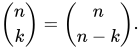
The symmetry of the binomial coefficients states that
This means that there are exactly as many combinations of k things in a set of size n as there are combinations of n − k things in a set of size n.
The key idea of the bijective proof may be understood from a simple example: selecting k children to be rewarded with ice cream cones, out of a group of n children, has exactly the same effect as choosing instead the n − k children to be denied ice cream cones.
Problems that admit bijective proofs are not limited to binomial coefficient identities. As the complexity of the problem increases, a bijective proof can become very sophisticated. This technique is particularly useful in areas of discrete mathematics such as combinatorics, graph theory, and number theory.
The most classical examples of bijective proofs in combinatorics include:
Source: Wikipedia. Article content is retrieved live through the MediaWiki API.
In combinatorics, bijective proof is a proof technique for proving that two sets have equally many elements, or that the sets in two combinatorial classes have equal size, by finding a bijective function that maps one set one-to-one onto the other. This technique can be useful as a way of finding a formula for the number of elements of certain sets, by corresponding them with other sets that are easier to count. Additionally, the nature of the bijection itself often provides powerful insights into each or both of the sets.
In mathematics, the term combinatorial proof is often used to mean either of two types of mathematical proof: A proof by double counting. A combinatorial identity is proven by counting the number of elements of some carefully chosen set in two different ways to obtain the different expressions in the identity. Since those expressions count the same objects, they must be equal to each other and thus the identity is established. A bijective proof. Two sets are shown to have the same number of members by exhibiting a bijection, i.e. a one-to-one correspondence, between them. The term "combinatorial proof" may also be used more broadly to refer to any kind of elementary proof in combinatorics. However, as Glass (2003) writes in his review of Benjamin & Quinn (2003) (a book about combinatorial proofs), these two simple techniques are enough to prove many theorems in combinatorics and number theory.
Igor Pak (Russian: Игорь Пак) (born 1971, Moscow, Soviet Union) is a professor of mathematics at the University of California, Los Angeles, working in combinatorics and discrete probability. He formerly taught at the Massachusetts Institute of Technology and the University of Minnesota, and he is best known for his bijective proof of the hook-length formula for the number of Young tableaux, and his work on random walks. He was a keynote speaker alongside George Andrews and Doron Zeilberger at the 2006 Harvey Mudd College Mathematics Conference on Enumerative Combinatorics. Pak is an associate editor for the journal Discrete Mathematics. He gave a Fejes Tóth Lecture at the University of Calgary in February 2009. In 2018, he was an invited speaker at the International Congress of Mathematicians in Rio de Janeiro.
In set theory, the Schröder–Bernstein theorem states that, if there exist injective functions f : A → B and g : B → A between the sets A and B, then there exists a bijective function h : A → B. In terms of the cardinality of the two sets, this classically implies that if |A| ≤ |B| and |B| ≤ |A|, then |A| = |B|; that is, A and B are equipotent. This is a useful feature in the ordering of cardinal numbers. The theorem is named after Ernst Schröder and Felix Bernstein. It is also known as the Cantor–Bernstein theorem or Cantor–Schröder–Bernstein theorem, after Georg Cantor, who first published it (albeit without proof).
Before the 1921 destruction of Tulsa’s Greenwood District, Black residents had created a remarkable center of business and community life. The district included stores, professional offices, entertainment venues and homes owned by Black citizens. Understanding Greenwood means learning what was built—not only what was burned.
MORE →Joe Louis.