Civil Rights
Movements, leaders, victories and the continuing fight for equality.

Explore the people, places, events, achievements, struggles and stories that shaped our journey.
Movements, leaders, victories and the continuing fight for equality.
Innovation, patents, science, technology and world-changing contributions.
Pioneers, champions, Negro Leagues, records, activism and excellence.
Meet the people whose lives, choices and achievements shaped the journey.
Black towns, communities, institutions and places where history happened.
Moments that changed communities, movements, institutions and the nation.
Katherine Johnson’s mathematical calculations helped guide some of America’s most important early space missions while she confronted the racial and gender barriers faced by Black women in twentieth-century America.
MORE →Reflects the personal views, recollections, and perspective of the author, Mike Davis.
This is a personal recollection on the Move fire on May 13, 1985
| Part of a series on |
| Machine learning and data mining |
|---|
AdaBoost (short for Adaptive Boosting) is a statistical classification meta-algorithm formulated by Yoav Freund and Robert Schapire in 1995, who won the 2003 Gödel Prize for their work. It can be used in conjunction with many types of learning algorithm to improve performance. The output of multiple weak learners is combined into a weighted sum that represents the final output of the boosted classifier. Usually, AdaBoost is presented for binary classification, although it can be generalized to multiple classes or bounded intervals of real values.[1][2]
AdaBoost is adaptive in the sense that subsequent weak learners (models) are adjusted in favor of instances misclassified by previous models. In some problems, it can be less susceptible to overfitting than other learning algorithms. The individual learners can be weak, but as long as the performance of each one is slightly better than random guessing, the final model can be proven to converge to a strong learner.
Although AdaBoost is typically used to combine weak base learners (such as decision stumps), it has been shown to also effectively combine strong base learners (such as deeper decision trees), producing an even more accurate model.[3]
Every learning algorithm tends to suit some problem types better than others, and typically has many different parameters and configurations to adjust before it achieves optimal performance on a dataset. AdaBoost (with decision trees as the weak learners) is often referred to as the best out-of-the-box classifier.[4][5] When used with decision tree learning, information gathered at each stage of the AdaBoost algorithm about the relative 'hardness' of each training sample is fed into the tree-growing algorithm such that later trees tend to focus on harder-to-classify examples.
AdaBoost refers to a particular method of training a boosted classifier. A boosted classifier is a classifier of the form where each is a weak learner that takes an object as input and returns a value indicating the class of the object. For example, in the two-class problem, the sign of the weak learner's output identifies the predicted object class and the absolute value gives the confidence in that classification.
Each weak learner produces an output hypothesis which fixes a prediction for each sample in the training set. At each iteration , a weak learner is selected and assigned a coefficient such that the total training error of the resulting -stage boosted classifier is minimized.
Here is the boosted classifier that has been built up to the previous stage of training and is the weak learner that is being considered for addition to the final classifier.
At each iteration of the training process, a weight is assigned to each sample in the training set equal to the current error on that sample. These weights can be used in the training of the weak learner. For instance, decision trees can be grown which favor the splitting of sets of samples with large weights.
This derivation follows Rojas (2009):[6]
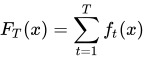
Suppose we have a data set where each item has an associated class , and a set of weak classifiers each of which outputs a classification for each item. After the -th iteration our boosted classifier is a linear combination of the weak classifiers of the form: where the class will be the sign of . At the -th iteration we want to extend this to a better boosted classifier by adding another weak classifier , with another weight :
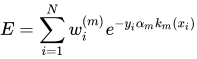
So it remains to determine which weak classifier is the best choice for , and what its weight should be. We define the total error of as the sum of its exponential loss on each data point, given as follows:
Letting and for , we have:
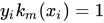
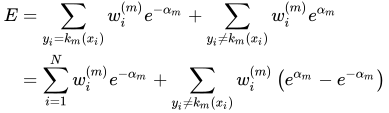
We can split this summation between those data points that are correctly classified by (so ) and those that are misclassified (so ):
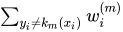
Since the only part of the right-hand side of this equation that depends on is , we see that the that minimizes is the one in the set that minimizes [assuming that ], i.e. the weak classifier with the lowest weighted error (with weights ).
To determine the desired weight that minimizes with the that we just determined, we differentiate:
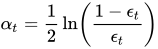
The value of that minimizes the above expression is:
because does not depend on
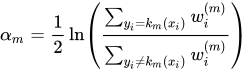
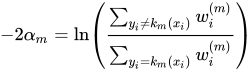
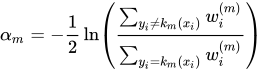
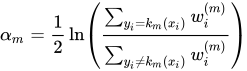
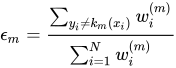
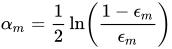
We calculate the weighted error rate of the weak classifier to be , so it follows that: which is the negative logit function multiplied by 0.5. Due to the convexity of as a function of , this new expression for gives the global minimum of the loss function.
Note: This derivation only applies when , though it can be a good starting guess in other cases, such as when the weak learner is biased (), has multiple leaves () or is some other function .
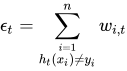
Thus we have derived the AdaBoost algorithm: At each iteration, choose the classifier , which minimizes the total weighted error , use this to calculate the error rate , use this to calculate the weight , and finally use this to improve the boosted classifier to .
 | This section needs more citations. (May 2016) |
Boosting is a form of linear regression in which the features of each sample are the outputs of some weak learner applied to .
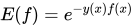
While regression tries to fit to as precisely as possible without loss of generalization, typically using least square error , whereas the AdaBoost error function takes into account the fact that only the sign of the final result is used, thus can be far larger than 1 without increasing error. However, the exponential increase in the error for sample as increases, resulting in excessive weights being assigned to outliers.
One feature of the choice of exponential error function is that the error of the final additive model is the product of the error of each stage, that is, . Thus it can be seen that the weight update in the AdaBoost algorithm is equivalent to recalculating the error on after each stage.
There is a lot of flexibility allowed in the choice of loss function. As long as the loss function is monotonic and continuously differentiable, the classifier is always driven toward purer solutions.[7] Zhang (2004) provides a loss function based on least squares, a modified Huber loss function:
This function is more well-behaved than LogitBoost for close to 1 or -1, does not penalise ‘overconfident’ predictions (), unlike unmodified least squares, and only penalises samples misclassified with confidence greater than 1 linearly, as opposed to quadratically or exponentially, and is thus less susceptible to the effects of outliers.
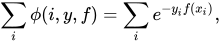
Boosting can be seen as minimization of a convex loss function over a convex set of functions.[8] Specifically, the loss being minimized by AdaBoost is the exponential loss whereas LogitBoost performs logistic regression, minimizing
In the gradient descent analogy, the output of the classifier for each training point is considered a point in n-dimensional space, where each axis corresponds to a training sample, each weak learner corresponds to a vector of fixed orientation and length, and the goal is to reach the target point (or any region where the value of loss function is less than the value at that point), in the fewest steps. Thus AdaBoost algorithms perform either Cauchy (find with the steepest gradient, choose to minimize test error) or Newton (choose some target point, find that brings closest to that point) optimization of training error.
With:
For in :
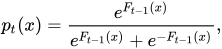
The output of decision trees is a class probability estimate , the probability that is in the positive class.[7] Friedman, Hastie and Tibshirani derive an analytical minimizer for for some fixed (typically chosen using weighted least squares error):
Thus, rather than multiplying the output of the entire tree by some fixed value, each leaf node is changed to output half the logit transform of its previous value.
LogitBoost represents an application of established logistic regression techniques to the AdaBoost method. Rather than minimizing error with respect to y, weak learners are chosen to minimize the (weighted least-squares) error of with respect to where
That is is the Newton–Raphson approximation of the minimizer of the log-likelihood error at stage , and the weak learner is chosen as the learner that best approximates by weighted least squares.
As p approaches either 1 or 0, the value of becomes very small and the z term, which is large for misclassified samples, can become numerically unstable, due to machine precision rounding errors. This can be overcome by enforcing some limit on the absolute value of z and the minimum value of w
While previous boosting algorithms choose greedily, minimizing the overall test error as much as possible at each step, GentleBoost features a bounded step size. is chosen to minimize , and no further coefficient is applied. Thus, in the case where a weak learner exhibits perfect classification performance, GentleBoost chooses exactly equal to , while steepest descent algorithms try to set . Empirical observations about the good performance of GentleBoost appear to back up Schapire and Singer's remark that allowing excessively large values of can lead to poor generalization performance.[9][10]
A technique for speeding up processing of boosted classifiers, early termination refers to only testing each potential object with as many layers of the final classifier necessary to meet some confidence threshold, speeding up computation for cases where the class of the object can easily be determined. One such scheme is the object detection framework introduced by Viola and Jones:[11] in an application with significantly more negative samples than positive, a cascade of separate boost classifiers is trained, the output of each stage biased such that some acceptably small fraction of positive samples is mislabeled as negative, and all samples marked as negative after each stage are discarded. If 50% of negative samples are filtered out by each stage, only a very small number of objects would pass through the entire classifier, reducing computation effort. This method has since been generalized, with a formula provided for choosing optimal thresholds at each stage to achieve some desired false positive and false negative rate.[12]
In the field of statistics, where AdaBoost is more commonly applied to problems of moderate dimensionality, early stopping is used as a strategy to reduce overfitting.[13] A validation set of samples is separated from the training set, performance of the classifier on the samples used for training is compared to performance on the validation samples, and training is terminated if performance on the validation sample is seen to decrease even as performance on the training set continues to improve.
For steepest descent versions of AdaBoost, where is chosen at each layer t to minimize test error, the next layer added is said to be maximally independent of layer t:[14] it is unlikely to choose a weak learner t+1 that is similar to learner t. However, there remains the possibility that t+1 produces similar information to some other earlier layer. Totally corrective algorithms, such as LPBoost, optimize the value of every coefficient after each step, such that new layers added are always maximally independent of every previous layer. This can be accomplished by backfitting, linear programming or some other method.
Pruning is the process of removing poorly performing weak classifiers to improve memory and execution-time cost of the boosted classifier. The simplest methods, which can be particularly effective in conjunction with totally corrective training, are weight- or margin-trimming: when the coefficient, or the contribution to the total test error, of some weak classifier falls below a certain threshold, that classifier is dropped. Margineantu & Dietterich[15] suggested an alternative criterion for trimming: weak classifiers should be selected such that the diversity of the ensemble is maximized. If two weak learners produce very similar outputs, efficiency can be improved by removing one of them and increasing the coefficient of the remaining weak learner.[16]
Source: Wikipedia. Article content is retrieved live through the MediaWiki API.
AdaBoost (short for Adaptive Boosting) is a statistical classification meta-algorithm formulated by Yoav Freund and Robert Schapire in 1995, who won the 2003 Gödel Prize for their work. It can be used in conjunction with many types of learning algorithm to improve performance. The output of multiple weak learners is combined into a weighted sum that represents the final output of the boosted classifier. Usually, AdaBoost is presented for binary classification, although it can be generalized to multiple classes or bounded intervals of real values. AdaBoost is adaptive in the sense that subsequent weak learners (models) are adjusted in favor of instances misclassified by previous models. In some problems, it can be less susceptible to overfitting than other learning algorithms. The individual learners can be weak, but as long as the performance of each one is slightly better than random guessing, the final model can be proven to converge to a strong learner. Although AdaBoost is typically used to combine weak base learners (such as decision stumps), it has been shown to also effectively combine strong base learners (such as deeper decision trees), producing an even more accurate model. Every learning algorithm tends to suit some problem types better than others, and typically has many different parameters and configurations to adjust before it achieves optimal performance on a dataset. AdaBoost (with decision trees as the weak learners) is often referred to as the best out-of-the-box classifier. When used with decision tree learning, information gathered at each stage of the AdaBoost algorithm about the relative 'hardness' of each training sample is fed into the tree-growing algorithm such that later trees tend to focus on harder-to-classify examples.
In machine learning (ML), boosting is an ensemble learning method that combines a set of less accurate models (called "weak learners") to create a single, highly accurate model (a "strong learner"). Unlike other ensemble methods that build models in parallel (such as bagging), boosting algorithms build models sequentially. Each new model in the sequence is trained to correct the errors made by its predecessors. This iterative process allows the overall model to improve its accuracy, particularly by reducing bias. Boosting is a popular and effective technique used in supervised learning for both classification and regression tasks. The theoretical foundation for boosting came from a question posed by Kearns and Valiant (1988, 1989): "Can a set of weak learners create a single strong learner?" A weak learner is defined as a classifier that performs only slightly better than random guessing, whereas a strong learner is a classifier that is highly correlated with the true classification. Robert Schapire's affirmative answer to this question in a 1990 paper led to the development of practical boosting algorithms. The first such algorithm was developed by Schapire, with Freund and Schapire later developing AdaBoost, which remains a foundational example of boosting.
Meta-learning is a subfield of machine learning where automatic learning algorithms are applied to metadata about machine learning experiments. As of 2017, the term had not found a standard interpretation, however the main goal is to use such metadata to understand how automatic learning can become flexible in solving learning problems, hence to improve the performance of existing learning algorithms or to learn (induce) the learning algorithm itself, hence the alternative term learning to learn. Flexibility is important because each learning algorithm is based on a set of assumptions about the data, its inductive bias. This means that it will only learn well if the bias matches the learning problem. A learning algorithm may perform very well in one domain, but not on the next. This poses strong restrictions on the use of machine learning or data mining techniques, since the relationship between the learning problem (often some kind of database) and the effectiveness of different learning algorithms is not yet understood. By using different kinds of metadata, like properties of the learning problem, algorithm properties (like performance measures), or patterns previously derived from the data, it is possible to learn, select, alter or combine different learning algorithms to effectively solve a given learning problem. Critiques of meta-learning approaches bear a strong resemblance to the critique of metaheuristic, a possibly related problem. A good analogy to meta-learning, and the inspiration for Jürgen Schmidhuber's early work (1987) and Yoshua Bengio et al.'s work (1991), considers that genetic evolution learns the learning procedure encoded in genes and executed in each individual's brain. In an open-ended hierarchical meta-learning system using genetic programming, better evolutionary methods can be learned by meta evolution, which itself can be improved by meta meta evolution, etc.
Gradient boosting is a machine learning technique based on boosting in a functional space, where the target is pseudo-residuals instead of residuals as in traditional boosting. It gives a prediction model in the form of an ensemble of weak prediction models, i.e., models that make very few assumptions about the data, which are typically simple decision trees. When a decision tree is the weak learner, the resulting algorithm is called gradient-boosted trees; it usually outperforms random forest. As with other boosting methods, a gradient-boosted trees model is built in stages, but it generalizes the other methods by allowing optimization of an arbitrary differentiable loss function.
Before the 1921 destruction of Tulsa’s Greenwood District, Black residents had created a remarkable center of business and community life. The district included stores, professional offices, entertainment venues and homes owned by Black citizens. Understanding Greenwood means learning what was built—not only what was burned.
MORE →Mae Jemison, aboard Space Shuttle Endeavour in 1992.


![{\displaystyle E_{t}=\sum _{i}E[F_{t-1}(x_{i})+\alpha _{t}h(x_{i})]}](https://wikimedia.org/api/rest_v1/media/math/render/svg/3ad2646753bae9d7170c88485eec7db956feecc1)