Civil Rights
Movements, leaders, victories and the continuing fight for equality.

Explore the people, places, events, achievements, struggles and stories that shaped our journey.
Movements, leaders, victories and the continuing fight for equality.
Innovation, patents, science, technology and world-changing contributions.
Pioneers, champions, Negro Leagues, records, activism and excellence.
Meet the people whose lives, choices and achievements shaped the journey.
Black towns, communities, institutions and places where history happened.
Moments that changed communities, movements, institutions and the nation.
In 1968 Shirley Chisholm became the first Black woman elected to the United States Congress. In 1972 she launched a campaign for the Democratic presidential nomination, breaking another political barrier.
MORE →Reflects the personal views, recollections, and perspective of the author, Mike Davis.
This is a personal recollection on the Move fire on May 13, 1985
 | This article needs more citations. (September 2021) |

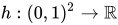
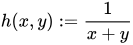
In mathematics, a function defined on some set with real or complex values is called bounded if the set of its values (its image) is bounded. In other words, there exists a real number such that
for all in .[1] A function that is not bounded is said to be unbounded.[citation needed]
If is real-valued and for all in , then the function is said to be bounded (from) above by . If for all in , then the function is said to be bounded (from) below by . A real-valued function is bounded if and only if it is bounded from above and below.[1][additional citation(s) needed]
An important special case is a bounded sequence, where is taken to be the set of natural numbers. Thus a sequence is bounded if there exists a real number such that
for every natural number . The set of all bounded sequences forms the sequence space .[citation needed]
The definition of boundedness can be generalized to functions taking values in a more general space by requiring that the image is a bounded set in .[citation needed]
Weaker than boundedness is local boundedness. A family of bounded functions may be uniformly bounded.
A bounded operator is not a bounded function in the sense of this page's definition (unless ), but has the weaker property of preserving boundedness; bounded sets are mapped to bounded sets . This definition can be extended to any function if and allow for the concept of a bounded set. Boundedness can also be determined by looking at a graph.[citation needed]
| Basic concepts | |||
|---|---|---|---|
| L1 spaces | |||
| L2 spaces | |||
| spaces | |||
| Maps | |||
| Inequalities | |||
| Results |
| ||
| Applications & related | |||
Source: Wikipedia. Article content is retrieved live through the MediaWiki API.

In mathematics, a function f {\displaystyle f} defined on some set X {\displaystyle X} with real or complex values is called bounded if the set of its values (its image) is bounded. In other words, there exists a real number M {\displaystyle M} such that | f ( x ) | ≤ M {\displaystyle |f(x)|\leq M} for all x {\displaystyle x} in X {\displaystyle X} . A function that is not bounded is said to be unbounded. If f {\displaystyle f} is real-valued and f ( x ) ≤ A {\displaystyle f(x)\leq A} for all x {\displaystyle x} in X {\displaystyle X} , then the function is said to be bounded (from) above by A {\displaystyle A} . If f ( x ) ≥ B {\displaystyle f(x)\geq B} for all x {\displaystyle x} in X {\displaystyle X} , then the function is said to be bounded (from) below by B {\displaystyle B} . A real-valued function is bounded if and only if it is bounded from above and below. An important special case is a bounded sequence, where X {\displaystyle X} is taken to be the set N {\displaystyle \mathbb {N} } of natural numbers. Thus a sequence f = ( a 0 , a 1 , a 2 , … ) {\displaystyle f=(a_{0},a_{1},a_{2},\ldots )} is bounded if there exists a real number M {\displaystyle M} such that | a n | ≤ M {\displaystyle |a_{n}|\leq M} for every natural number n {\displaystyle n} . The set of all bounded sequences forms the sequence space l ∞ {\displaystyle l^{\infty }} . The definition of boundedness can be generalized to functions f : X → Y {\displaystyle f:X\rightarrow Y} taking values in a more general space Y {\displaystyle Y} by requiring that the image f ( X ) {\displaystyle f(X)} is a bounded set in Y {\displaystyle Y} .
In harmonic analysis in mathematics, a function of bounded mean oscillation, also known as a BMO function, is a real-valued function whose mean oscillation is bounded (finite). The space of functions of bounded mean oscillation (BMO) is a function space that, in some precise sense, plays the same role in the theory of Hardy spaces Hp that the space L∞ of essentially bounded functions plays in the theory of Lp-spaces. It is also called John–Nirenberg space, after Fritz John and Louis Nirenberg who introduced and studied it for the first time.
In mathematics, in the area of complex analysis, Nachbin's theorem (named after Leopoldo Nachbin) is a result used to establish bounds on the growth rates for analytic functions. In particular, Nachbin's theorem may be used to give the domain of convergence of the generalized Borel transform, also called Nachbin summation. This article provides a brief review of growth rates, including the idea of a function of exponential type. Classification of growth rates based on type help provide a finer tool than big O or Landau notation, since a number of theorems about the analytic structure of the bounded function and its integral transforms can be stated.
In mathematics, in particular in measure theory, a content μ {\displaystyle \mu } is a real-valued function defined on a collection of subsets A {\displaystyle {\mathcal {A}}} such that μ ( A ) ∈ [ 0 , ∞ ] whenever A ∈ A . {\displaystyle \mu (A)\in \ [0,\infty ]{\text{ whenever }}A\in {\mathcal {A}}.} μ ( ∅ ) = 0. {\displaystyle \mu (\varnothing )=0.} μ ( ⋃ i = 1 n A i ) = ∑ i = 1 n μ ( A i ) whenever A 1 , … , A n , ⋃ i = 1 n A i ∈ A and A i ∩ A j = ∅ for i ≠ j . {\displaystyle \mu {\Bigl (}\bigcup _{i=1}^{n}A_{i}{\Bigr )}=\sum _{i=1}^{n}\mu (A_{i}){\text{ whenever }}A_{1},\dots ,A_{n},\bigcup _{i=1}^{n}A_{i}\in {\mathcal {A}}{\text{ and }}A_{i}\cap A_{j}=\varnothing {\text{ for }}i\neq j.} That is, a content is a generalization of a measure: while the latter must be countably additive, the former must only be finitely additive. In many important applications the A {\displaystyle {\mathcal {A}}} is chosen to be a ring of sets or to be at least a semiring of sets in which case some additional properties can be deduced which are described below. For this reason some authors prefer to define contents only for the case of semirings or even rings. If a content is additionally σ-additive it is called a pre-measure and if furthermore A {\displaystyle {\mathcal {A}}} is a σ-algebra, the content is called a measure. Therefore, every (real-valued) measure is a content, but not vice versa. Contents give a good notion of integrating bounded functions on a space but can behave badly when integrating unbounded functions, while measures give a good notion of integrating unbounded functions.
Before the 1921 destruction of Tulsa’s Greenwood District, Black residents had created a remarkable center of business and community life. The district included stores, professional offices, entertainment venues and homes owned by Black citizens. Understanding Greenwood means learning what was built—not only what was burned.
MORE →The Greenwood District.







![{\displaystyle (-\infty ,-2]}](https://wikimedia.org/api/rest_v1/media/math/render/svg/f2e43d01f84850c7d9742877ce6a35cde6c91c28)


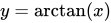

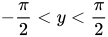
![{\displaystyle f:[0,1]\rightarrow \mathbb {R} }](https://wikimedia.org/api/rest_v1/media/math/render/svg/29d08e15410d8d326f4ee95edfa4816f4794cf2c)


![{\displaystyle [0,1]}](https://wikimedia.org/api/rest_v1/media/math/render/svg/738f7d23bb2d9642bab520020873cccbef49768d)