Civil Rights
Movements, leaders, victories and the continuing fight for equality.

Explore the people, places, events, achievements, struggles and stories that shaped our journey.
Movements, leaders, victories and the continuing fight for equality.
Innovation, patents, science, technology and world-changing contributions.
Pioneers, champions, Negro Leagues, records, activism and excellence.
Meet the people whose lives, choices and achievements shaped the journey.
Black towns, communities, institutions and places where history happened.
Moments that changed communities, movements, institutions and the nation.
Mansa Musa was the ruler of the Mali Empire in West Africa. Details recorded here should be sourced; unknown information is left blank.
MORE →Reflects the personal views, recollections, and perspective of the author, Mike Davis.
This is a personal recollection on the Move fire on May 13, 1985


In mathematics, the floor function is the function that takes a real number x as input and returns the greatest integer less than or equal to x, written ⌊x⌋ or floor(x). Similarly, the ceiling function returns the least integer greater than or equal to x, written ⌈x⌉ or ceil(x).[1]
For example, for floor: ⌊2.4⌋ = 2, ⌊−2.4⌋ = −3, and for ceiling: ⌈2.4⌉ = 3, and ⌈−2.4⌉ = −2.
The floor of x is also called the integral part, integer part, greatest integer, or entier of x, and was historically denoted [x] (among other notations).[2] However, the term "integer part" is ambiguous, as it can also mean truncation towards zero, which differs from the floor function for negative numbers.
For an integer n, ⌊n⌋ = ⌈n⌉ = n.
Although floor(x + 1) and ceil(x) are equal for non-integer values of x, and thus produce graphs that appear exactly alike, they differ when x is an integer. For example, when x = 2.0001, ⌊2.0001 + 1⌋ = ⌈2.0001⌉ = 3. However, if x = 2, then ⌊2 + 1⌋ = 3 but ⌈2⌉ = 2.
| x | Floor ⌊x⌋ | Ceiling ⌈x⌉ | Fractional part {x} |
|---|---|---|---|
| 2 | 2 | 2 | 0 |
| 2.0001 | 2 | 3 | 0.0001 |
| e | 2 | 3 | 0.7182... |
| 2.9 | 2 | 3 | 0.9 |
| 2.999 | 2 | 3 | 0.999 |
| −π | −4 | −3 | 0.8584... |
| −2 | −2 | −2 | 0 |
The integral part or integer part of a number (partie entière in the original) was first defined in 1798 by Adrien-Marie Legendre in his proof of the Legendre's formula.
Carl Friedrich Gauss introduced the square bracket notation [x] in his third proof of quadratic reciprocity (1808).[3] This remained the standard[4] in mathematics until Kenneth E. Iverson introduced, in his 1962 book A Programming Language, the names "floor" and "ceiling" and the corresponding notations ⌊x⌋ and ⌈x⌉.[5][6] (Iverson used square brackets for a different purpose, the Iverson bracket notation.) Both notations are now used in mathematics, although Iverson's notation will be followed in this article.
In some sources, boldface or double brackets ⟦x⟧ are used for floor, and reversed brackets ⟧x⟦ or ]x[ for ceiling.[7][8]
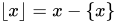
The fractional part is the sawtooth function, denoted by {x} for real x and defined by the formula
For all x,
These characters are provided in Unicode and HTML entities:
In the LaTeX typesetting system, these symbols can be specified with the \lceil, \rceil, \lfloor, and \rfloor commands in math mode. LaTeX has supported UTF-8 since 2018, so the Unicode characters can now be used directly.[10] Larger versions are\left\lceil, \right\rceil, \left\lfloor, and \right\rfloor.
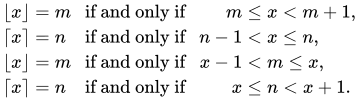
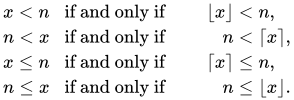
Given real numbers x and y, integers m and n and the set of integers , floor and ceiling may be defined by the equations
Since there is exactly one integer in a half-open interval of length one, for any real number x, there are unique integers m and n satisfying the equation where and may also be taken as the definition of floor and ceiling.
These formulas can be used to simplify expressions involving floors and ceilings.[11]
In the language of order theory, the floor function is a residuated mapping, that is, part of a Galois connection: it is the upper adjoint of the function that embeds the integers into the reals.
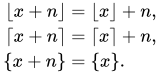
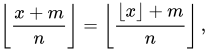
These formulas show how adding an integer n to the arguments affects the functions:
The above are never true if n is not an integer; however, for every x and y, the following inequalities hold:
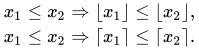
Both floor and ceiling functions are monotonically non-decreasing functions:
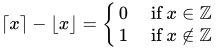
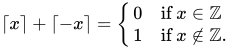
It is clear from the definitions that with equality if and only if x is an integer, i.e.
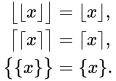
In fact, for integers n, both floor and ceiling functions are the identity:
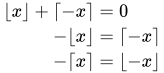
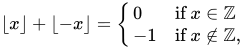
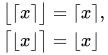
Negating the argument switches floor and ceiling and changes the sign: and:
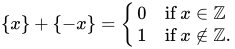
Negating the argument complements the fractional part:
The floor, ceiling, and fractional part functions are idempotent:
The result of nested floor or ceiling functions is the innermost function: due to the identity property for integers.
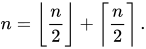
If m and n are integers and n ≠ 0,
If n is positive[12]
If m is positive[13]
For m = 2 these imply
More generally,[14] for positive m (See Hermite's identity)
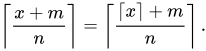
The following can be used to convert floors to ceilings and vice versa (with m being positive)[15]
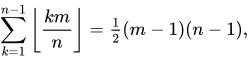
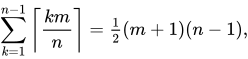
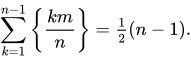
For all m and n strictly positive integers:[16] which, for positive and coprime m and n, reduces to and similarly for the ceiling and fractional part functions (still for positive and coprime m and n),
Since the right-hand side of the general case is symmetrical in m and n, this implies that
More generally, if m and n are positive,
This is sometimes called a reciprocity law.[17]
Division by positive integers gives rise to an interesting and sometimes useful property. Assuming ,
Similarly,
Indeed, keeping in mind that The second equivalence involving the ceiling function can be proved similarly.
For d being a positive integer with x greater than d. Then [18] where is the remainder of dividing by d
For a positive integer n, and arbitrary real numbers m and x:[19]
None of the functions discussed in this article are continuous, but all are piecewise linear: the functions , , and have discontinuities at the integers.
is upper semi-continuous and and are lower semi-continuous.
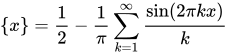
Since none of the functions discussed in this article are continuous, none of them have a power series expansion. Since floor and ceiling are not periodic, they do not have uniformly convergent Fourier series expansions. The fractional part function has Fourier series expansion[20] for x not an integer.
At points of discontinuity, a Fourier series converges to a value that is the average of its limits on the left and the right, unlike the floor, ceiling and fractional part functions: for y fixed and x a multiple of y the Fourier series given converges to y/2, rather than to x mod y = 0. At points of continuity the series converges to the true value.
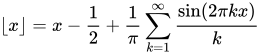
Using the formula gives for x not an integer.
For an integer x and a positive integer y, the modulo operation, denoted by x mod y, gives the value of the remainder when x is divided by y. This definition can be extended to real x and y, y ≠ 0, by the formula
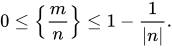
Then it follows from the definition of floor function that this extended operation satisfies many natural properties. Notably, x mod y is always between 0 and y, i.e.,
if y is positive, and if y is negative,
Gauss's third proof of quadratic reciprocity, as modified by Eisenstein, has two basic steps.[21][22]
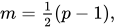
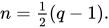
Let p and q be distinct positive odd prime numbers, and let
First, Gauss's lemma is used to show that the Legendre symbols are given by
The second step is to use a geometric argument to show that
Combining these formulas gives quadratic reciprocity in the form
There are formulas that use floor to express the quadratic character of small numbers mod odd primes p:[23]
For an arbitrary real number , rounding to the nearest integer with tie breaking towards positive infinity is given by rounding towards negative infinity is given as
If tie-breaking is away from 0, then the rounding function is (where is the sign function), and rounding towards even can be expressed with the more cumbersome which is the above expression for rounding towards positive infinity minus an integrality indicator for .
Rounding a real number to the nearest integer value forms a very basic type of quantizer – a uniform one. A typical (mid-tread) uniform quantizer with a quantization step size equal to some value can be expressed as
The number of digits in base b of a positive integer k is
The number of possible strings of arbitrary length that doesn't use any character twice is given by[24][better source needed] where:
For n = 26, this comes out to 1096259850353149530222034277.
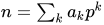
Let n be a positive integer and p a positive prime number. The exponent of the highest power of p that divides n! is given by a version of Legendre's formula[25] where is the way of writing n in base p. This is a finite sum, since the floors are zero when pk > n.
The Beatty sequence shows how every positive irrational number gives rise to a partition of the natural numbers into two sequences via the floor function.[26]
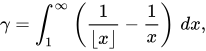
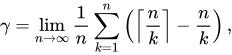
There are formulas for Euler's constant γ = 0.57721 56649 ... that involve the floor and ceiling, e.g.[27] and
The fractional part function also shows up in integral representations of the Riemann zeta function. It is straightforward to prove (using integration by parts)[28] that if is any function with a continuous derivative in the closed interval [a, b],
Letting for real part of s greater than 1 and letting a and b be integers, and letting b approach infinity gives
This formula is valid for all s with real part greater than −1, (except s = 1, where there is a pole) and combined with the Fourier expansion for {x} can be used to extend the zeta function to the entire complex plane and to prove its functional equation.[29]
For s = σ + it in the critical strip 0 < σ < 1,
In 1947 van der Pol used this representation to construct an analogue computer for finding roots of the zeta function.[30]
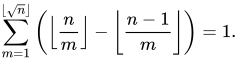
The floor function appears in several formulas characterizing prime numbers. For example, since it follows that a positive integer n is a prime if and only if[31]
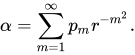
One may also give formulas for producing the prime numbers. For example, let pn be the n-th prime, and for any integer r > 1, define the real number α by the sum
Then[32]
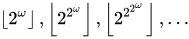
A similar result is that there is a number θ = 1.3064... (Mills' constant) with the property that are all prime.[33]
There is also a number ω = 1.9287800... with the property that are all prime.[33]
Let π(x) be the number of primes less than or equal to x. It is a straightforward deduction from Wilson's theorem that[34]
Also, if n ≥ 2,[35]
None of the formulas in this section are of any practical use.[36][37]
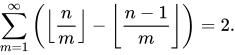
Ramanujan submitted these problems to the Journal of the Indian Mathematical Society.[38]
If n is a positive integer, prove that
Some generalizations to the above floor function identities have been proven.[39]
The study of Waring's problem has led to an unsolved problem:
Are there any positive integers k ≥ 6 such that[40]
Mahler has proved there can only be a finite number of such k; none are known.[41]

int function from floating-point conversion in CIn most programming languages, the simplest method to convert a floating point number to an integer does not do floor or ceiling, but truncation. The reason for this is historical, as the first machines used ones' complement and truncation was simpler to implement (floor is simpler in two's complement). FORTRAN was defined to require this behavior and thus almost all processors implement conversion this way. Some consider this to be an unfortunate historical design decision that has led to bugs handling negative offsets and graphics on the negative side of the origin.[citation needed]
An arithmetic right-shift of a signed integer by is the same as . Division by a power of 2 is often written as a right-shift, not for optimization as might be assumed, but because the floor of negative results is required. Assuming such shifts are "premature optimization" and replacing them with division can break software.[42]
Many programming languages (including C, C++,[43][44] C#,[45][46] Java,[47][48]
Julia,[49]
PHP,[50][51] R,[52] and Python[53]) provide standard functions for floor and ceiling, usually called floor and ceil, or less commonly ceiling.[54] The language APL uses ⌊x for floor. The J Programming Language, a follow-on to APL that is designed to use standard keyboard symbols, uses <. for floor and >. for ceiling.[55]
ALGOL usesentier for floor.
In Microsoft Excel the function INT rounds down rather than toward zero,[56] while FLOOR rounds toward zero, the opposite of what "int" and "floor" do in other languages. Since 2010 FLOOR has been changed to error if the number is negative.[57] The OpenDocument file format, as used by OpenOffice.org, Libreoffice and others, INT[58] and FLOOR both do floor, and FLOOR has a third argument to reproduce Excel's earlier behavior.[59]
floor function". Retrieved 5 December 2010.
ceil function". Retrieved 5 December 2010.
ceil function". Retrieved 18 July 2013.
floor function". Retrieved 18 July 2013.
math module". Retrieved 18 July 2013.

Source: Wikipedia. Article content is retrieved live through the MediaWiki API.

In mathematics, the floor function is the function that takes a real number x as input and returns the greatest integer less than or equal to x, written ⌊x⌋ or floor(x). Similarly, the ceiling function returns the least integer greater than or equal to x, written ⌈x⌉ or ceil(x). For example, for floor: ⌊2.4⌋ = 2, ⌊−2.4⌋ = −3, and for ceiling: ⌈2.4⌉ = 3, and ⌈−2.4⌉ = −2. The floor of x is also called the integral part, integer part, greatest integer, or entier of x, and was historically denoted [x] (among other notations). However, the term "integer part" is ambiguous, as it can also mean truncation towards zero, which differs from the floor function for negative numbers. For an integer n, ⌊n⌋ = ⌈n⌉ = n. Although floor(x + 1) and ceil(x) are equal for non-integer values of x, and thus produce graphs that appear exactly alike, they differ when x is an integer. For example, when x = 2.0001, ⌊2.0001 + 1⌋ = ⌈2.0001⌉ = 3. However, if x = 2, then ⌊2 + 1⌋ = 3 but ⌈2⌉ = 2.
In mathematics, an integer-valued function is a function whose values are integers. In other words, it is a function that assigns an integer to each member of its domain. The floor and ceiling functions are examples of integer-valued functions of a real variable, but on real numbers and, generally, on (non-disconnected) topological spaces integer-valued functions are not especially useful. Any such function on a connected space either has discontinuities or is constant. On the other hand, on discrete and other totally disconnected spaces integer-valued functions have roughly the same importance as real-valued functions have on non-discrete spaces. Any function with natural, or non-negative integer values is a partial case of an integer-valued function.
A ceiling is the upper surface of a room. Ceiling may also refer to: Ceiling function in mathematics Glass ceiling, a barrier to advancement of a qualified person Ceiling (aeronautics), the maximum density altitude an aircraft can reach under a set of conditions Price ceiling, an imposed limit on the price of a product Ceiling (cloud), the height above ground at which (accumulated) cloud layers cover more than 50% of the sky Ceilings (album), an album by Dentist "The Ceiling" (short story), a 2001 short story by American writer Kevin Brockmeier The Ceiling (album), a 2019 album by Jaws Katto, also known as The Ceiling, a short film that competed in the Short Film Palme d'Or group at the 2017 Cannes Film Festival "Ceilings" (song), a 2022 song by Lizzy McAlpine The Ceiling, a 1961 film by Věra Chytilová

In mathematics, the pigeonhole principle states that if n items are put into m containers, with n > m, then at least one container must contain more than one item. For example, of three gloves, at least two must be right-handed or at least two must be left-handed, because there are three objects but only two categories of handedness to put them into. This seemingly obvious statement, a type of counting argument, can be used to demonstrate possibly unexpected results. For example, given that the population of London is more than one unit greater than the maximum number of hairs that can be on a human head, the principle requires that there must be at least two people in London who have the same number of hairs on their heads. Although the pigeonhole principle appears as early as 1622 in a book by Jean Leurechon, it is commonly called Dirichlet's box principle or Dirichlet's drawer principle after an 1834 treatment of the principle by Peter Gustav Lejeune Dirichlet under the name Schubfachprinzip ("drawer principle" or "shelf principle"). The principle has several generalizations and can be stated in various ways. In a more quantified version: for natural numbers k and m, if n = km + 1 objects are distributed among m sets, the pigeonhole principle asserts that at least one of the sets will contain at least k + 1 objects. For arbitrary n and m, this generalizes to k + 1 = ⌊ ( n − 1 ) / m ⌋ + 1 = ⌈ n / m ⌉ {\displaystyle k+1=\lfloor (n-1)/m\rfloor +1=\lceil n/m\rceil } , where ⌊ ⋯ ⌋ {\displaystyle \lfloor \cdots \rfloor } and ⌈ ⋯ ⌉ {\displaystyle \lceil \cdots \rceil } denote the floor and ceiling functions, respectively. Though the principle's most straightforward application is to finite sets (such as pigeons and boxes), it is also used with infinite sets that cannot be put into one-to-one correspondence. To do so requires the formal statement of the pigeonhole principle: "there does not exist an injective function whose codomain is smaller than its domain". Advanced mathematical proofs like Siegel's lemma build upon this more general concept.
Before the 1921 destruction of Tulsa’s Greenwood District, Black residents had created a remarkable center of business and community life. The district included stores, professional offices, entertainment venues and homes owned by Black citizens. Understanding Greenwood means learning what was built—not only what was burned.
MORE →Shirley Chisholm, elected in 1968.







![{\displaystyle {\begin{aligned}\lfloor x\rfloor +\lfloor y\rfloor &\leq \lfloor x+y\rfloor \leq \lfloor x\rfloor +\lfloor y\rfloor +1,\\[3mu]\lceil x\rceil +\lceil y\rceil -1&\leq \lceil x+y\rceil \leq \lceil x\rceil +\lceil y\rceil .\end{aligned}}}](https://wikimedia.org/api/rest_v1/media/math/render/svg/c51c4db96365020b998169d24d9df06a4db2b74d)










![{\displaystyle {\begin{aligned}&\left\lfloor {\frac {x{\vphantom {1}}}{n}}\right\rfloor +\left\lfloor {\frac {m+x}{n}}\right\rfloor +\left\lfloor {\frac {2m+x}{n}}\right\rfloor +\dots +\left\lfloor {\frac {(n-1)m+x}{n}}\right\rfloor \\[5mu]=&\left\lfloor {\frac {x{\vphantom {1}}}{m}}\right\rfloor +\left\lfloor {\frac {n+x}{m}}\right\rfloor +\left\lfloor {\frac {2n+x}{m}}\right\rfloor +\cdots +\left\lfloor {\frac {(m-1)n+x}{m}}\right\rfloor .\end{aligned}}}](https://wikimedia.org/api/rest_v1/media/math/render/svg/3dbbd8db363654b80187d2b59fbc7e82d5291350)






![{\displaystyle {\begin{aligned}\left\lfloor {\frac {\left\lfloor {\frac {x}{m}}\right\rfloor }{n}}\right\rfloor &=\left\lfloor {\frac {x}{mn}}\right\rfloor \\[4px]\left\lceil {\frac {\left\lceil {\frac {x}{m}}\right\rceil }{n}}\right\rceil &=\left\lceil {\frac {x}{mn}}\right\rceil .\end{aligned}}}](https://wikimedia.org/api/rest_v1/media/math/render/svg/f44075408c5b7a7b2cfde72dfb6525efed3bc97d)





![{\displaystyle {\begin{aligned}\left({\frac {q}{p}}\right)&=(-1)^{\left\lfloor {\frac {q}{p}}\right\rfloor +\left\lfloor {\frac {2q}{p}}\right\rfloor +\dots +\left\lfloor {\frac {mq}{p}}\right\rfloor },\\[5mu]\left({\frac {p}{q}}\right)&=(-1)^{\left\lfloor {\frac {p}{q}}\right\rfloor +\left\lfloor {\frac {2p}{q}}\right\rfloor +\dots +\left\lfloor {\frac {np}{q}}\right\rfloor }.\end{aligned}}}](https://wikimedia.org/api/rest_v1/media/math/render/svg/b0ef8e9e25f4bb73b3c8d935ec673b29c50bf548)


![{\displaystyle {\begin{aligned}\left({\frac {2}{p}}\right)&=(-1)^{\left\lfloor {\frac {p+1}{4}}\right\rfloor },\\[5mu]\left({\frac {3}{p}}\right)&=(-1)^{\left\lfloor {\frac {p+1}{6}}\right\rfloor }.\end{aligned}}}](https://wikimedia.org/api/rest_v1/media/math/render/svg/d5895c01c9ac887cbbea1493c4023f5362fbf1b4)