Civil Rights
Movements, leaders, victories and the continuing fight for equality.

Explore the people, places, events, achievements, struggles and stories that shaped our journey.
Movements, leaders, victories and the continuing fight for equality.
Innovation, patents, science, technology and world-changing contributions.
Pioneers, champions, Negro Leagues, records, activism and excellence.
Meet the people whose lives, choices and achievements shaped the journey.
Black towns, communities, institutions and places where history happened.
Moments that changed communities, movements, institutions and the nation.
In 1968 Shirley Chisholm became the first Black woman elected to the United States Congress. In 1972 she launched a campaign for the Democratic presidential nomination, breaking another political barrier.
MORE →Reflects the personal views, recollections, and perspective of the author, Mike Davis.
This is a personal recollection on the Move fire on May 13, 1985
In mathematics, the Chinese remainder theorem states that if one knows the remainders of the Euclidean division of an integer n by several integers, then one can determine uniquely the remainder of the division of n by the product of these integers, under the condition that the divisors are pairwise coprime (no two divisors share a common factor other than 1).[1]

The theorem is sometimes called Sunzi's theorem. Both names of the theorem refer to its earliest known statement that appeared in Sunzi Suanjing, a Chinese manuscript written during the 3rd to 5th century CE. This first statement was restricted to the following example:
If one knows that the remainder of n divided by 3 is 2, the remainder of n divided by 5 is 3, and the remainder of n divided by 7 is 2, then with no other information, one can determine the remainder of n divided by 105 (the product of 3, 5, and 7) without knowing the value of n. In this example, the remainder is 23. Moreover, this remainder is the only possible positive value of n that is less than 105.
The Chinese remainder theorem is widely used for computing with large integers, as it allows replacing a computation for which one knows a bound on the size of the result by several similar computations on small integers.
The Chinese remainder theorem (expressed in terms of congruences) is true over every principal ideal domain. It has been generalized to any ring, with a formulation involving two-sided ideals.
The earliest known statement of the problem appears in the 5th-century book Sunzi Suanjing by the Chinese mathematician Sunzi:[2]
There are certain things whose number is unknown. If we count them by threes, we have two left over; by fives, we have three left over; and by sevens, two are left over. How many things are there?[3]
Sunzi's work would not be considered a theorem by modern standards; it only gives one particular problem, without showing how to solve it, much less any proof about the general case or a general algorithm for solving it.[4] An algorithm for solving this problem was described by Aryabhata (6th century).[5] Special cases of the Chinese remainder theorem were also known to Brahmagupta (7th century) and appear in Fibonacci's Liber Abaci (1202).[6] The result was later generalized with a complete solution called Da-yan-shu (大衍術) in Qin Jiushao's 1247 Mathematical Treatise in Nine Sections [7] which was translated into English in early 19th century by British missionary Alexander Wylie.[8]

The notion of congruences was first introduced and used by Carl Friedrich Gauss in his Disquisitiones Arithmeticae of 1801.[10] Gauss illustrates the Chinese remainder theorem on a problem involving calendars, namely, "to find the years that have a certain period number with respect to the solar and lunar cycle and the Roman indiction."[11] Gauss introduces a procedure for solving the problem that had already been used by Leonhard Euler but was in fact an ancient method that had appeared several times.[12]
Let n1, ..., nk be integers greater than 1, which are often called moduli or divisors. Let us denote by N the product of the ni.
The Chinese remainder theorem asserts that if the ni are pairwise coprime, and if a1, ..., ak are integers such that 0 ≤ ai < ni for every i, then there is one and only one integer x, such that 0 ≤ x < N and the remainder of the Euclidean division of x by ni is ai for every i.
This may be restated as follows in terms of congruences: If the are pairwise coprime, and if a1, ..., ak are any integers, then the system
has a solution, and any two solutions, say x1 and x2, are congruent modulo N, that is, x1 ≡ x2 (mod N ).[13]
In abstract algebra, the theorem is often restated as: If the ni are pairwise coprime, the map
defines a ring isomorphism[14]
between the ring of integers modulo N and the direct product of the rings of integers modulo the ni. This means that for doing a sequence of arithmetic operations in one may do the same computation independently in each and then get the result by applying the isomorphism (from the right to the left). This may be much faster than the direct computation if N and the number of operations are large. This is widely used, under the name multi-modular computation, for linear algebra over the integers or the rational numbers.
The theorem can also be restated in the language of combinatorics as the fact that the infinite arithmetic progressions of integers form a Helly family.[15]
The existence and the uniqueness of the solution may be proven independently. However, the first proof of existence, given below, uses this uniqueness.
Suppose that x and y are both solutions to all the congruences. As x and y give the same remainder, when divided by ni, their difference x − y is a multiple of each ni. As the ni are pairwise coprime, their product N also divides x − y, and thus x and y are congruent modulo N. If x and y are supposed to be non-negative and less than N (as in the first statement of the theorem), then their difference may be a multiple of N only if x = y.
The map
maps congruence classes modulo N to sequences of congruence classes modulo ni. The proof of uniqueness shows that this map is injective. As the domain and the codomain of this map have the same number of elements, the map is also surjective, which proves the existence of the solution.
This proof is very simple but does not provide any direct way for computing a solution. Moreover, it cannot be generalized to other situations where the following proof can.
Existence may be established by an explicit construction of x.[16] This construction may be split into two steps, first solving the problem in the case of two moduli, and then extending this solution to the general case by induction on the number of moduli.
We want to solve the system:
where and are coprime.
Bézout's identity asserts the existence of two integers and such that
The integers and may be computed by the extended Euclidean algorithm.
A solution is given by
Indeed,
implying that The second congruence is proved similarly, by exchanging the subscripts 1 and 2.
Consider a sequence of congruence equations:
where the are pairwise coprime. The two first equations have a solution provided by the method of the previous section. The set of the solutions of these two first equations is the set of all solutions of the equation
As the other are coprime with this reduces solving the initial problem of k equations to a similar problem with equations. Iterating the process, one gets eventually the solutions of the initial problem.
For constructing a solution, it is not necessary to make an induction on the number of moduli. However, such a direct construction involves more computation with large numbers, which makes it less efficient and less used. Nevertheless, Lagrange interpolation is a special case of this construction, applied to polynomials instead of integers.
Let be the product of all moduli but one. As the are pairwise coprime, and are coprime. Thus Bézout's identity applies, and there exist integers and such that
A solution of the system of congruences is
In fact, as is a multiple of for we have
for every
Consider a system of congruences:
where the are pairwise coprime, and let In this section several methods are described for computing the unique solution for , such that and these methods are applied on the example
Several methods of computation are presented. The two first ones are useful for small examples, but become very inefficient when the product is large. The third one uses the existence proof given in § Existence (constructive proof). It is the most convenient when the product is large, or for computer computation.
It is easy to check whether a value of x is a solution: it suffices to compute the remainder of the Euclidean division of x by each ni. Thus, to find the solution, it suffices to check successively the integers from 0 to N until finding the solution.
Although very simple, this method is very inefficient. For the simple example considered here, 40 integers (including 0) have to be checked for finding the solution, which is 39. This is an exponential time algorithm, as the size of the input is, up to a constant factor, the number of digits of N, and the average number of operations is of the order of N.
Therefore, this method is rarely used, either for hand-written computation or on computers.

The search of the solution may be made dramatically faster by sieving. For this method, we suppose, without loss of generality, that (if it were not the case, it would suffice to replace each by the remainder of its division by ). This implies that the solution belongs to the arithmetic progression
By testing the values of these numbers modulo one eventually finds a solution of the two first congruences. Then the solution belongs to the arithmetic progression
Testing the values of these numbers modulo and continuing until every modulus has been tested eventually yields the solution.
This method is faster if the moduli have been ordered by decreasing value, that is if For the example, this gives the following computation. We consider first the numbers that are congruent to 4 modulo 5 (the largest modulus), which are 4, 9 = 4 + 5, 14 = 9 + 5, ... For each of them, compute the remainder by 4 (the second largest modulus) until getting a number congruent to 3 modulo 4. Then one can proceed by adding 20 = 5 × 4 at each step, and computing only the remainders by 3. This gives
This method works well for hand-written computation with a product of moduli that is not too big. However, it is much slower than other methods, for very large products of moduli. Although dramatically faster than the systematic search, this method also has an exponential time complexity and is therefore not used on computers.
The constructive existence proof shows that, in the case of two moduli, the solution may be obtained by the computation of the Bézout coefficients of the moduli, followed by a few multiplications, additions and reductions modulo (for getting a result in the interval ). As the Bézout's coefficients may be computed with the extended Euclidean algorithm, the whole computation, at most, has a quadratic time complexity of where denotes the number of digits of
For more than two moduli, the method for two moduli allows the replacement of any two congruences by a single congruence modulo the product of the moduli. Iterating this process provides eventually the solution with a complexity, which is quadratic in the number of digits of the product of all moduli. This quadratic time complexity does not depend on the order in which the moduli are regrouped. One may regroup the two first moduli, then regroup the resulting modulus with the next one, and so on. This strategy is the easiest to implement, but it also requires more computation involving large numbers.
Another strategy consists in partitioning the moduli in pairs whose product have comparable sizes (as much as possible), applying, in parallel, the method of two moduli to each pair, and iterating with a number of moduli approximatively divided by two. This method allows an easy parallelization of the algorithm. Also, if fast algorithms (that is, algorithms working in quasilinear time) are used for the basic operations, this method provides an algorithm for the whole computation that works in quasilinear time.
On the current example (which has only three moduli), both strategies are identical and work as follows.
Bézout's identity for 3 and 4 is
Putting this in the formula given for proving the existence gives
for a solution of the two first congruences, the other solutions being obtained by adding to −9 any multiple of 3 × 4 = 12. One may continue with any of these solutions, but the solution 3 = −9 +12 is smaller (in absolute value) and thus leads probably to an easier computation
Bézout identity for 5 and 3 × 4 = 12 is
Applying the same formula again, we get a solution of the problem:
The other solutions are obtained by adding any multiple of 3 × 4 × 5 = 60, and the smallest positive solution is −21 + 60 = 39.
The system of congruences solved by the Chinese remainder theorem may be rewritten as a system of linear Diophantine equations:
where the unknown integers are and the Therefore, every general method for solving such systems may be used for finding the solution of Chinese remainder theorem, such as the reduction of the matrix of the system to Smith normal form or Hermite normal form. However, as usual when using a general algorithm for a more specific problem, this approach is less efficient than the method of the preceding section, based on a direct use of Bézout's identity.
In § Statement, the Chinese remainder theorem has been stated in three different ways: in terms of remainders, of congruences, and of a ring isomorphism. The statement in terms of remainders does not apply, in general, to principal ideal domains, as remainders are not defined in such rings. However, the two other versions make sense over a principal ideal domain R: it suffices to replace "integer" by "element of the domain" and by R. These two versions of the theorem are true in this context, because the proofs (except for the first existence proof), are based on Euclid's lemma and Bézout's identity, which are true over every principal domain.
However, in general, the theorem is only an existence theorem and does not provide any way for computing the solution, unless one has an algorithm for computing the coefficients of Bézout's identity.
The statement in terms of remainders given in § Theorem statement cannot be generalized to any principal ideal domain, but its generalization to Euclidean domains is straightforward. The univariate polynomials over a field is the typical example of a Euclidean domain which is not the integers. Therefore, we state the theorem for the case of the ring for a field For getting the theorem for a general Euclidean domain, it suffices to replace the degree by the Euclidean function of the Euclidean domain.
The Chinese remainder theorem for polynomials is thus: Let (the moduli) be, for , pairwise coprime polynomials in . Let be the degree of , and be the sum of the If are polynomials such that or for every i, then, there is one and only one polynomial , such that and the remainder of the Euclidean division of by is for every i.
The construction of the solution may be done as in § Existence (constructive proof) or § Existence (direct proof). However, the latter construction may be simplified by using, as follows, partial fraction decomposition instead of the extended Euclidean algorithm.
Thus, we want to find a polynomial , which satisfies the congruences
for
Consider the polynomials
The partial fraction decomposition of gives k polynomials with degrees such that
and thus
Then a solution of the simultaneous congruence system is given by the polynomial
In fact, we have
for
This solution may have a degree larger than The unique solution of degree less than may be deduced by considering the remainder of the Euclidean division of by This solution is
A special case of Chinese remainder theorem for polynomials is Lagrange interpolation. For this, consider k monic polynomials of degree one:
They are pairwise coprime if the are all different. The remainder of the division by of a polynomial is , by the polynomial remainder theorem.
Now, let be constants (polynomials of degree 0) in Both Lagrange interpolation and Chinese remainder theorem assert the existence of a unique polynomial of degree less than such that
for every
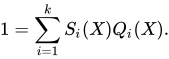
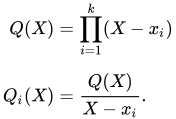
Lagrange interpolation formula is exactly the result, in this case, of the above construction of the solution. More precisely, let
The partial fraction decomposition of is
In fact, reducing the right-hand side to a common denominator one gets
and the numerator is equal to one, as being a polynomial of degree less than which takes the value one for different values of
Using the above general formula, we get the Lagrange interpolation formula:
Hermite interpolation is an application of the Chinese remainder theorem for univariate polynomials, which may involve moduli of arbitrary degrees (Lagrange interpolation involves only moduli of degree one).
The problem consists of finding a polynomial of the least possible degree, such that the polynomial and its first derivatives take given values at some fixed points.
More precisely, let be elements of the ground field and, for let be the values of the first derivatives of the sought polynomial at (including the 0th derivative, which is the value of the polynomial itself). The problem is to find a polynomial such that its j th derivative takes the value at for and
Consider the polynomial
This is the Taylor polynomial of order at , of the unknown polynomial Therefore, we must have
Conversely, any polynomial that satisfies these congruences, in particular verifies, for any
therefore is its Taylor polynomial of order at , that is, solves the initial Hermite interpolation problem. The Chinese remainder theorem asserts that there exists exactly one polynomial of degree less than the sum of the which satisfies these congruences.
There are several ways for computing the solution One may use the method described at the beginning of § Over univariate polynomial rings and Euclidean domains. One may also use the constructions given in § Existence (constructive proof) or § Existence (direct proof).
The Chinese remainder theorem can be generalized to non-coprime moduli.
Let be positive integers and let be integers. The system of simultaneous congruences
has a solution if and only if divides whenever [17]
When this condition is satisfied, the set of solutions forms a single congruence class modulo That is, any two solutions differ by a multiple of , and adding a multiple of to a solution gives another solution.
To illustrate this for the case of two congruences, let be positive integers and let be any integers; let and , and consider the system of congruences:
If , then this system has a unique solution modulo . Otherwise, it has no solutions.
If one uses Bézout's identity to write , then a solution is given by
This defines an integer, as g divides both m and n.
The Chinese remainder theorem can be generalized to any ring, by using coprime ideals (also called comaximal ideals). Two ideals I and J are coprime if there are elements and such that This relation plays the role of Bézout's identity in the proofs related to this generalization, which otherwise are very similar. The generalization may be stated as follows.[18][19]
Let I1, ..., Ik be two-sided ideals of a ring and let I be their intersection. If the ideals are pairwise coprime, we have the isomorphism:
between the quotient ring and the direct product of the where "" denotes the image of the element in the quotient ring defined by the ideal Moreover, if is commutative, then the ideal intersection of pairwise coprime ideals is equal to their product; that is
if Ii and Ij are coprime for all i ≠ j.
Let be pairwise coprime two-sided ideals with and
be the isomorphism defined above. Let be the element of whose components are all 0 except the i th which is 1, and
The are central idempotents that are pairwise orthogonal; this means, in particular, that and for every i and j. Moreover, one has and
In summary, this generalized Chinese remainder theorem is the equivalence between giving pairwise coprime two-sided ideals with a zero intersection, and giving central and pairwise orthogonal idempotents that sum to 1.[20]
The Chinese remainder theorem has been used to construct a Gödel numbering for sequences, which is involved in the proof of Gödel's incompleteness theorems.
The prime-factor FFT algorithm (also called Good-Thomas algorithm) uses the Chinese remainder theorem for reducing the computation of a fast Fourier transform of size to the computation of two fast Fourier transforms of smaller sizes and (providing that and are coprime).
Most implementations of RSA use the Chinese remainder theorem during signing of HTTPS certificates and during decryption.
The Chinese remainder theorem can also be used in secret sharing, which consists of distributing a set of shares among a group of people who, all together (but no one alone), can recover a certain secret from the given set of shares. Each of the shares is represented in a congruence, and the solution of the system of congruences using the Chinese remainder theorem is the secret to be recovered. Secret sharing using the Chinese remainder theorem uses, along with the Chinese remainder theorem, special sequences of integers that guarantee the impossibility of recovering the secret from a set of shares with less than a certain cardinality.
The range ambiguity resolution techniques used with medium pulse repetition frequency radar can be seen as a special case of the Chinese remainder theorem.
Given a surjection of finite abelian groups, we can use the Chinese remainder theorem to give a complete description of any such map. First of all, the theorem gives isomorphisms
where . In addition, for any induced map
from the original surjection, we have and since for a pair of primes , the only non-zero surjections
can be defined if and .
These observations are pivotal for constructing the ring of profinite integers, which is given as an inverse limit of all such maps.
Dedekind's theorem on the linear independence of characters. Let M be a monoid and k an integral domain, viewed as a monoid by considering the multiplication on k. Then any finite family ( fi )i∈I of distinct monoid homomorphisms fi : M → k is linearly independent. In other words, every family (αi)i∈I of elements αi ∈ k satisfying
must be equal to the family (0)i∈I.
Proof. First assume that k is a field, otherwise, replace the integral domain k by its quotient field, and nothing will change. We can linearly extend the monoid homomorphisms fi : M → k to k-algebra homomorphisms Fi : k[M] → k, where k[M] is the monoid ring of M over k. Then, by linearity, the condition
yields
Next, for i, j ∈ I; i ≠ j the two k-linear maps Fi : k[M] → k and Fj : k[M] → k are not proportional to each other. Otherwise fi and fj would also be proportional, and thus equal since as monoid homomorphisms they satisfy: fi (1) = 1 = fj (1), which contradicts the assumption that they are distinct.
Therefore, the kernels Ker Fi and Ker Fj are distinct. Since k[M]/Ker Fi ≅ Fi (k[M]) = k is a field, Ker Fi is a maximal ideal of k[M] for every i in I. Because they are distinct and maximal the ideals Ker Fi and Ker Fj are coprime whenever i ≠ j. The Chinese Remainder Theorem (for general rings) yields an isomorphism:
where
Consequently, the map
is surjective. Under the isomorphisms k[M]/Ker Fi → Fi (k[M]) = k, the map Φ corresponds to:
Now,
yields
for every vector (ui)i∈I in the image of the map ψ. Since ψ is surjective, this means that
for every vector
Consequently, (αi)i∈I = (0)i∈I. QED.
| International | |
|---|---|
| National | |
Source: Wikipedia. Article content is retrieved live through the MediaWiki API.

In mathematics, the Chinese remainder theorem states that if one knows the remainders of the Euclidean division of an integer n by several integers, then one can determine uniquely the remainder of the division of n by the product of these integers, under the condition that the divisors are pairwise coprime (no two divisors share a common factor other than 1). The theorem is sometimes called Sunzi's theorem. Both names of the theorem refer to its earliest known statement that appeared in Sunzi Suanjing, a Chinese manuscript written during the 3rd to 5th century CE. This first statement was restricted to the following example: If one knows that the remainder of n divided by 3 is 2, the remainder of n divided by 5 is 3, and the remainder of n divided by 7 is 2, then with no other information, one can determine the remainder of n divided by 105 (the product of 3, 5, and 7) without knowing the value of n. In this example, the remainder is 23. Moreover, this remainder is the only possible positive value of n that is less than 105. The Chinese remainder theorem is widely used for computing with large integers, as it allows replacing a computation for which one knows a bound on the size of the result by several similar computations on small integers. The Chinese remainder theorem (expressed in terms of congruences) is true over every principal ideal domain. It has been generalized to any ring, with a formulation involving two-sided ideals.
Secret sharing consists of recovering a secret S from a set of shares, each containing partial information about the secret. The Chinese remainder theorem (CRT) states that for a given system of simultaneous congruence equations, the solution is unique in some Z/nZ, with n > 0 under some appropriate conditions on the congruences. Secret sharing can thus use the CRT to produce the shares presented in the congruence equations and the secret could be recovered by solving the system of congruences to get the unique solution, which will be the secret to recover.
Remainder theorem may refer to: Polynomial remainder theorem Chinese remainder theorem

In mathematics, the Euclidean algorithm, or Euclid's algorithm, is an efficient method for computing the greatest common divisor (GCD) of two integers, the largest number that divides them both without a remainder. It is named after the ancient Greek mathematician Euclid, who first described it in his Elements (c. 300 BC). It is an example of an algorithm, and is one of the oldest algorithms in common use. It can be used to reduce fractions to their simplest form, and is a part of many other number-theoretic and cryptographic calculations. The Euclidean algorithm is based on the principle that the greatest common divisor of two numbers does not change if the larger number is replaced by its difference with the smaller number. For example, 21 is the GCD of 252 and 105 (as 252 = 21 × 12 and 105 = 21 × 5), and the same number 21 is also the GCD of 105 and 252 − 105 = 147. Since this replacement reduces the larger of the two numbers, repeating this process gives successively smaller pairs of numbers until the two numbers become equal. When that occurs, that number is the GCD of the original two numbers. By reversing the steps or using the extended Euclidean algorithm, the GCD can be expressed as a linear combination of the two original numbers, that is the sum of the two numbers, each multiplied by an integer (for example, 21 = 5 × 10⁵ + (−2) × 252). The fact that the GCD can always be expressed in this way is known as Bézout's identity. The version of the Euclidean algorithm described above—which follows Euclid's original presentation—may require many subtraction steps to find the GCD when one of the given numbers is much bigger than the other. A more efficient version of the algorithm shortcuts these steps, instead replacing the larger of the two numbers by its remainder when divided by the smaller of the two (with this version, the algorithm stops when reaching a zero remainder). With this improvement, the algorithm never requires more steps than five times the number of digits (base 10) of the smaller integer. This was proven by Gabriel Lamé in 1844 (Lamé's Theorem), and marks the beginning of computational complexity theory. Additional methods for improving the algorithm's efficiency were developed in the 20th century. The Euclidean algorithm has many theoretical and practical applications. It is used for reducing fractions to their simplest form and for performing division in modular arithmetic. Computations using this algorithm form part of the cryptographic protocols that are used to secure internet communications, and in methods for breaking these cryptosystems by factoring large composite numbers. The Euclidean algorithm may be used to solve Diophantine equations, such as finding numbers that satisfy multiple congruences according to the Chinese remainder theorem, to construct continued fractions, and to find accurate rational approximations to real numbers. Finally, it can be used as a basic tool for proving theorems in number theory such as Lagrange's four-square theorem and the uniqueness of prime factorizations. The original algorithm was described only for natural numbers and geometric lengths (real numbers), but the algorithm was generalized in the 19th century to other types of numbers, such as Gaussian integers and polynomials of one variable. This led to modern abstract algebraic notions such as Euclidean domains.
Before the 1921 destruction of Tulsa’s Greenwood District, Black residents had created a remarkable center of business and community life. The district included stores, professional offices, entertainment venues and homes owned by Black citizens. Understanding Greenwood means learning what was built—not only what was burned.
MORE →Madam C.J. Walker