Civil Rights
Movements, leaders, victories and the continuing fight for equality.

Explore the people, places, events, achievements, struggles and stories that shaped our journey.
Movements, leaders, victories and the continuing fight for equality.
Innovation, patents, science, technology and world-changing contributions.
Pioneers, champions, Negro Leagues, records, activism and excellence.
Meet the people whose lives, choices and achievements shaped the journey.
Black towns, communities, institutions and places where history happened.
Moments that changed communities, movements, institutions and the nation.
Katherine Johnson’s mathematical calculations helped guide some of America’s most important early space missions while she confronted the racial and gender barriers faced by Black women in twentieth-century America.
MORE →Reflects the personal views, recollections, and perspective of the author, Mike Davis.
This is a personal recollection on the Move fire on May 13, 1985

In theoretical computer science, circuit complexity is a branch of computational complexity theory in which Boolean functions are classified according to the size or depth of the Boolean circuits that compute them. A related notion is the circuit complexity of a recursive language that is decided by a uniform family of circuits (see below).
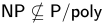
Proving lower bounds on size of Boolean circuits computing explicit Boolean functions is a popular approach to separating complexity classes. For example, a prominent circuit class P/poly consists of Boolean functions computable by circuits of polynomial size. Proving that would separate P and NP (see below).
Complexity classes defined in terms of Boolean circuits include AC0, AC, TC0, NC1, NC, and P/poly.
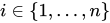
A Boolean circuit with input bits is a directed acyclic graph in which every node (usually called gates in this context) is either an input node of in-degree 0 labelled by one of the input bits, an AND gate, an OR gate, or a NOT gate. One of these gates is designated as the output gate. Such a circuit naturally computes a function of its inputs. The size of a circuit is the number of gates it contains and its depth is the maximal length of a path from an input gate to the output gate.
There are two major notions of circuit complexity.[1] The circuit-size complexity of a Boolean function is the minimal size of any circuit computing . The circuit-depth complexity of a Boolean function is the minimal depth of any circuit computing .
These notions generalize when one considers the circuit complexity of any formal language that contains strings with different bit lengths, especially infinite languages. Boolean circuits, however, only allow a fixed number of input bits. Thus, no single Boolean circuit is capable of deciding such a language.
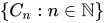
To account for this possibility, one considers families of circuits where each accepts inputs of size . Each circuit family will naturally generate the language by circuit outputting when a length string is a member of the family, and otherwise. We say that a family of circuits is size minimal if there is no other family that decides on inputs of any size, , with a circuit of smaller size than (respectively for depth minimal families).
Conversely, every formal language is decided by some Boolean circuit family. Thus, circuit complexity is meaningful even for non-recursive languages. The notion of a uniform family enables variants of circuit complexity to be related to algorithm-based complexity measures of recursive languages. However, the non-uniform variant is helpful to find lower bounds on how complex any circuit family must be in order to decide given languages.
Hence, the circuit-size complexity of a formal language is defined as the function , that relates a bit length of an input, , to the circuit-size complexity of a minimal circuit that decides whether inputs of that length are in . The circuit-depth complexity is defined similarly.
Boolean circuits are one of the prime examples of so-called non-uniform models of computation in the sense that inputs of different lengths are processed by different circuits, in contrast with uniform models such as Turing machines where the same computational device is used for all possible input lengths. An individual computational problem is thus associated with a particular family of Boolean circuits where each is the circuit handling inputs of n bits. A uniformity condition is often imposed on these families, requiring the existence of some possibly resource-bounded Turing machine that, on input n, produces a description of the individual circuit . When this Turing machine has a running time polynomial in n, the circuit family is said to be P-uniform. The stricter requirement of DLOGTIME-uniformity is of particular interest in the study of shallow-depth circuit-classes such as AC0 or TC0. When no resource bounds are specified, a language is recursive (i.e., decidable by a Turing machine) if and only if the language is decided by a uniform family of Boolean circuits.
A family of Boolean circuits is polynomial-time uniform if there exists a deterministic Turing machine M, such that
A family of Boolean circuits is logspace uniform if there exists a deterministic Turing machine M, such that
Circuit complexity goes back to Shannon in 1949,[2] who proved that almost all Boolean functions on n variables require circuits of size Θ(2n/n). Despite this fact, complexity theorists have so far been unable to prove a superlinear lower bound for any explicit function.
Superpolynomial lower bounds have been proved under certain restrictions on the family of circuits used. The first function for which superpolynomial circuit lower bounds were shown was the parity function, which computes the sum of its input bits modulo 2. The fact that parity is not contained in AC0 was first established independently by Ajtai in 1983[3][4] and by Furst, Saxe and Sipser in 1984.[5] Later improvements by Håstad in 1987[6] established that any family of constant-depth circuits computing the parity function requires exponential size. Extending a result of Razborov,[7] Smolensky in 1987[8] proved that this is true even if the circuit is augmented with gates computing the sum of its input bits modulo some odd prime p.
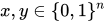
The k-clique problem is to decide whether a given graph on n vertices has a clique of size k. For any particular choice of the constants n and k, the graph can be encoded in binary using bits, which indicate for each possible edge whether it is present. Then the k-clique problem is formalized as a function such that outputs 1 if and only if the graph encoded by the string contains a clique of size k. This family of functions is monotone and can be computed by a family of circuits, but it has been shown that it cannot be computed by a polynomial-size family of monotone circuits (that is, circuits with AND and OR gates but without negation). The original result of Razborov in 1985[7] was later improved to an exponential-size lower bound by Alon and Boppana in 1987.[9] In 2008, Rossman[10] showed that constant-depth circuits with AND, OR, and NOT gates require size to solve the k-clique problem even in the average case. Moreover, there is a circuit of size that computes .
In 1999, Raz and McKenzie later showed that the monotone NC hierarchy is infinite.[11]
The integer division problem lies in uniform TC0.[12]
Circuit lower bounds are generally difficult. Known results include
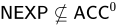
It is open whether NEXPTIME has nonuniform TC0 circuits.
Proofs of circuit lower bounds are strongly connected to derandomization. A proof that would imply that either or that the permanent of a matrix cannot be computed by nonuniform arithmetic circuits (polynomials) of polynomial size and polynomial degree.[17]
In 1997, Razborov and Rudich showed that many known circuit lower bounds for explicit Boolean functions imply the existence of so called natural properties useful against the respective circuit class.[18] On the other hand, natural properties useful against P/poly would break strong pseudorandom generators. This is often interpreted as a "natural proofs" barrier for proving strong circuit lower bounds. In 2016, Carmosino, Impagliazzo, Kabanets and Kolokolova proved that natural properties can be also used to construct efficient learning algorithms.[19]
 |
Many circuit complexity classes are defined in terms of class hierarchies. For each non-negative integer i, there is a class NCi, consisting of polynomial-size circuits of depth O(logi(n)), using bounded fan-in AND, OR, and NOT gates. The union NC of all these classes is a subject of study. By considering unbounded fan-in gates, the classes ACi and AC (which is equal to NC) can be constructed.[20] Many other circuit complexity classes with the same size and depth restrictions can be constructed by allowing different sets of gates.
If a certain language, , belongs to the time-complexity class for some function , then has circuit complexity . If the Turing Machine that accepts the language is oblivious (meaning that it reads and writes the same memory cells regardless of input), then has circuit complexity .[21]
A monotone Boolean circuit is one that has only AND and OR gates, but no NOT gates. A monotone circuit can only compute a monotone Boolean function, which is a function where for every , , where means that for all .
{{cite journal}}: Cite uses deprecated parameter |citeseerx= (help)
{{cite conference}}: Cite uses deprecated parameter |citeseerx= (help)CS1 maint: miscellaneous url (link)
Source: Wikipedia. Article content is retrieved live through the MediaWiki API.

In theoretical computer science, circuit complexity is a branch of computational complexity theory in which Boolean functions are classified according to the size or depth of the Boolean circuits that compute them. A related notion is the circuit complexity of a recursive language that is decided by a uniform family of circuits C 1 , C 2 , … {\displaystyle C_{1},C_{2},\ldots } (see below). Proving lower bounds on size of Boolean circuits computing explicit Boolean functions is a popular approach to separating complexity classes. For example, a prominent circuit class P/poly consists of Boolean functions computable by circuits of polynomial size. Proving that N P ⊈ P / p o l y {\displaystyle {\mathsf {NP}}\not \subseteq {\mathsf {P/poly}}} would separate P and NP (see below). Complexity classes defined in terms of Boolean circuits include AC0, AC, TC0, NC1, NC, and P/poly.
In computational complexity theory, arithmetic circuits are the standard model for computing polynomials. Informally, an arithmetic circuit takes as inputs either variables or numbers, and is allowed to either add or multiply two expressions it has already computed. Arithmetic circuits provide a formal way to understand the complexity of computing polynomials. The basic type of question in this line of research is "what is the most efficient way to compute a given polynomial f {\displaystyle f} ?"
In computational complexity theory and circuit complexity, a Boolean circuit is a mathematical model for combinational digital logic circuits. A formal language can be decided by a family of Boolean circuits, one circuit for each possible input length. Boolean circuits are defined in terms of the logic gates they contain. For example, a circuit might contain binary AND and OR gates and unary NOT gates, or be entirely described by binary NAND gates. Each gate corresponds to some Boolean function that takes a fixed number of bits as input and outputs a single bit. Boolean circuits provide a model for many digital components used in computer engineering, including multiplexers, adders, and arithmetic logic units, but they exclude sequential logic. They are an abstraction that omits many aspects relevant to designing real digital logic circuits, such as metastability, fanout, glitches, power consumption, and propagation delay variability.
In theoretical computer science and mathematics, computational complexity theory focuses on classifying computational problems according to their resource usage, and explores the relationships between these classifications. A computational problem is a task solved by a computer and is solvable by mechanical application of mathematical steps, such as an algorithm. A problem is regarded as inherently difficult if its solution requires significant resources, whatever the algorithm used. The theory formalizes this intuition, by introducing mathematical models of computation to study these problems and quantifying their computational complexity, i.e., the amount of resources needed to solve them, such as time and storage. Other measures of complexity are also used, such as the amount of communication (used in communication complexity), the number of gates in a circuit (used in circuit complexity) and the number of processors (used in parallel computing). One of the roles of computational complexity theory is to determine the practical limits on what computers can and cannot do. The P versus NP problem, one of the seven Millennium Prize Problems, is part of the field of computational complexity. Closely related fields in theoretical computer science are analysis of algorithms and computability theory. A key distinction between analysis of algorithms and computational complexity theory is that the former is devoted to analyzing the amount of resources needed by a particular algorithm to solve a problem, whereas the latter asks a more general question about all possible algorithms that could be used to solve the same problem. More precisely, computational complexity theory tries to classify problems that can or cannot be solved with appropriately restricted resources. In turn, imposing restrictions on the available resources is what distinguishes computational complexity from computability theory: the latter theory asks what kinds of problems can, in principle, be solved algorithmically.
Before the 1921 destruction of Tulsa’s Greenwood District, Black residents had created a remarkable center of business and community life. The district included stores, professional offices, entertainment venues and homes owned by Black citizens. Understanding Greenwood means learning what was built—not only what was burned.
MORE →Joe Louis.