Civil Rights
Movements, leaders, victories and the continuing fight for equality.

Explore the people, places, events, achievements, struggles and stories that shaped our journey.
Movements, leaders, victories and the continuing fight for equality.
Innovation, patents, science, technology and world-changing contributions.
Pioneers, champions, Negro Leagues, records, activism and excellence.
Meet the people whose lives, choices and achievements shaped the journey.
Black towns, communities, institutions and places where history happened.
Moments that changed communities, movements, institutions and the nation.
In August 1908, a white mob attacked Springfield, Illinois’s Black community, destroying homes and businesses and lynching two Black men. National outrage over the violence helped spur the movement that created the NAACP the following year.
MORE →Reflects the personal views, recollections, and perspective of the author, Mike Davis.
This is a personal recollection on the Move fire on May 13, 1985
In computer science and graph theory, the term color-coding refers to an algorithmic technique which is useful in the discovery of network motifs. For example, it can be used to detect a simple path of length k in a given graph. The traditional color-coding algorithm is probabilistic, but it can be derandomized without much overhead in the running time.
Color-coding also applies to the detection of cycles of a given length, and more generally it applies to the subgraph isomorphism problem (an NP-complete problem), where it yields polynomial time algorithms when the subgraph pattern that it is trying to detect has bounded treewidth.
The color-coding method was proposed and analyzed in 1994 by Noga Alon, Raphael Yuster, and Uri Zwick.[1][2]
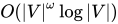
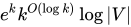
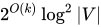
The following results can be obtained through the method of color-coding:
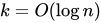
To solve the problem of finding a subgraph in a given graph G = (V, E), where H can be a path, a cycle, or any bounded treewidth graph where , the method of color-coding begins by randomly coloring each vertex of G with colors, and then tries to find a colorful copy of H in colored G. Here, a graph is colorful if every vertex in it is colored with a distinct color. This method works by repeating (1) random coloring a graph and (2) finding colorful copy of the target subgraph, and eventually the target subgraph can be found if the process is repeated a sufficient number of times.
Suppose a copy of H in G becomes colorful with some non-zero probability p. It immediately follows that if the random coloring is repeated 1/p times, then this copy is expected to become colorful once. Note that though p is small, it is shown that if , p is only polynomially small. Suppose again there exists an algorithm such that, given a graph G and a coloring which maps each vertex of G to one of the k colors, it finds a copy of colorful H, if one exists, within some runtime O(r). Then the expected time to find a copy of H in G, if one exists, is .
Sometimes it is also desirable to use a more restricted version of colorfulness. For example, in the context of finding cycles in planar graphs, it is possible to develop an algorithm that finds well-colored cycles. Here, a cycle is well-colored if its vertices are colored by consecutive colors.
An example would be finding a simple cycle of length k in graph G = (V, E).
By applying random coloring method, each simple cycle has a probability of to become colorful, since there are ways of coloring the k vertices on the cycle, among which there are colorful occurrences. Then an algorithm (described next) can be used to find colorful cycles in the randomly colored graph G in time , where is the matrix multiplication constant. Therefore, it takes overall time to find a simple cycle of length k in G.
The colorful cycle-finding algorithm works by first finding all pairs of vertices in V that are connected by a simple path of length k − 1, and then checking whether the two vertices in each pair are connected. Given a coloring function c : V → {1, ..., k} to color graph G, enumerate all partitions of the color set {1, ..., k} into two subsets C1, C2 of size each. Note that V can be divided into V1 and V2 accordingly, and let G1 and G2 denote the subgraphs induced by V1 and V2 respectively. Then, recursively find colorful paths of length in each of G1 and G2. Suppose the Boolean matrix A1 and A2 represent the connectivity of each pair of vertices in G1 and G2 by a colorful path, respectively, and let B be the matrix describing the adjacency relations between vertices of V1 and those of V2, the Boolean product gives all pairs of vertices in V that are connected by a colorful path of length k − 1. Thus, the recursive relation of matrix multiplications is , which yields a runtime of . Although this algorithm finds only the end points of the colorful path, another algorithm by Alon and Naor[4] that finds colorful paths themselves can be incorporated into it.
The derandomization of color-coding involves enumerating possible colorings of a graph G, such that the randomness of coloring G is no longer required. For the target subgraph H in G to be discoverable, the enumeration has to include at least one instance where the H is colorful. To achieve this, enumerating a k-perfect family F of hash functions from {1, ..., |V|} to {1, ..., k} is sufficient. By definition, F is k-perfect if for every subset S of {1, ..., |V|} where , there exists a hash function h in F such that h : S → {1, ..., k} is perfect. In other words, there must exist a hash function in F that colors any given k vertices with k distinct colors.
There are several approaches to construct such a k-perfect hash family:
In the case of derandomizing well-coloring, where each vertex on the subgraph is colored consecutively, a k-perfect family of hash functions from {1, ..., |V|} to {1, ..., k!} is needed. A sufficient k-perfect family which maps from {1, ..., |V|} to {1, ..., kk} can be constructed in a way similar to the approach 3 above (the first step). In particular, it is done by using nklog k random bits that are almost klog k independent, and the size of the resulting k-perfect family will be .
The derandomization of color-coding method can be easily parallelized, yielding efficient NC algorithms.
Recently, color-coding has attracted much attention in the field of bioinformatics. One example is the detection of signaling pathways in protein-protein interaction (PPI) networks. Another example is to discover and to count the number of motifs in PPI networks. Studying both signaling pathways and motifs allows a deeper understanding of the similarities and differences of many biological functions, processes, and structures among organisms.
Due to the huge amount of gene data that can be collected, searching for pathways or motifs can be highly time consuming. However, by exploiting the color-coding method, the motifs or signaling pathways with vertices in a network G with n vertices can be found very efficiently in polynomial time. Thus, this enables us to explore more complex or larger structures in PPI networks.
Source: Wikipedia. Article content is retrieved live through the MediaWiki API.
In computer science and graph theory, the term color-coding refers to an algorithmic technique which is useful in the discovery of network motifs. For example, it can be used to detect a simple path of length k in a given graph. The traditional color-coding algorithm is probabilistic, but it can be derandomized without much overhead in the running time. Color-coding also applies to the detection of cycles of a given length, and more generally it applies to the subgraph isomorphism problem (an NP-complete problem), where it yields polynomial time algorithms when the subgraph pattern that it is trying to detect has bounded treewidth. The color-coding method was proposed and analyzed in 1994 by Noga Alon, Raphael Yuster, and Uri Zwick.

The Unified Vehicular Volume Reduction Program (UVVRP), commonly called number coding or color coding, is a road space rationing program in the Philippines that aims to reduce traffic congestion, in particular during peak hours, by restricting the use of major public roads by certain types of vehicles based on the final digit on their license plates. First implemented in 1995 in Metro Manila, the program has since been emulated in the cities of Baguio, Cabanatuan, and Dagupan, and the province of Cavite with slight variations.
Color code or color coding may refer to: Color code, standardized mappings from systems of colors to meanings, as in traffic lights Color coding technology for visualization, methods of choosing meanings for colors in information visualization Color-coding, a technique for speeding up pattern matching algorithms by randomly assigning colors to objects Color-code (band), a Japanese all-female music group Colour Coding, an Australian indie pop band Color Code Personality Profile, a classification of people's motivations into four types associated with four colors Color-coding, formally called Unified Vehicular Volume Reduction Program, a system restricting when cars can drive in Metro Manila Gender color-coding, the stereotyped association of color with gender in some cultures Electronic color code, the color code used to identify electronic parts Web colors, defined with a hexadecimal triplet code
The Telecommunications Industry Association's TIA-598-C Optical Fiber Cable Color Coding is an American National Standard that provides all necessary information for color-coding optical fiber cables in a uniform manner. It defines identification schemes for fibers, buffered fibers, fiber units, and groups of fiber units within outside plant and premises optical fiber cables. This standard allows for fiber units to be identified by means of a printed legend. This method can be used for identification of fiber ribbons and fiber subunits. The legend will contain a corresponding printed numerical position number and/or color for use in identification. TIA-598-C replaced the previous issue of ANSI/EIA/TIA Standard 598, dated 2001. Changes included the following: designation of Aqua (AQ) as the jacket color for indoor cable containing laser-optimized (LO) 50/125 μm MM optical fiber designation, and of Blue (BL) as jacket color for indoor cable containing polarization-maintaining fiber; expanding the color definition for Slate (SL); and adding color definitions from ANSI/EIA Standard 359-A, colors for Color Identification and Coding, for reference. For more than 12 fibers, the color codes are repeated and striped with black (except black, which is striped with yellow). Every twelve adds one stripe.
Before the 1921 destruction of Tulsa’s Greenwood District, Black residents had created a remarkable center of business and community life. The district included stores, professional offices, entertainment venues and homes owned by Black citizens. Understanding Greenwood means learning what was built—not only what was burned.
MORE →Brown v. Board of Education in 1954.