Civil Rights
Movements, leaders, victories and the continuing fight for equality.

Explore the people, places, events, achievements, struggles and stories that shaped our journey.
Movements, leaders, victories and the continuing fight for equality.
Innovation, patents, science, technology and world-changing contributions.
Pioneers, champions, Negro Leagues, records, activism and excellence.
Meet the people whose lives, choices and achievements shaped the journey.
Black towns, communities, institutions and places where history happened.
Moments that changed communities, movements, institutions and the nation.
Katherine Johnson’s mathematical calculations helped guide some of America’s most important early space missions while she confronted the racial and gender barriers faced by Black women in twentieth-century America.
MORE →Reflects the personal views, recollections, and perspective of the author, Mike Davis.
This is a personal recollection on the Move fire on May 13, 1985
In mathematics, the commutator gives an indication of the extent to which a certain binary operation fails to be commutative. There are different definitions used in group theory and ring theory.
The commutator of two elements, g and h, of a group G, is the element
This element is equal to the group's identity if and only if g and h commute (that is, if and only if gh = hg).
The set of all commutators of a group is not in general closed under the group operation, but the subgroup of G generated by all commutators is closed and is called the derived group or the commutator subgroup of G. Commutators are used to define nilpotent and solvable groups and the largest abelian quotient group.
The definition of the commutator above is used throughout this article, but many group theorists define the commutator as
Using the first definition, this can be expressed as [g−1, h−1].
Commutator identities are an important tool in group theory.[3] The expression ax denotes the conjugate of a by x, defined as x−1ax.
Identity (5) is also known as the Hall–Witt identity, after Philip Hall and Ernst Witt. It is a group-theoretic analogue of the Jacobi identity for the ring-theoretic commutator (see next section).
N.B., the above definition of the conjugate of a by x is used by some group theorists.[4] Many other group theorists define the conjugate of a by x as xax−1.[5] This is often written . Similar identities hold for these conventions.
Many identities that are true modulo certain subgroups are also used. These can be particularly useful in the study of solvable groups and nilpotent groups. For instance, in any group, second powers behave well:
If the derived subgroup is central, then
Rings often do not support division. Thus, the commutator of two elements a and b of a ring (or any associative algebra) is defined differently by
The commutator is zero if and only if a and b commute. In linear algebra, if two endomorphisms of a space are represented by commuting matrices in terms of one basis, then they are so represented in terms of every basis. By using the commutator as a Lie bracket, every associative algebra can be turned into a Lie algebra.
The anticommutator of two elements a and b of a ring or associative algebra is defined by
Sometimes is used to denote anticommutator, while is then used for commutator.[6] The anticommutator is used less often, but can be used to define Clifford algebras and Jordan algebras and in the derivation of the Dirac equation in particle physics.
The commutator of two operators acting on a Hilbert space is a central concept in quantum mechanics, since it quantifies how well the two observables described by these operators can be measured simultaneously. The uncertainty principle is ultimately a theorem about such commutators, by virtue of the Robertson–Schrödinger relation.[7] In phase space, equivalent commutators of function star-products are called Moyal brackets and are completely isomorphic to the Hilbert space commutator structures mentioned.
The commutator has the following properties:
Relation (3) is called anticommutativity, while (4) is the Jacobi identity.
If A is a fixed element of a ring R, identity (1) can be interpreted as a Leibniz rule for the map given by . In other words, the map adA defines a derivation on the ring R. Identities (2), (3) represent Leibniz rules for more than two factors, and are valid for any derivation. Identities (4)–(6) can also be interpreted as Leibniz rules. Identities (7), (8) express Z-bilinearity.
From identity (9), one finds that the commutator of integer powers of ring elements is:
Some of the above identities can be extended to the anticommutator using the above ± subscript notation.[8] For example:
Consider a ring or algebra in which the exponential can be meaningfully defined, such as a Banach algebra or a ring of formal power series.
In such a ring, Hadamard's lemma applied to nested commutators gives: (For the last expression, see Adjoint derivation below.) This formula underlies the Baker–Campbell–Hausdorff expansion of log(exp(A) exp(B)).
A similar expansion expresses the group commutator of expressions (analogous to elements of a Lie group) in terms of a series of nested commutators (Lie brackets),
When dealing with graded algebras, the commutator is usually replaced by the graded commutator, defined in homogeneous components as
Especially if one deals with multiple commutators in a ring R, another notation turns out to be useful. For an element , we define the adjoint mapping by:
This mapping is a derivation on the ring R:
By the Jacobi identity, it is also a derivation over the commutation operation:
Composing such mappings, we get for example and We may consider itself as a mapping, , where is the ring of mappings from R to itself with composition as the multiplication operation. Then is a Lie algebra homomorphism, preserving the commutator:
By contrast, it is not always a ring homomorphism: usually .
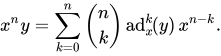
The general Leibniz rule, expanding repeated derivatives of a product, can be written abstractly using the adjoint representation:
Replacing by the differentiation operator , and by the multiplication operator , we get , and applying both sides to a function g, the identity becomes the usual Leibniz rule for the nth derivative .
| International | |
|---|---|
| National | |
| Other | |
Source: Wikipedia. Article content is retrieved live through the MediaWiki API.
In mathematics, the commutator gives an indication of the extent to which a certain binary operation fails to be commutative. There are different definitions used in group theory and ring theory.

A commutator is a rotary electrical switch in certain types of electric motors and electrical generators that periodically reverses the current direction between the rotor and the external circuit. It consists of a cylinder composed of multiple metal contact segments on the rotating armature of the machine. Two or more electrical contacts called "brushes" made of a soft conductive material like carbon press against the commutator, making sliding contact with successive segments of the commutator as it rotates. The windings (coils of wire) on the armature are connected to the commutator segments. Commutators are used in direct current (DC) machines: dynamos (DC generators) and many DC motors as well as universal motors. In a motor the commutator applies electric current to the windings. By reversing the current direction in the rotating windings each half turn, a steady rotating force (torque) is produced. In a generator the commutator picks off the current generated in the windings, reversing the direction of the current with each half turn, serving as a mechanical rectifier to convert the alternating current from the windings to unidirectional direct current in the external load circuit. The first direct current commutator-type machine, the dynamo, was built by Hippolyte Pixii in 1832, based on a suggestion by André-Marie Ampère. Commutators are relatively inefficient, and also require periodic maintenance such as brush replacement. Therefore, commutated machines are declining in use, being replaced by alternating current (AC) machines, and in recent years by brushless DC motors which use semiconductor switches.
In mathematics, more specifically in abstract algebra, the commutator subgroup or derived subgroup of a group is the subgroup generated by all the commutators of the group. The commutator subgroup is important because it is the smallest normal subgroup such that the quotient group of the original group by this subgroup is abelian. In other words, G / N {\displaystyle G/N} is abelian if and only if N {\displaystyle N} contains the commutator subgroup of G {\displaystyle G} . So in some sense it provides a measure of how far the group is from being abelian; the larger the commutator subgroup is, the "less abelian" the group is.
A mercury swivel commutator is a connector mainly used in animal experimentation to prevent the twisting of electrode wires attached to moving animals.
Before the 1921 destruction of Tulsa’s Greenwood District, Black residents had created a remarkable center of business and community life. The district included stores, professional offices, entertainment venues and homes owned by Black citizens. Understanding Greenwood means learning what was built—not only what was burned.
MORE →Brown v. Board of Education in 1954.
![{\displaystyle x^{y}=x[x,y].}](https://wikimedia.org/api/rest_v1/media/math/render/svg/dbfda5e3214a078a56860ef1d958532efd6ecc6c)
![{\displaystyle [y,x]=[x,y]^{-1}.}](https://wikimedia.org/api/rest_v1/media/math/render/svg/59c8c7dabf4a3f20a3f9a04a295468426eb22009)
![{\displaystyle [x,zy]=[x,y]\cdot [x,z]^{y}}](https://wikimedia.org/api/rest_v1/media/math/render/svg/6a9b7c4a764e30d0e2c80b7f31778d427aa3e032)
![{\displaystyle [xz,y]=[x,y]^{z}\cdot [z,y].}](https://wikimedia.org/api/rest_v1/media/math/render/svg/51d505bd20b4dfad61942e780f9019f2342a28df)
![{\displaystyle \left[x,y^{-1}\right]=[y,x]^{y^{-1}}}](https://wikimedia.org/api/rest_v1/media/math/render/svg/e3ec042607b8431621da1694a5e0373d26817d09)
![{\displaystyle \left[x^{-1},y\right]=[y,x]^{x^{-1}}.}](https://wikimedia.org/api/rest_v1/media/math/render/svg/5ec4802d72362fa5f8b6f440bee17b73b8f9ff48)
![{\displaystyle \left[\left[x,y^{-1}\right],z\right]^{y}\cdot \left[\left[y,z^{-1}\right],x\right]^{z}\cdot \left[\left[z,x^{-1}\right],y\right]^{x}=1}](https://wikimedia.org/api/rest_v1/media/math/render/svg/18d4c7cbd3df6c090da7d53c504a2bbbf911faaf)
![{\displaystyle \left[\left[x,y\right],z^{x}\right]\cdot \left[[z,x],y^{z}\right]\cdot \left[[y,z],x^{y}\right]=1.}](https://wikimedia.org/api/rest_v1/media/math/render/svg/969627eb5e4b01b893d68ba8cb5aefb6fb9dcb4e)

![{\displaystyle (xy)^{2}=x^{2}y^{2}[y,x][[y,x],y].}](https://wikimedia.org/api/rest_v1/media/math/render/svg/9c75b2bcc9c723ec68c6e482e9e1e002b02082d3)
![{\displaystyle (xy)^{n}=x^{n}y^{n}[y,x]^{\binom {n}{2}}.}](https://wikimedia.org/api/rest_v1/media/math/render/svg/128ae0855aada1e122d118d63c2bfa18a08eb603)
![{\displaystyle [a,b]=ab-ba.}](https://wikimedia.org/api/rest_v1/media/math/render/svg/c73ba7fbd6260acd540051cc2c6f9131ff0d7f8e)

![{\displaystyle [a,b]_{+}}](https://wikimedia.org/api/rest_v1/media/math/render/svg/c7289995fc78776166741f2a036fbcfb0e632c02)
![{\displaystyle [a,b]_{-}}](https://wikimedia.org/api/rest_v1/media/math/render/svg/59120bf940c61971319243298b88ebb28f752588)
![{\displaystyle [A+B,C]=[A,C]+[B,C]}](https://wikimedia.org/api/rest_v1/media/math/render/svg/b3f1c95436e1c9c40871bc7a3704072ae067dc10)
![{\displaystyle [A,A]=0}](https://wikimedia.org/api/rest_v1/media/math/render/svg/7c816c8f8631ef069ad0b1aee64ed996ad8309ed)
![{\displaystyle [A,B]=-[B,A]}](https://wikimedia.org/api/rest_v1/media/math/render/svg/37b04a066443e96c0b27d4b14f7f5d51c7b2b0c3)
![{\displaystyle [A,[B,C]]+[B,[C,A]]+[C,[A,B]]=0}](https://wikimedia.org/api/rest_v1/media/math/render/svg/046dbc0d4387302c8d321afb443e35bc1890fcac)
![{\displaystyle [A,BC]=[A,B]C+B[A,C]}](https://wikimedia.org/api/rest_v1/media/math/render/svg/1c7c96785faa7d6e5ecc7d8ada53830b24338c60)
![{\displaystyle [A,BCD]=[A,B]CD+B[A,C]D+BC[A,D]}](https://wikimedia.org/api/rest_v1/media/math/render/svg/aa03949d714777910e992c14aeed34adf42d9766)
![{\displaystyle [A,BCDE]=[A,B]CDE+B[A,C]DE+BC[A,D]E+BCD[A,E]}](https://wikimedia.org/api/rest_v1/media/math/render/svg/8b79c370dc9984ff5e2720b3e06c6153af7ba572)
![{\displaystyle [AB,C]=A[B,C]+[A,C]B}](https://wikimedia.org/api/rest_v1/media/math/render/svg/71ba3177011b65b292d8dc39dd2e3391f29b0a07)
![{\displaystyle [ABC,D]=AB[C,D]+A[B,D]C+[A,D]BC}](https://wikimedia.org/api/rest_v1/media/math/render/svg/b9e755fd1fe3c26c40e007256c6976b9612e5d9b)
![{\displaystyle [ABCD,E]=ABC[D,E]+AB[C,E]D+A[B,E]CD+[A,E]BCD}](https://wikimedia.org/api/rest_v1/media/math/render/svg/4e00b8c22f5a63ff3dbbcf8a74f0d01f43994afa)
![{\displaystyle [A,B+C]=[A,B]+[A,C]}](https://wikimedia.org/api/rest_v1/media/math/render/svg/7f50e382d516600cfe9f7a34376ebe694bb62177)
![{\displaystyle [A+B,C+D]=[A,C]+[A,D]+[B,C]+[B,D]}](https://wikimedia.org/api/rest_v1/media/math/render/svg/2e47836a02ce95e65488370410a80446b1ae636c)
![{\displaystyle [AB,CD]=A[B,C]D+[A,C]BD+CA[B,D]+C[A,D]B=A[B,C]D+AC[B,D]+[A,C]DB+C[A,D]B}](https://wikimedia.org/api/rest_v1/media/math/render/svg/a8b90ee684250322ac794d8cb193d75c8c1d4db3)
![{\displaystyle [[A,C],[B,D]]=[[[A,B],C],D]+[[[B,C],D],A]+[[[C,D],A],B]+[[[D,A],B],C]}](https://wikimedia.org/api/rest_v1/media/math/render/svg/33e847e641c8d2810846e666be23d2512b08eb2f)

![{\displaystyle \operatorname {ad} _{A}(B)=[A,B]}](https://wikimedia.org/api/rest_v1/media/math/render/svg/8a40684049019f333e05818bcd1ce5b48f839561)
![{\displaystyle [A^{N},B^{M}]=\sum _{n=0}^{N-1}\sum _{m=0}^{M-1}A^{n}B^{m}[A,B]B^{M-m-1}A^{N-n-1}=\sum _{n=0}^{N-1}\sum _{m=0}^{M-1}B^{m}A^{n}[A,B]A^{N-n-1}B^{M-m-1}}](https://wikimedia.org/api/rest_v1/media/math/render/svg/d6becce6d1f8d926cacdaa106d7b58dc3b04880e)
![{\displaystyle [AB,C]_{\pm }=A[B,C]_{-}+[A,C]_{\pm }B}](https://wikimedia.org/api/rest_v1/media/math/render/svg/187aaec93ded1a30cd6ad33d9e323c786d4a39fd)
![{\displaystyle [AB,CD]_{\pm }=A[B,C]_{-}D+AC[B,D]_{-}+[A,C]_{-}DB+C[A,D]_{\pm }B}](https://wikimedia.org/api/rest_v1/media/math/render/svg/2abfd9c204056463779a2541fa7f5bc02930bf9a)
![{\displaystyle [[A,B],[C,D]]=[[[B,C]_{+},A]_{+},D]-[[[B,D]_{+},A]_{+},C]+[[[A,D]_{+},B]_{+},C]-[[[A,C]_{+},B]_{+},D]}](https://wikimedia.org/api/rest_v1/media/math/render/svg/6c14c4def5d057ec857052e280d0c27658c3796d)
![{\displaystyle \left[A,[B,C]_{\pm }\right]+\left[B,[C,A]_{\pm }\right]+\left[C,[A,B]_{\pm }\right]=0}](https://wikimedia.org/api/rest_v1/media/math/render/svg/7fa38c6ec51fd44c85b6a7dd7820d8ebaee4f2cf)
![{\displaystyle [A,BC]_{\pm }=[A,B]_{-}C+B[A,C]_{\pm }=[A,B]_{\pm }C\mp B[A,C]_{-}}](https://wikimedia.org/api/rest_v1/media/math/render/svg/cee7d373e2721aa7ec3c50a8f645785d7da7b804)
![{\displaystyle [A,BC]=[A,B]_{\pm }C\mp B[A,C]_{\pm }}](https://wikimedia.org/api/rest_v1/media/math/render/svg/2f480a46e5c19fea0ae860621b38e69606a71239)

![{\textstyle e^{A}Be^{-A}\ =\ B+[A,B]+{\frac {1}{2!}}[A,[A,B]]+{\frac {1}{3!}}[A,[A,[A,B]]]+\cdots \ =\ e^{\operatorname {ad} _{A}}(B).}](https://wikimedia.org/api/rest_v1/media/math/render/svg/5e4b0b44677de183969e936bb4cede2bf5515ad4)

![{\displaystyle e^{A}e^{B}e^{-A}e^{-B}=\exp \!\left([A,B]+{\frac {1}{2!}}[A{+}B,[A,B]]+{\frac {1}{3!}}\left({\frac {1}{2}}[A,[B,[B,A]]]+[A{+}B,[A{+}B,[A,B]]]\right)+\cdots \right).}](https://wikimedia.org/api/rest_v1/media/math/render/svg/f104655d91482ecf24b550407ef28112b27bd564)
![{\displaystyle [\omega ,\eta ]_{gr}:=\omega \eta -(-1)^{\deg \omega \deg \eta }\eta \omega .}](https://wikimedia.org/api/rest_v1/media/math/render/svg/4a31537974b529c2386b07f032b0452d7ab70e81)


![{\displaystyle \operatorname {ad} _{x}(y)=[x,y]=xy-yx.}](https://wikimedia.org/api/rest_v1/media/math/render/svg/06e06c88110f66faa14de2b3fba0644b13e96429)

![{\displaystyle \mathrm {ad} _{x}[y,z]\ =\ [\mathrm {ad} _{x}\!(y),z]\,+\,[y,\mathrm {ad} _{x}\!(z)].}](https://wikimedia.org/api/rest_v1/media/math/render/svg/97e49b2f65e16c28bbcad712a40e4bf680ebf909)
![{\displaystyle \operatorname {ad} _{x}\operatorname {ad} _{y}(z)=[x,[y,z]\,]}](https://wikimedia.org/api/rest_v1/media/math/render/svg/8c27f6b58b814f258e43d4529f26e9ec0523b58a)
![{\displaystyle \operatorname {ad} _{x}^{2}\!(z)\ =\ \operatorname {ad} _{x}\!(\operatorname {ad} _{x}\!(z))\ =\ [x,[x,z]\,].}](https://wikimedia.org/api/rest_v1/media/math/render/svg/856ad01497c91a4c78ba471c5ba199d82744c717)



![{\displaystyle \operatorname {ad} _{[x,y]}=\left[\operatorname {ad} _{x},\operatorname {ad} _{y}\right].}](https://wikimedia.org/api/rest_v1/media/math/render/svg/3c43069feeed684198e360f083c3c004bf3cb2f2)