Civil Rights
Movements, leaders, victories and the continuing fight for equality.

Explore the people, places, events, achievements, struggles and stories that shaped our journey.
Movements, leaders, victories and the continuing fight for equality.
Innovation, patents, science, technology and world-changing contributions.
Pioneers, champions, Negro Leagues, records, activism and excellence.
Meet the people whose lives, choices and achievements shaped the journey.
Black towns, communities, institutions and places where history happened.
Moments that changed communities, movements, institutions and the nation.
Mansa Musa was the ruler of the Mali Empire in West Africa. Details recorded here should be sourced; unknown information is left blank.
MORE →Reflects the personal views, recollections, and perspective of the author, Mike Davis.
This is a personal recollection on the Move fire on May 13, 1985
| Part of a series on |
| Numeral systems |
|---|
| List of numeral systems |
In arithmetic, a complex-base system is a positional numeral system whose radix is an imaginary (proposed by Donald Knuth in 1955[1][2]) or complex number (proposed by S. Khmelnik in 1964[3] and Walter F. Penney in 1965[4][5][6]).
Let be an integral domain , and the (Archimedean) absolute value on it.
A number in a positional number system is represented as an expansion
where
| is the radix (or base) with , | ||
| is the exponent (position or place), | ||
| are digits from the finite set of digits , usually with |
The cardinality is called the level of decomposition.
A positional number system or coding system is a pair
with radix and set of digits , and we write the standard set of digits with digits as
Desirable are coding systems with the features:
In this notation our standard decimal coding scheme is denoted by
the standard binary system is
the negabinary system is
and the balanced ternary system[2] is
All these coding systems have the mentioned features for and , and the last two do not require a sign.
Well-known positional number systems for the complex numbers include the following ( being the imaginary unit):
Binary coding systems of complex numbers, i.e. systems with the digits , are of practical interest.[9] Listed below are some coding systems (all are special cases of the systems above) and resp. codes for the (decimal) numbers −1, 2, −2, i. The standard binary (which requires a sign, first line) and the "negabinary" systems (second line) are also listed for comparison. They do not have a genuine expansion for i.
| Radix | –1 ← | 2 ← | –2 ← | i ← | Twins and triplets | |
|---|---|---|---|---|---|---|
| 2 | –1 | 10 | –10 | i | 1 ← | 0.1 = 1.0 |
| –2 | 11 | 110 | 10 | i | 1/3 ← | 0.01 = 1.10 |
| 101 | 10100 | 100 | 10.101010100...[11] | ← | 0.0011 = 11.1100 | |
| 111 | 1010 | 110 | 11.110001100...[11] | ← | 1.011 = 11.101 = 11100.110 | |
| 101 | 10100 | 100 | 10 | 1/3 + 1/3i ← | 0.0011 = 11.1100 | |
| –1+i | 11101 | 1100 | 11100 | 11 | 1/5 + 3/5i ← | 0.010 = 11.001 = 1110.100 |
| 2i | 103 | 2 | 102 | 10.2 | 1/5 + 2/5i ← | 0.0033 = 1.3003 = 10.0330 = 11.3300 |
As in all positional number systems with an Archimedean absolute value, there are some numbers with multiple representations. Examples of such numbers are shown in the right column of the table. All of them are repeating fractions with the repetend marked by a horizontal line above it.
If the set of digits is minimal, the set of such numbers has a measure of 0. This is the case with all the mentioned coding systems.
The almost binary quater-imaginary system is listed in the bottom line for comparison purposes. There, real and imaginary part interleave each other.

Of particular interest are the quater-imaginary base (base 2i) and the base −1 ± i systems discussed below, both of which can be used to finitely represent the Gaussian integers without sign.
Base −1 ± i, using digits 0 and 1, was proposed by S. Khmelnik in 1964[3] and Walter F. Penney in 1965.[4][6]
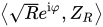
The rounding region of an integer – i.e., a set of complex (non-integer) numbers that share the integer part of their representation in this system – has in the complex plane a fractal shape: the twindragon (see figure). This set is, by definition, all points that can be written as with . can be decomposed into 16 pieces congruent to . Notice that if is rotated counterclockwise by 135°, we obtain two adjacent sets congruent to , because . The rectangle in the center intersects the coordinate axes counterclockwise at the following points: , , and , and . Thus, contains all complex numbers with absolute value ≤1/15.[12]
As a consequence, there is an injection of the complex rectangle
into the interval of real numbers by mapping
with .[13]
Furthermore, there are the two mappings
and
both surjective, which give rise to a surjective (thus space-filling) mapping
which, however, is not continuous and thus not a space-filling curve. But a very close relative, the Davis-Knuth dragon, is continuous and a space-filling curve.
Source: Wikipedia. Article content is retrieved live through the MediaWiki API.
In arithmetic, a complex-base system is a positional numeral system whose radix is an imaginary (proposed by Donald Knuth in 1955) or complex number (proposed by S. Khmelnik in 1964 and Walter F. Penney in 1965).

In artificial intelligence (AI), an expert system is a computer system emulating the decision-making ability of a human expert. Expert systems are designed to solve complex problems by reasoning through bodies of knowledge, represented mainly as if–then rules rather than through conventional procedural programming code. Expert systems were among the first truly successful forms of AI software. They were created in the 1970s and then proliferated in the 1980s, being then widely regarded as the future of AI before the advent of successful artificial neural networks. An expert system is divided into two subsystems: 1) a knowledge base, which represents facts and rules; and 2) an inference engine, which applies the rules to the known facts to deduce new facts, and can include explaining and debugging abilities.

A numeral system is a writing system for expressing numbers without words; that is, a mathematical notation for representing numbers of a given set, using digits (in positional notation) or other symbols (in sign-value notation) in a consistent manner. The same sequence of symbols may represent different numbers in different numeral systems. For example, "11" represents the number eleven in the decimal or base-10 numeral system (today, the most common system globally), the number three in the binary or base-2 numeral system (used in modern computers), and the number two in the unary numeral system (used in tallying scores). The number the numeral represents is called its value. Additionally, not all number systems can represent the same set of numbers; for example, Roman, Greek, and Egyptian numerals all lack an official representation of the number zero. Ideally, a numeral system will: Represent a useful set of numbers (e.g. all integers, or rational numbers) Give every number represented a unique representation (or at least a standard representation) Reflect the algebraic and arithmetic structure of the numbers. For example, the usual decimal representation gives every nonzero natural number a unique representation as a finite sequence of digits, beginning with a non-zero digit. Numeral systems are sometimes called number systems, but that name is ambiguous, as it could refer to different systems of numbers, such as the system of real numbers, the system of complex numbers, various hypercomplex number systems, the system of p-adic numbers, etc. Such systems are, however, not the topic of this article.

The basal ganglia (BG) or basal nuclei are a group of subcortical nuclei (cluster of neurons) found in the brains of vertebrates. Positioned at the base of the forebrain and the top of the midbrain, they have strong connections with the cerebral cortex, thalamus, brainstem and other brain areas. The basal ganglia are associated with a variety of functions, including regulating voluntary motor movements, procedural learning, habit formation, conditional learning, eye movements, cognition, and emotion. The main functional components of the basal ganglia include the striatum, consisting of both the dorsal striatum (caudate nucleus and putamen) and the ventral striatum (nucleus accumbens and olfactory tubercle), the globus pallidus, the ventral pallidum, the substantia nigra, and the subthalamic nucleus. Each of these components has complex internal anatomical and neurochemical structures. The largest component, the striatum (dorsal and ventral), receives input from various brain areas but only sends output to other components of the basal ganglia. The globus pallidus receives input from the striatum and sends inhibitory output to a number of motor-related areas. The substantia nigra is the source of the striatal input of the neurotransmitter dopamine, which plays an important role in basal ganglia function. The subthalamic nucleus mainly receives input from the striatum and cerebral cortex and projects to the globus pallidus. The basal ganglia are thought to play a key role in action selection, aiding in the choice of behaviors to execute. More specifically, they regulate motor and premotor cortical areas, facilitating smooth voluntary movements. Experimental studies show that the basal ganglia exert an inhibitory influence on a number of motor systems, and that a release of this inhibition permits a motor system to become active. The "behavior switching" that takes place within the basal ganglia is influenced by signals from many parts of the brain, including the prefrontal cortex, which plays a key role in executive functions. It has also been hypothesized that the basal ganglia are not only responsible for motor action selection, but also for the selection of more cognitive actions. Computational models of action selection in the basal ganglia incorporate this. The basal ganglia are of major importance for normal brain function and behaviour. Their dysfunction results in a wide range of neurological conditions including disorders of behaviour control and movement, as well as cognitive deficits that are similar to those that result from damage to the prefrontal cortex. Those of behaviour include Tourette syndrome, obsessive–compulsive disorder, and addiction. Movement disorders include, most notably Parkinson's disease, which involves degeneration of the dopamine-producing cells in the substantia nigra; Huntington's disease, which primarily involves damage to the striatum; dystonia; and more rarely hemiballismus. The basal ganglia have a limbic sector whose components are assigned distinct names: the nucleus accumbens, ventral pallidum, and ventral tegmental area (VTA). There is considerable evidence that this limbic part plays a central role in reward learning as well as cognition and frontal lobe functioning, via the mesolimbic pathway from the VTA to the nucleus accumbens that uses the neurotransmitter dopamine, and the mesocortical pathway. A number of highly addictive drugs, including cocaine, amphetamine, and nicotine, are thought to work by increasing the efficacy of this dopamine signal. There is also evidence implicating overactivity of the VTA dopaminergic projection in schizophrenia.
Before the 1921 destruction of Tulsa’s Greenwood District, Black residents had created a remarkable center of business and community life. The district included stores, professional offices, entertainment venues and homes owned by Black citizens. Understanding Greenwood means learning what was built—not only what was burned.
MORE →Madam C.J. Walker