Civil Rights
Movements, leaders, victories and the continuing fight for equality.

Explore the people, places, events, achievements, struggles and stories that shaped our journey.
Movements, leaders, victories and the continuing fight for equality.
Innovation, patents, science, technology and world-changing contributions.
Pioneers, champions, Negro Leagues, records, activism and excellence.
Meet the people whose lives, choices and achievements shaped the journey.
Black towns, communities, institutions and places where history happened.
Moments that changed communities, movements, institutions and the nation.
Mansa Musa was the ruler of the Mali Empire in West Africa. Details recorded here should be sourced; unknown information is left blank.
MORE →Reflects the personal views, recollections, and perspective of the author, Mike Davis.
This is a personal recollection on the Move fire on May 13, 1985

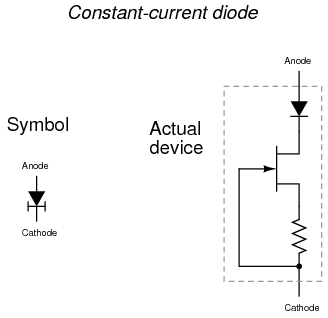
A constant-current diode is an electronic device that limits current to a maximal specified value for the device. It is known as a current-limiting diode (CLD) or current-regulating diode (CRD).

It consists of an n-channel JFET with the gate shorted to the source, which functions like a two-terminal current limiter (analogous to a voltage-limiting Zener diode). It allows a current through it to rise to a certain value, but not higher.
Note that some devices are unidirectional and voltage across the device must have only one polarity for it to operate as a CLD, whereas other devices are bidirectional and can operate properly with either polarity.
Wide-bandgap materials such as silicon carbide have been used in production devices to enable high-voltage applications in the kilovolt range.[1]
 | This electronics-related article is a stub. You can help Wikipedia by adding missing information. |
Source: Wikipedia. Article content is retrieved live through the MediaWiki API.

A constant-current diode is an electronic device that limits current to a maximal specified value for the device. It is known as a current-limiting diode (CLD) or current-regulating diode (CRD). It consists of an n-channel JFET with the gate shorted to the source, which functions like a two-terminal current limiter (analogous to a voltage-limiting Zener diode). It allows a current through it to rise to a certain value, but not higher. Note that some devices are unidirectional and voltage across the device must have only one polarity for it to operate as a CLD, whereas other devices are bidirectional and can operate properly with either polarity. Wide-bandgap materials such as silicon carbide have been used in production devices to enable high-voltage applications in the kilovolt range.

The Shockley diode equation, or the diode law, named after transistor co-inventor William Shockley of Bell Labs, models the exponential current–voltage (I–V) relationship of semiconductor diodes in moderate constant current forward bias or reverse bias: I D = I S ( e V D n V T − 1 ) , {\displaystyle I_{\text{D}}=I_{\text{S}}\left(e^{\frac {V_{\text{D}}}{nV_{\text{T}}}}-1\right),} where I D {\displaystyle I_{\text{D}}} is the diode current, I S {\displaystyle I_{\text{S}}} is the reverse-bias saturation current (or scale current), V D {\displaystyle V_{\text{D}}} is the voltage across the diode, V T {\displaystyle V_{\text{T}}} is the thermal voltage, and n {\displaystyle n} is the ideality factor, also known as the quality factor, emission coefficient, or the material constant. The equation is called the Shockley ideal diode equation when the ideality factor n {\displaystyle n} equals 1, thus n {\displaystyle n} is sometimes omitted. The ideality factor typically varies from 1 to 2 (though can in some cases be higher), depending on the fabrication process and semiconductor material. The ideality factor was added to account for imperfect junctions observed in real transistors, mainly due to carrier recombination as charge carriers cross the depletion region. The thermal voltage V T {\displaystyle V_{\text{T}}} is defined as: V T = k T q , {\displaystyle V_{\text{T}}={\frac {kT}{q}},} where k {\displaystyle k} is the Boltzmann constant, T {\displaystyle T} is the absolute temperature of the p–n junction, and q {\displaystyle q} is the elementary charge (the magnitude of an electron's charge). For example, it is approximately 25.852 mV at 300 K (27 °C; 80 °F). The reverse saturation current I S {\displaystyle I_{\text{S}}} is not constant for a given device, but varies with temperature; usually more significantly than V T {\displaystyle V_{\text{T}}} , so that V D {\displaystyle V_{\text{D}}} typically decreases as T {\displaystyle T} increases. Under reverse bias, the diode equation's exponential term is near 0, so the current is near the somewhat constant − I S {\displaystyle -I_{\text{S}}} reverse current value (roughly a picoampere for silicon diodes or a microampere for germanium diodes, although this is obviously a function of size). For moderate forward bias voltages the exponential becomes much larger than 1, since the thermal voltage is very small in comparison. The − 1 {\displaystyle -1} in the diode equation is then negligible, so the forward diode current will approximate I S e V D n V T . {\displaystyle I_{\text{S}}e^{\frac {V_{\text{D}}}{nV_{\text{T}}}}.} The use of the diode equation in circuit problems is illustrated in the article on diode modeling.
In electronics, an avalanche diode is a diode (made from silicon or other semiconductor) that is designed to experience avalanche breakdown at a specified reverse bias voltage. The junction of an avalanche diode is designed to prevent current concentration and resulting hot spots, so that the diode is undamaged by the breakdown. The avalanche breakdown is due to minority carriers accelerated enough to create ionization in the crystal lattice, producing more carriers, which in turn create more ionization. Because the avalanche breakdown is uniform across the whole junction, the breakdown voltage is nearly constant with changing current when compared to a non-avalanche diode. The Zener diode exhibits an apparently similar effect in addition to Zener breakdown. Both effects are present in any such diode, but one usually dominates the other. Avalanche diodes are optimized for avalanche effect, so they exhibit small but significant voltage drop under breakdown conditions, unlike Zener diodes that always maintain a voltage higher than breakdown. This feature provides better surge protection than a simple Zener diode and acts more like a gas-discharge tube replacement. Avalanche diodes have a small positive temperature coefficient of voltage, whereas diodes relying on the Zener effect have a negative temperature coefficient.
A constant current (steady current, time-independent current, stationary current) is a type of direct current (DC) that does not change its intensity with time. The syntagma stationary current is a contradiction in terms, however in use.
Before the 1921 destruction of Tulsa’s Greenwood District, Black residents had created a remarkable center of business and community life. The district included stores, professional offices, entertainment venues and homes owned by Black citizens. Understanding Greenwood means learning what was built—not only what was burned.
MORE →Shirley Chisholm, elected in 1968.