Civil Rights
Movements, leaders, victories and the continuing fight for equality.

Explore the people, places, events, achievements, struggles and stories that shaped our journey.
Movements, leaders, victories and the continuing fight for equality.
Innovation, patents, science, technology and world-changing contributions.
Pioneers, champions, Negro Leagues, records, activism and excellence.
Meet the people whose lives, choices and achievements shaped the journey.
Black towns, communities, institutions and places where history happened.
Moments that changed communities, movements, institutions and the nation.
In August 1908, a white mob attacked Springfield, Illinois’s Black community, destroying homes and businesses and lynching two Black men. National outrage over the violence helped spur the movement that created the NAACP the following year.
MORE →Reflects the personal views, recollections, and perspective of the author, Mike Davis.
This is a personal recollection on the Move fire on May 13, 1985
 | This article may be confusing or unclear to readers. (July 2023) |
Constructing skill trees (CST) is a hierarchical reinforcement learning algorithm which can build skill trees from a set of sample solution trajectories obtained from demonstration. CST uses an incremental MAP (maximum a posteriori) change point detection algorithm to segment each demonstration trajectory into skills and integrate the results into a skill tree. CST was introduced by George Konidaris, Scott Kuindersma, Andrew Barto and Roderic Grupen in 2010.[1]
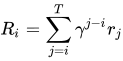
CST consists of mainly three parts;change point detection, alignment and merging. The main focus of CST is online change-point detection. The change-point detection algorithm is used to segment data into skills and uses the sum of discounted reward as the target regression variable. Each skill is assigned an appropriate abstraction. A particle filter is used to control the computational complexity of CST.
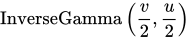
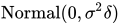
The change point detection algorithm is implemented as follows. The data for times and models Q with prior are given. The algorithm is assumed to be able to fit a segment from time to t using model q with the fit probability . A linear regression model with Gaussian noise is used to compute . The Gaussian noise prior has mean zero, and variance which follows . The prior for each weight follows .
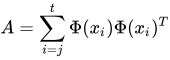
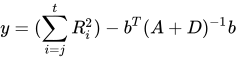
The fit probability is computed by the following equation.
Then, CST compute the probability of the changepoint at time j with model q, and using a Viterbi algorithm.
The descriptions of the parameters and variables are as follows;
The skill length l is assumed to follow a Geometric distribution with parameter p
Using the method above, CST can segment data into a skill chain. The time complexity of the change point detection is and storage size is , where N is the number of particles, L is the time of computing , and there are change points.
Next step is alignment. CST needs to align the component skills because the change-point does not occur in the exactly same places. Thus, when segmenting second trajectory after segmenting the first trajectory, it has a bias on the location of change point in the second trajectory. This bias follows a mixture of gaussians.
The last step is merging. CST merges skill chains into a skill tree. CST merges a pair of trajectory segments by allocating the same skill. All trajectories have the same goal and it merges two chains by starting at their final segments. If two segments are statistically similar, it merges them. This procedure is repeated until it fails to merge a pair of skill segments. are used to determine whether a pair of trajectories are modeled better as one skill or as two different skills.
The following pseudocode describes the change point detection algorithm:
particles := [];
Process each incoming data point
for t = 1:T do
//Compute fit probabilities for all particles
for p ∈ particles do
p_tjq := (1 − G(t − p.pos − 1)) × p.fit_prob × model_prior(p.model) × p.prev_MAP
p.MAP := p_tjq × g(t−p.pos) / (1 − G(t − p.pos − 1))
end
// Filter if necessary
if the number of particles ≥ N then
particles := particle_filter(p.MAP, M)
end
// Determine the Viterbi path
for t = 1 do
max_path := []
max_MAP := 1/|Q|
else
max_particle := p.MAP
max_path := max_particle.path ∪ max_particle
max_MAP := max_particle.MAP
end
// Create new particles for a changepoint at time t
for q ∈ Q do
new_p := create_particle(model=q, pos=t, prev_MAP=max_MAP, path=max_path)
p := p ∪ new_p
end
// Update all particles
for p ∈ P do
particles := update_particle(current_state, current_reward, p)
end
end
// Return the most likely path to the final point
return max_path
function update_particle(current_state, current_reward, particle) is
    p := particle
    r_t := current_reward
    // Initialization
    if t = 0 then
        p.A := zero matrix(p.m, p.m)
        p.b := zero vector(p.m)
        p.z := zero vector(p.m)
        p.sum r := 0
        p.tr1 := 0
        p.tr2 := 0
    end if
    // Compute the basis function vector for the current state
    Φt := p.Φ (current state)
    // Update sufficient statistics
    p.A := p.A + ΦtΦT
t
    p.z := 𝛾p.z + Φt
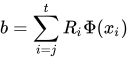
    p.b := p.b + rt p.z
    p.tr1 := 1 + 𝛾2 p.tr1
    p.sum r := sum p.r + r2
t p.tr1 + 2𝛾rt p.tr2
    p.tr2 := 𝛾p.tr2 + rt p.tr1
    p.fit_prob := compute_fit_prob(p, v, u, delta, 𝛾)
CTS assume that the demonstrated skills form a tree, the domain reward function is known and the best model for merging a pair of skills is the model selected for representing both individually.
CST is much faster learning algorithm than skill chaining. CST can be applied to learning higher dimensional policies. Even unsuccessful episode can improve skills. Skills acquired using agent-centric features can be used for other problems.
CST has been used to acquire skills from human demonstration in the PinBall domain. It has been also used to acquire skills from human demonstration on a mobile manipulator.
Source: Wikipedia. Article content is retrieved live through the MediaWiki API.
Constructing skill trees (CST) is a hierarchical reinforcement learning algorithm which can build skill trees from a set of sample solution trajectories obtained from demonstration. CST uses an incremental MAP (maximum a posteriori) change point detection algorithm to segment each demonstration trajectory into skills and integrate the results into a skill tree. CST was introduced by George Konidaris, Scott Kuindersma, Andrew Barto and Roderic Grupen in 2010.
Palm Trees and Power Lines is a 2022 American coming-of-age drama film directed by Jamie Dack in her feature directorial debut, based on her 2018 short film of the same name. The screenplay by Dack and Audrey Findlay is from a story by Dack. The film stars Lily McInerny as a disconnected teenage girl falling into a relationship with a man (Jonathan Tucker) twice her age. The film had its world premiere at the 38th Sundance Film Festival on January 24, 2022, where Dack won the U.S. Dramatic Competition Directing Award. It was released in select theaters in the United States and on VOD on March 3, 2023, by Momentum Pictures. The film received positive reviews from critics and earned four nominations at the 38th Independent Spirit Awards, including Best First Feature.

A hedge or hedgerow is a line of shrubs and sometimes trees, planted and trained to form a barrier or to mark the boundary of an area, such as between neighbouring properties. Hedges that are used to separate a road from adjoining fields or one field from another, and are of sufficient age to incorporate larger trees, are known as hedgerows. Often they serve as windbreaks to improve conditions for the adjacent crops, as in bocage country. When clipped and maintained, hedges are also a simple form of topiary. Hedges and Hedgerows are usually no wider than about three feet (one meter). A hedge often operates as, and sometimes is called, a "live fence". This may either consist of individual fence posts connected with wire or other fencing material, or it may be in the form of densely planted hedges without interconnecting wire. This is common in tropical areas where low-income farmers can demarcate properties and reduce maintenance of fence posts that otherwise deteriorate rapidly. Many other benefits can be obtained depending on the species chosen.

Urban forestry is the care and management of single trees and tree populations in urban settings for the purpose of improving the urban environment. Also called urban tree canopy, urban forestry involves both planning and management, including the programming of care and maintenance operations of the urban forest. Urban forestry advocates the role of trees as a critical part of the urban infrastructure. Urban foresters plant and maintain trees, support appropriate tree and forest preservation, conduct research and promote the many benefits trees provide. Urban forestry is practiced by municipal and commercial arborists, municipal and utility foresters, environmental policymakers, city planners, consultants, educators, researchers and community activists. Urban forests mitigate the effects of urban heat island through evapotranspiration and the shading of streets and buildings. There are many environmental impacts that are associated with the inequity of the urban tree canopy. Strategically, planting trees is a proven method of climate change adaptation and mitigation. Wildlife is also attracted to urban forests for their increased surface waters due to reduced runoff in these areas. Forests that have been included in urban environments have shown beneficial effects for the residents who live there. Urban forestry has been shown to promote psychological healing, stress recovery, and to improve concentration and productivity. Street trees, if managed and cared for, are beneficial in creating sustainable and healthy communities. The inequitable distribution of canopy cover in lower socioeconomic neighborhoods has resulted in many social impacts that raise environmental justice concerns.
Before the 1921 destruction of Tulsa’s Greenwood District, Black residents had created a remarkable center of business and community life. The district included stores, professional offices, entertainment venues and homes owned by Black citizens. Understanding Greenwood means learning what was built—not only what was burned.
MORE →Mae Jemison, aboard Space Shuttle Endeavour in 1992.