Civil Rights
Movements, leaders, victories and the continuing fight for equality.

Explore the people, places, events, achievements, struggles and stories that shaped our journey.
Movements, leaders, victories and the continuing fight for equality.
Innovation, patents, science, technology and world-changing contributions.
Pioneers, champions, Negro Leagues, records, activism and excellence.
Meet the people whose lives, choices and achievements shaped the journey.
Black towns, communities, institutions and places where history happened.
Moments that changed communities, movements, institutions and the nation.
Wilmington, North Carolina once had a thriving Black middle class and an elected interracial government. In 1898 white supremacists used violence to overthrow that government, kill Black residents and drive many others from the city.
MORE →Reflects the personal views, recollections, and perspective of the author, Mike Davis.
This is a personal recollection on the Move fire on May 13, 1985

In topology, the degree or Brouwer degree of a continuous mapping between two compact oriented manifolds of the same dimension is a number that represents the number of times that the domain manifold wraps around the range manifold under the mapping. The degree is always an integer, but may be positive or negative depending on the orientations.
The degree of a map between general manifolds was first defined by Brouwer,[1] who showed that the degree is homotopy invariant and used it to prove the Brouwer fixed point theorem. Less general forms of the concept existed before Brouwer, such as the winding number and the Kronecker characteristic (or Kronecker integral).[2]
In modern mathematics, the degree of a map plays an important role in topology and geometry. In physics, the degree of a continuous map (for instance a map from space to some order parameter set) is one example of a topological quantum number.
The simplest and most important case is the degree of a continuous map from the -sphere to itself (in the case , this is called the winding number):
Let be a continuous map. Then induces a pushforward homomorphism , where is the th homology group. Considering the fact that , we see that must be of the form for some fixed . This is then called the degree of .
Let X and Y be closed connected oriented m-dimensional manifolds. Poincaré duality implies that the manifold's top homology group is isomorphic to Z. Choosing an orientation means choosing a generator of the top homology group.
A continuous map f : X →Y induces a homomorphism f∗ from Hm(X) to Hm(Y). Let [X], resp. [Y] be the chosen generator of Hm(X), resp. Hm(Y) (or the fundamental class of X, Y). Then the degree of f is defined to be f∗([X]). In other words,
If y in Y and f −1(y) is a finite set, the degree of f can be computed by considering the m-th local homology groups of X at each point in f −1(y). Namely, if , then
In the language of differential topology, the degree of a smooth map can be defined as follows: If f is a smooth map whose domain is a compact manifold and p is a regular value of f, consider the finite set
By p being a regular value, in a neighborhood of each xi the map f is a local diffeomorphism. Diffeomorphisms can be either orientation preserving or orientation reversing. Let r be the number of points xi at which f is orientation preserving and s be the number at which f is orientation reversing. When the codomain of f is connected, the number r − s is independent of the choice of p (though n is not!) and one defines the degree of f to be r − s. This definition coincides with the algebraic topological definition above.
The same definition works for compact manifolds with boundary but then f should send the boundary of X to the boundary of Y.
One can also define degree modulo 2 (deg2(f)) the same way as before but taking the fundamental class in Z2 homology. In this case deg2(f) is an element of Z2 (the field with two elements), the manifolds need not be orientable and if n is the number of preimages of p as before then deg2(f) is n modulo 2.
Integration of differential forms gives a pairing between (C∞-)singular homology and de Rham cohomology: , where is a homology class represented by a cycle and a closed form representing a de Rham cohomology class. For a smooth map f: X →Y between orientable m-manifolds, one has
where f∗ and f∗ are induced maps on chains and forms respectively. Since f∗[X] = deg f · [Y], we have
for any m-form ω on Y.
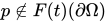
If is a bounded region, smooth, a regular value of and , then the degree is defined by the formula
where is the Jacobian matrix of in .
This definition of the degree may be naturally extended for non-regular values such that where is a point close to . The topological degree can also be calculated using a surface integral over the boundary of ,[3] and if is a connected n-polytope, then the degree can be expressed as a sum of determinants over a certain subdivision of its facets.[4]
The degree satisfies the following properties:[5]
These properties characterise the degree uniquely and the degree may be defined by them in an axiomatic way.
In a similar way, we could define the degree of a map between compact oriented manifolds with boundary.
The degree of a map is a homotopy invariant; moreover for continuous maps from the sphere to itself it is a complete homotopy invariant, i.e. two maps are homotopic if and only if .
In other words, degree is an isomorphism between and .
Moreover, the Hopf theorem states that for any -dimensional closed oriented manifold M, two maps are homotopic if and only if
A self-map of the n-sphere is extendable to a map from the n+1-ball to the n-sphere if and only if . (Here the function F extends f in the sense that f is the restriction of F to .)
There is an algorithm for calculating the topological degree deg(f, B, 0) of a continuous function f from an n-dimensional box B (a product of n intervals) to , where f is given in the form of arithmetical expressions.[6] An implementation of the algorithm is available in TopDeg - a software tool for computing the degree (LGPL-3).
{{cite journal}}: CS1 maint: periodical has ISBN (link)
Source: Wikipedia. Article content is retrieved live through the MediaWiki API.

In topology, the degree or Brouwer degree of a continuous mapping between two compact oriented manifolds of the same dimension is a number that represents the number of times that the domain manifold wraps around the range manifold under the mapping. The degree is always an integer, but may be positive or negative depending on the orientations. The degree of a map between general manifolds was first defined by Brouwer, who showed that the degree is homotopy invariant and used it to prove the Brouwer fixed point theorem. Less general forms of the concept existed before Brouwer, such as the winding number and the Kronecker characteristic (or Kronecker integral). In modern mathematics, the degree of a map plays an important role in topology and geometry. In physics, the degree of a continuous map (for instance a map from space to some order parameter set) is one example of a topological quantum number.

An important problem in topology is how to enlarge a space by adding points so that certain kinds of limits exist. The Stone–Čech compactification of a space provides the most extensive such enlargement: it adds enough points to ensure the existence of all generalized limits, including those detected by nets or ultrafilters rather than ordinary sequences. The construction was implicitly introduced by Andrey Nikolayevich Tikhonov (1930) and explicitly described by Marshall Stone (1937) and Eduard Čech (1937). In more detail, the Stone–Čech compactification is a technique for constructing a universal map from a topological space X to a compact Hausdorff space β X {\displaystyle \beta X} . The Stone–Čech compactification β X {\displaystyle \beta X} is the unique "most general" compact Hausdorff space generated by X, in the sense that any continuous map from X into any other compact Hausdorff space factors uniquely through β X {\displaystyle \beta X} . If the space X is a Tychonoff space, the map from X to β X {\displaystyle \beta X} is an embedding, and X can be identified as a dense subspace of β X {\displaystyle \beta X} . For a Tychonoff space, β X {\displaystyle \beta X} is the largest compactification of X: any other Hausdorff compactification of X is a quotient space of β X {\displaystyle \beta X} . For infinite spaces, the structure of β X {\displaystyle \beta X} is often extremely complex, and proving its existence generally requires the axiom of choice.
In mathematics, a sheaf (pl.: sheaves) is a tool for systematically tracking data (such as sets, abelian groups, rings) attached to the open sets of a topological space and defined locally with regard to them. For example, for each open set, the data could be the ring of continuous functions defined on that open set. Such data are well-behaved in that they can be restricted to smaller open sets, and also the data assigned to an open set are equivalent to all collections of compatible data assigned to collections of smaller open sets covering the original open set (intuitively, every datum is the sum of its constituent data). The field of mathematics that studies sheaves is called sheaf theory. Sheaves are understood conceptually as general and abstract objects. Their precise definition is rather technical. They are specifically defined as sheaves of sets or as sheaves of rings, for example, depending on the type of data assigned to the open sets. There are also maps (or morphisms) from one sheaf to another; sheaves (of a specific type, such as sheaves of abelian groups) with their morphisms on a fixed topological space form a category. On the other hand, to each continuous map there is associated both a direct image functor, taking sheaves and their morphisms on the domain to sheaves and morphisms on the codomain, and an inverse image functor operating in the opposite direction. These functors, and certain variants of them, are essential parts of sheaf theory. Due to their general nature and versatility, sheaves have several applications in topology and especially in algebraic and differential geometry. First, geometric structures such as that of a differentiable manifold or a scheme can be expressed in terms of a sheaf of rings on the space. In such contexts, several geometric constructions such as vector bundles or divisors are naturally specified in terms of sheaves. Second, sheaves provide the framework for a very general cohomology theory, which encompasses also the "usual" topological cohomology theories such as singular cohomology. Especially in algebraic geometry and the theory of complex manifolds, sheaf cohomology provides a powerful link between topological and geometric properties of spaces. Sheaves also provide the basis for the theory of D-modules, which provide applications to the theory of differential equations. In addition, generalisations of sheaves to more general settings than topological spaces, such as the notion of a sheaf on a category with respect to some Grothendieck topology, have provided applications to mathematical logic and to number theory.
In mathematics, more specifically in topology, an open map is a function between two topological spaces that maps open sets to open sets. That is, a function f : X → Y {\displaystyle f:X\to Y} is open if for any open set U {\displaystyle U} in X , {\displaystyle X,} the image f ( U ) {\displaystyle f(U)} is open in Y . {\displaystyle Y.} Likewise, a closed map is a function that maps closed sets to closed sets. A map may be open, closed, both, or neither; in particular, an open map need not be closed and vice versa. Open and closed maps are not necessarily continuous. Further, continuity is independent of openness and closedness in the general case and a continuous function may have one, both, or neither property; this fact remains true even if one restricts oneself to metric spaces. Although their definitions seem more natural, open and closed maps are much less important than continuous maps. Recall that, by definition, a function f : X → Y {\displaystyle f:X\to Y} is continuous if and only if the preimage of every open set of Y {\displaystyle Y} is open in X . {\displaystyle X.} (Equivalently, if and only if the preimage of every closed set of Y {\displaystyle Y} is closed in X {\displaystyle X} ). Early study of open maps was pioneered by Simion Stoilow and Gordon Thomas Whyburn.
Before the 1921 destruction of Tulsa’s Greenwood District, Black residents had created a remarkable center of business and community life. The district included stores, professional offices, entertainment venues and homes owned by Black citizens. Understanding Greenwood means learning what was built—not only what was burned.
MORE →Shirley Chisholm, elected in 1968.