Civil Rights
Movements, leaders, victories and the continuing fight for equality.

Explore the people, places, events, achievements, struggles and stories that shaped our journey.
Movements, leaders, victories and the continuing fight for equality.
Innovation, patents, science, technology and world-changing contributions.
Pioneers, champions, Negro Leagues, records, activism and excellence.
Meet the people whose lives, choices and achievements shaped the journey.
Black towns, communities, institutions and places where history happened.
Moments that changed communities, movements, institutions and the nation.
In 1968 Shirley Chisholm became the first Black woman elected to the United States Congress. In 1972 she launched a campaign for the Democratic presidential nomination, breaking another political barrier.
MORE →Reflects the personal views, recollections, and perspective of the author, Mike Davis.
This is a personal recollection on the Move fire on May 13, 1985
Control reconfiguration is an active approach in control theory to achieve fault-tolerant control for dynamic systems.[1] It is used when severe faults, such as actuator or sensor outages, cause a break-up of the control loop, which must be restructured to prevent failure at the system level. In addition to loop restructuring, the controller parameters must be adjusted to accommodate changed plant dynamics. Control reconfiguration is a building block toward increasing the dependability of systems under feedback control.[2]

The figure to the right shows a plant controlled by a controller in a standard control loop.
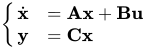
The nominal linear model of the plant is
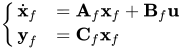
The plant subject to a fault (indicated by a red arrow in the figure) is modelled in general by
where the subscript indicates that the system is faulty. This approach models multiplicative faults by modified system matrices. Specifically, actuator faults are represented by the new input matrix , sensor faults are represented by the output map , and internal plant faults are represented by the system matrix .
The upper part of the figure shows a supervisory loop consisting of fault detection and isolation (FDI) and reconfiguration which changes the loop by
To this end, the vectors of inputs and outputs contain all available signals, not just those used by the controller in fault-free operation.
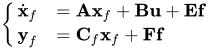
Alternative scenarios can model faults as an additive external signal influencing the state derivatives and outputs as follows:
The goal of reconfiguration is to keep the reconfigured control-loop performance sufficient for preventing plant shutdown. The following goals are distinguished:
Internal stability of the reconfigured closed loop is usually the minimum requirement. The equilibrium recovery goal (also referred to as weak goal) refers to the steady-state output equilibrium which the reconfigured loop reaches after a given constant input. This equilibrium must equal the nominal equilibrium under the same input (as time tends to infinity). This goal ensures steady-state reference tracking after reconfiguration. The output trajectory recovery goal (also referred to as strong goal) is even stricter. It requires that the dynamic response to an input must equal the nominal response at all times. Further restrictions are imposed by the state trajectory recovery goal, which requires that the state trajectory be restored to the nominal case by the reconfiguration under any input.
Usually a combination of goals is pursued in practice, such as the equilibrium-recovery goal with stability.
The question whether or not these or similar goals can be reached for specific faults is addressed by reconfigurability analysis.

This paradigm aims at keeping the nominal controller in the loop. To this end, a reconfiguration block can be placed between the faulty plant and the nominal controller. Together with the faulty plant, it forms the reconfigured plant. The reconfiguration block has to fulfill the requirement that the behaviour of the reconfigured plant matches the behaviour of the nominal, that is fault-free plant.[3]
In linear model following, a formal feature of the nominal closed loop is attempted to be recovered. In the classical pseudo-inverse method, the closed loop system matrix of a state-feedback control structure is used. The new controller is found to approximate in the sense of an induced matrix norm.[4]
In perfect model following, a dynamic compensator is introduced to allow for the exact recovery of the complete loop behaviour under certain conditions.
In eigenstructure assignment, the nominal closed loop eigenvalues and eigenvectors (the eigenstructure) is recovered to the nominal case after a fault.
Optimisation control schemes include: linear-quadratic regulator design (LQR), model predictive control (MPC) and eigenstructure assignment methods.[5]
Some probabilistic approaches have been developed.[6]
There are learning automata, neural networks, etc.[7]
The methods by which reconfiguration is achieved differ considerably. The following list gives an overview of mathematical approaches that are commonly used.[8]
Prior to control reconfiguration, it must be at least determined whether a fault has occurred (fault detection) and if so, which components are affected (fault isolation). Preferably, a model of the faulty plant should be provided (fault identification). These questions are addressed by fault diagnosis methods.
Fault accommodation is another common approach to achieve fault tolerance. In contrast to control reconfiguration, accommodation is limited to internal controller changes. The sets of signals manipulated and measured by the controller are fixed, which means that the loop cannot be restructured.[9]
{{citation}}: CS1 maint: location missing publisher (link){{citation}}: CS1 maint: location missing publisher (link)Source: Wikipedia. Article content is retrieved live through the MediaWiki API.
Control reconfiguration is an active approach in control theory to achieve fault-tolerant control for dynamic systems. It is used when severe faults, such as actuator or sensor outages, cause a break-up of the control loop, which must be restructured to prevent failure at the system level. In addition to loop restructuring, the controller parameters must be adjusted to accommodate changed plant dynamics. Control reconfiguration is a building block toward increasing the dependability of systems under feedback control.
To reconfigure refers to: Reconfigurable computing: changing the data path of a computing system in addition to the control flow Control reconfiguration: changing the loop structure and controller parameters in an automatic control loop Reconfigurable antenna: changing the antenna physically or electrically to control its antenna properties
Reconfigurability denotes the Reconfigurable Computing capability of a system, so that its behavior can be changed by reconfiguration, i. e. by loading different configware code. This static reconfigurability distinguishes between reconfiguration time and run time. Dynamic reconfigurability denotes the capability of a dynamically reconfigurable system that can dynamically change its behavior during run time, usually in response to dynamic changes in its environment. In the context of Wireless communication dynamic reconfigurability tackles the changeable behavior of wireless networks and associated equipment, specifically in the fields of radio spectrum, radio access technologies, protocol stacks, and application services. Research regarding the (dynamic) reconfigurability of Wireless communication systems is ongoing for example in working group 6 of the Wireless World Research Forum (WWRF), in the Wireless Innovation Forum (WINNF) (formerly Software Defined Radio Forum), and in the European FP6 project End-to-End Reconfigurability (E²R). Recently, E²R initiated a related standardization effort on the cohabitation of heterogeneous wireless radio systems in the framework of the IEEE P1900.4 Working Group. See cognitive radio. In the context of Control reconfiguration, a field of fault-tolerant control within control engineering, reconfigurability is a property of faulty systems meaning that the original control goals specified for the fault-free system can be reached after suitable control reconfiguration.
Bonnie Heck Ferri is an American electrical engineer and academic administrator, the Vice Provost for Graduate and Postdoctoral Education at Georgia Tech, where she was the first woman to earn a Ph.D. in electrical engineering, and the first woman to join the faculty in the Department of Electrical and Computer Engineering. Her publications include work on engineering education and control theory, including control reconfiguration and distributed control systems.
Before the 1921 destruction of Tulsa’s Greenwood District, Black residents had created a remarkable center of business and community life. The district included stores, professional offices, entertainment venues and homes owned by Black citizens. Understanding Greenwood means learning what was built—not only what was burned.
MORE →Mae Jemison, aboard Space Shuttle Endeavour in 1992.