Civil Rights
Movements, leaders, victories and the continuing fight for equality.

Explore the people, places, events, achievements, struggles and stories that shaped our journey.
Movements, leaders, victories and the continuing fight for equality.
Innovation, patents, science, technology and world-changing contributions.
Pioneers, champions, Negro Leagues, records, activism and excellence.
Meet the people whose lives, choices and achievements shaped the journey.
Black towns, communities, institutions and places where history happened.
Moments that changed communities, movements, institutions and the nation.
In 1968 Shirley Chisholm became the first Black woman elected to the United States Congress. In 1972 she launched a campaign for the Democratic presidential nomination, breaking another political barrier.
MORE →Reflects the personal views, recollections, and perspective of the author, Mike Davis.
This is a personal recollection on the Move fire on May 13, 1985
A control variable (or scientific constant) in scientific experimentation is an experimental element which is constant (controlled) and unchanged throughout the course of the investigation. Control variables could strongly influence experimental results were they not held constant during the experiment in order to test the relative relationship of the dependent variable (DV) and independent variable (IV). The control variables themselves are not of primary interest to the experimenter.
"Good controls", also known as “confounders” or “deconfounders”, are variables which are theorized to be unaffected by the treatment and which are intended to eliminate omitted-variable bias.[1] "Bad controls", on the other hand, are variables that could be affected by the treatment, might contribute to collider bias, and lead to erroneous results.[1]
A variable in an experiment which is held constant in order to assess the relationship between multiple variables[a], is a control variable.[2][3] A control variable is an element that is not changed throughout an experiment because its unchanging state allows better understanding of the relationship between the other variables being tested.[4]
In any system existing in a natural state, many variables may be interdependent, with each affecting the other. Scientific experiments test the relationship of an IV (or independent variable: that element that is manipulated by the experimenter) to the DV (or dependent variable: that element affected by the manipulation of the IV).[4] Any additional independent variable can be a control variable.[2]
A control variable is an experimental condition or element that is kept the same throughout the experiment, and it is not of primary concern in the experiment, nor will it influence the outcome of the experiment.[3] Any unexpected (e.g.: uncontrolled) change in a control variable during an experiment would invalidate the correlation of dependent variables (DV) to the independent variable (IV), thus skewing the results, and invalidating the working hypothesis. This indicates the presence of a spurious relationship existing within experimental parameters.[4] Unexpected results may result from the presence of a confounding variable, thus requiring a re-working of the initial experimental hypothesis. Confounding variables are a threat to the internal validity of an experiment.[5][4] This situation may be resolved by first identifying the confounding variable and then redesigning the experiment taking that information into consideration. One way to this is to control the confounding variable, thus making it a control variable. If, however, the spurious relationship cannot be identified, the working hypothesis may have to be abandoned.[4][5]
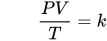
Take, for example, the well known combined gas law, which is stated mathematically as:
where:
In an experimental verification of parts of the combined gas law, (P * V = T), where Pressure, Temperature, and Volume are all variables, to test the resultant changes to any of these variables requires at least one to be kept constant.[3] This is in order to see comparable experimental results in the remaining variables.
If Temperature is made the control variable and it is not allowed to change throughout the course of the experiment, the relationship between the dependent variables, Pressure, and Volume, can quickly be established by changing the value for one or the other, and this is Boyle's law. For instance, if the Pressure is raised then the Volume must decrease.
If, however, Volume is made the control variable and it is not allowed to change throughout the course of the experiment, the relationship between dependent variables, Pressure, and Temperature, can quickly be established by changing the value for one or the other, and this is Gay-Lussac's law. For instance, if the Pressure is raised then the Temperature must increase.
Source: Wikipedia. Article content is retrieved live through the MediaWiki API.
A control variable (or scientific constant) in scientific experimentation is an experimental element which is constant (controlled) and unchanged throughout the course of the investigation. Control variables could strongly influence experimental results were they not held constant during the experiment in order to test the relative relationship of the dependent variable (DV) and independent variable (IV). The control variables themselves are not of primary interest to the experimenter. "Good controls", also known as “confounders” or “deconfounders”, are variables which are theorized to be unaffected by the treatment and which are intended to eliminate omitted-variable bias. "Bad controls", on the other hand, are variables that could be affected by the treatment, might contribute to collider bias, and lead to erroneous results.
VVC (Variable Valve Control) is an automobile variable valve timing technology developed by Rover and applied to some high performance variants of the company's K Series 1800cc engine.
Variable structure control (VSC) is a form of discontinuous nonlinear control. The method alters the dynamics of a nonlinear system by application of a high-frequency switching control. The state-feedback control law is not a continuous function of time; it switches from one smooth condition to another. So the structure of the control law varies based on the position of the state trajectory; the method switches from one smooth control law to another and possibly very fast speeds (e.g., for a countably infinite number of times in a finite time interval). VSC and associated sliding mode behaviour was first investigated in early 1950s in the Soviet Union by Emelyanov and several coresearchers. The main mode of VSC operation is sliding mode control (SMC). The strengths of SMC include: Low sensitivity to plant parameter uncertainty Greatly reduced-order modeling of plant dynamics Finite-time convergence (due to discontinuous control law) The weaknesses of SMC include: Chattering due to implementation imperfections Over-focus on matched uncertainties (i.e., uncertainties that enter into the control channel) However, the evolution of VSC is an active area of research.
The nomenclature of mechanical ventilation in the respiration of patients in medical treatment varies widely across associated hardware and modes of operation, with some terms specific to device brand, model, trademark, or mode of mechanical ventilation. While there is a standardized nomenclature of mechanical ventilation for modes, this is not the case for settings and variables. However, these terms can be categorized using a schema that combines control variables, breath sequences, and targeting schemes. The target variable should not be confused with the cycle variable or the control variable. The target variable only sets an upper limit for pressure, volume, or flow. The term trigger (commonly flow or pressure) denotes the criterion that starts inspiration, and cycle denotes the criterion that stops it.
Before the 1921 destruction of Tulsa’s Greenwood District, Black residents had created a remarkable center of business and community life. The district included stores, professional offices, entertainment venues and homes owned by Black citizens. Understanding Greenwood means learning what was built—not only what was burned.
MORE →The Greenwood District.