Civil Rights
Movements, leaders, victories and the continuing fight for equality.

Explore the people, places, events, achievements, struggles and stories that shaped our journey.
Movements, leaders, victories and the continuing fight for equality.
Innovation, patents, science, technology and world-changing contributions.
Pioneers, champions, Negro Leagues, records, activism and excellence.
Meet the people whose lives, choices and achievements shaped the journey.
Black towns, communities, institutions and places where history happened.
Moments that changed communities, movements, institutions and the nation.
Wilmington, North Carolina once had a thriving Black middle class and an elected interracial government. In 1898 white supremacists used violence to overthrow that government, kill Black residents and drive many others from the city.
MORE →Reflects the personal views, recollections, and perspective of the author, Mike Davis.
This is a personal recollection on the Move fire on May 13, 1985

Depth of focus is a lens optics concept that measures the tolerance of placement of the image-capturing plane (the plane of an image sensor or a film in a camera) in relation to the lens. In a camera, depth of focus indicates the tolerance of the film's displacement within the camera and is therefore sometimes referred to as "lens-to-film tolerance".
The phrase depth of focus is sometimes erroneously used to refer to depth of field (DOF), which is the object position range over which objects are acceptably focused on an image, whereas the depth of focus refers to the zone behind the lens wherein the film plane or image sensor is placed to produce an in-focus image. Depth of field depends on the focus distance, while depth of focus does not.
Depth of focus can have two slightly different meanings. The first is the distance over which the image-capturing plane can be displaced while a single object plane remains on it with acceptably sharp focus;[1][2][clarification needed] the second is the image-side conjugate of depth of field.[2][clarification needed] With the first meaning, the depth of focus is symmetrical about the image plane; with the second, the depth of focus is slightly greater on the far side of the image plane.
While depth of field is generally measured in macroscopic units such as meters and feet, depth of focus is typically measured in microscopic units such as fractions of a millimeter or thousandths of an inch. In optometry depth of focus is usually measured in dioptres.
The same factors that determine depth of field also determine depth of focus, but these factors can have different effects than they have in depth of field. Both depth of field and depth of focus increase with smaller apertures. For distant subjects (beyond macro range), depth of focus is relatively insensitive to focal length and subject distance, for a fixed f-number. In the macro region, depth of focus increases with longer focal length or closer subject distance, while depth of field decreases.
In small-format cameras, the smaller circle of confusion limit yields a proportionately smaller depth of focus. In motion-picture cameras, different lens mount and camera gate combinations have exact flange focal distance measurements to which lenses are calibrated.
The choice to place gels or other filters behind the lens becomes a much more critical decision when dealing with smaller formats. Placement of items behind the lens will alter the optics pathway, shifting the focal plane. Therefore, often this insertion must be done in concert with stopping down the lens in order to compensate enough to make any shift negligible given a greater depth of focus. It is often advised in 35 mm motion-picture filmmaking not to use filters behind the lens if the lens is wider than 25 mm.
If the depth of focus relates to a single plane in object space, it can be calculated from[1]
where t is the total depth of focus, N is the lens f-number, c is the circle of confusion, v is the image distance, and f is the lens focal length. In most cases, the image distance (not to be confused with subject distance) is not easily determined; the depth of focus can also be given in terms of magnification m:
The magnification depends on the focal length and the subject distance, and sometimes it can be difficult to estimate. When the magnification is small, the formula simplifies to
The simple formula is often used as a guideline, as it is much easier to calculate, and in many cases, the difference from the exact formula is insignificant. Moreover, the simple formula will always err on the conservative side (i.e., depth of focus will always be greater than calculated).
Following historical convention, the circle of confusion is sometimes taken as the lens focal length divided by 1000 (with the result in same units as the focal length);[2][3] this formula makes most sense in the case of normal lens (as opposed to wide-angle or telephoto), where the focal length is a representation of the format size. This practice is now deprecated; it is more common to base the circle of confusion on the format size (for example, the diagonal divided by 1000 or 1500).[3]
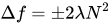
In astronomy, the depth of focus is the amount of defocus that introduces a wavefront error. It can be calculated as[4][5]
Source: Wikipedia. Article content is retrieved live through the MediaWiki API.

Depth of focus is a lens optics concept that measures the tolerance of placement of the image-capturing plane (the plane of an image sensor or a film in a camera) in relation to the lens. In a camera, depth of focus indicates the tolerance of the film's displacement within the camera and is therefore sometimes referred to as "lens-to-film tolerance".
In seismology, the depth of focus or focal depth is the depth at which an earthquake occurs. Earthquakes occurring at a depth of less than 70 km (43 mi) are classified as shallow-focus earthquakes, while those with a focal depth between 70 km (43 mi) and 300 km (190 mi) are commonly termed mid-focus or intermediate-depth earthquakes. In subduction zones, where older and colder oceanic crust sinks under another tectonic plate, deep-focus earthquakes may occur at much greater depths in the mantle, ranging from 300 km (190 mi) up to 700 km (430 mi). The cause of deep-focus earthquakes is still not entirely understood since subducted lithosphere at that pressure and temperature regime should not exhibit brittle behavior. A possible mechanism for the generation of deep-focus earthquakes is faulting caused by olivine undergoing a phase transition into a spinel structure, with which they are believed to be associated. Earthquakes at this depth of focus typically occur at oceanic-continental convergent boundaries, along Wadati–Benioff zones.

The depth of field (DOF) is the distance between the nearest and the farthest objects that are in acceptably sharp focus in an image captured with a camera. See also the closely related depth of focus.

An intraocular lens (IOL) is a lens implanted in the eye usually as part of a treatment for cataracts or for correcting other vision problems such as near-sightedness (myopia) and far-sightedness (hyperopia); a form of refractive surgery. If the natural lens is left in the eye, the IOL is known as phakic, otherwise it is a pseudophakic lens (or false lens). Both kinds of IOLs are designed to provide the same light-focusing function as the natural crystalline lens. This can be an alternative to LASIK, but LASIK is not an alternative to an IOL for treatment of cataracts. IOLs usually consist of a small plastic lens with plastic side struts, called haptics, to hold the lens in place in the capsular bag inside the eye. IOLs were originally made of a rigid material (PMMA), although this has largely been superseded by the use of flexible materials, such as silicone. Most IOLs fitted today are fixed monofocal lenses matched to distance vision. However, other types are available, such as a multifocal intraocular lens that provides multiple-focused vision at far and reading distance, and adaptive IOLs that provide limited visual accommodation. Multifocal IOLs can also be trifocal IOLs or extended depth of focus (EDOF) lenses. As of 2021, nearly 28 million cataract procedures took place annually worldwide. That is about 75,000 procedures per day globally. The procedure can be done under local or topical anesthesia with the patient awake throughout the operation. The use of a flexible IOL enables the lens to be rolled for insertion into the capsular bag through a very small incision, thus avoiding the need for stitches. This procedure usually takes less than 30 minutes in the hands of an experienced ophthalmologist, and the recovery period is about two to three weeks. After surgery, patients should avoid strenuous exercise or anything else that significantly increases blood pressure. They should visit their ophthalmologists regularly for three weeks to monitor the implants. IOL implantation carries several risks associated with eye surgeries, such as infection, loosening of the lens, lens rotation, inflammation, nighttime halos and retinal detachment. Though IOLs enable many patients to have reduced dependence on glasses, most patients still rely on glasses for certain activities, such as reading. These reading glasses may be avoided in some cases if multifocal IOLs, trifocal IOLs or EDOF lenses are used.
Before the 1921 destruction of Tulsa’s Greenwood District, Black residents had created a remarkable center of business and community life. The district included stores, professional offices, entertainment venues and homes owned by Black citizens. Understanding Greenwood means learning what was built—not only what was burned.
MORE →Mae Jemison, aboard Space Shuttle Endeavour in 1992.