Civil Rights
Movements, leaders, victories and the continuing fight for equality.

Explore the people, places, events, achievements, struggles and stories that shaped our journey.
Movements, leaders, victories and the continuing fight for equality.
Innovation, patents, science, technology and world-changing contributions.
Pioneers, champions, Negro Leagues, records, activism and excellence.
Meet the people whose lives, choices and achievements shaped the journey.
Black towns, communities, institutions and places where history happened.
Moments that changed communities, movements, institutions and the nation.
Katherine Johnson’s mathematical calculations helped guide some of America’s most important early space missions while she confronted the racial and gender barriers faced by Black women in twentieth-century America.
MORE →Reflects the personal views, recollections, and perspective of the author, Mike Davis.
This is a personal recollection on the Move fire on May 13, 1985

In the theory of computation, a branch of theoretical computer science, a deterministic finite automaton (DFA) is a finite-state machine that accepts or rejects a given string of symbols, by running through a state sequence uniquely determined by the string.[1] Deterministic refers to the uniqueness of the computation run. It is also known as a deterministic finite acceptor (DFA), deterministic finite-state machine (DFSM), or deterministic finite-state automaton (DFSA). In search of the simplest models to capture finite-state machines, Warren McCulloch and Walter Pitts were among the first researchers to introduce a concept similar to finite automata in 1943.[2][3]
The figure illustrates a deterministic finite automaton using a state diagram. In this example automaton, there are three states: S0, S1, and S2 (denoted graphically by circles). The automaton takes a finite sequence of 0s and 1s as input. For each state, there is a transition arrow leading out to a next state for both 0 and 1. Upon reading a symbol, a DFA jumps deterministically from one state to another by following the transition arrow. For example, if the automaton is currently in state S0 and the current input symbol is 1, then it deterministically jumps to state S1. A DFA has a start state (denoted graphically by an arrow coming in from nowhere) where computations begin, and a set of accept states (denoted graphically by a double circle) which help define when a computation is successful.
A DFA is defined as an abstract mathematical concept, but is often implemented in hardware and software for solving various specific problems such as lexical analysis and pattern matching. For example, a DFA can model software that decides whether or not online user input such as email addresses are syntactically valid.[4]
DFAs have been generalized to nondeterministic finite automata (NFA) which may have several arrows of the same label starting from a state. Using the powerset construction method, every NFA can be translated to a DFA that recognizes the same language. DFAs, and NFAs as well, recognize exactly the set of regular languages.[1]
A deterministic finite automaton M is a 5-tuple, (Q, Σ, δ, q0, F), consisting of
Let w = a1a2...an be a string over the alphabet Σ. The automaton M accepts the string w if a sequence of states, r0, r1, ..., rn, exists in Q with the following conditions:
In words, the first condition says that the machine starts in the start state q0. The second condition says that given each character of string w, the machine will transition from state to state according to the transition function δ. The last condition says that the machine accepts w if the last input of w causes the machine to halt in one of the accepting states. Otherwise, it is said that the automaton rejects the string. The set of strings that M accepts is the language recognized by M and this language is denoted by L(M).
A deterministic finite automaton without accept states and without a starting state is known as a transition system or semiautomaton.
For more comprehensive introduction of the formal definition see automata theory.
The following example is of a DFA M, with a binary alphabet, which requires that the input contains an even number of 0s.

M = (Q, Σ, δ, q0, F) where
0 |
1
| |
| S1 | S2 | S1 |
| S2 | S1 | S2 |
The state S1 represents that there has been an even number of 0s in the input so far, while S2 signifies an odd number. A 1 in the input does not change the state of the automaton. When the input ends, the state will show whether the input contained an even number of 0s or not. If the input did contain an even number of 0s, M will finish in state S1, an accepting state, so the input string will be accepted.
The language recognized by M is the regular language given by the regular expression (1*) (0 (1*) 0 (1*))*, where * is the Kleene star, e.g., 1* denotes any number (possibly zero) of consecutive ones.
According to the above definition, deterministic finite automata are always complete: they define from each state a transition for each input symbol.
While this is the most common definition, some authors use the term deterministic finite automaton for a slightly different notion: an automaton that defines at most one transition for each state and each input symbol; the transition function is allowed to be partial.[5] When no transition is defined, such an automaton halts.
A local automaton is a DFA, not necessarily complete, for which all edges with the same label lead to a single vertex. Local automata accept the class of local languages, those for which membership of a word in the language is determined by a "sliding window" of length two on the word.[6][7]
A Myhill graph over an alphabet A is a directed graph with vertex set A and subsets of vertices labelled "start" and "finish". The language accepted by a Myhill graph is the set of directed paths from a start vertex to a finish vertex: the graph thus acts as an automaton.[6] The class of languages accepted by Myhill graphs is the class of local languages.[8]
When the start state and accept states are ignored, a DFA of n states and an alphabet of size k can be seen as a digraph of n vertices in which all vertices have k out-arcs labeled 1, ..., k (a k-out digraph). It is known that when k ≥ 2 is a fixed integer, with high probability, the largest strongly connected component (SCC) in such a k-out digraph chosen uniformly at random is of linear size and it can be reached by all vertices.[9] It has also been proven that if k is allowed to increase as n increases, then the whole digraph has a phase transition for strong connectivity similar to Erdős–Rényi model for connectivity.[10]
In a random DFA, the maximum number of vertices reachable from one vertex is very close to the number of vertices in the largest SCC with high probability.[9][11] This is also true for the largest induced sub-digraph of minimum in-degree one, which can be seen as a directed version of 1-core.[10]

If DFAs recognize the languages that are obtained by applying an operation on the DFA recognizable languages then DFAs are said to be closed under the operation. The DFAs are closed under the following operations.
For each operation, an optimal construction with respect to the number of states has been determined in state complexity research. Since DFAs are equivalent to nondeterministic finite automata (NFA), these closures may also be proved using closure properties of NFA.
A run of a given DFA can be seen as a sequence of compositions of a very general formulation of the transition function with itself. Here we construct that function.
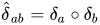
For a given input symbol , one may construct a transition function by defining for all . (This trick is called currying.) From this perspective, "acts" on a state in Q to yield another state. One may then consider the result of function composition repeatedly applied to the various functions , , and so on. Given a pair of letters , one may define a new function , where denotes function composition.
Clearly, this process may be recursively continued, giving the following recursive definition of :
is defined for all words . A run of the DFA is a sequence of compositions of with itself.
Repeated function composition forms a monoid. For the transition functions, this monoid is known as the transition monoid, or sometimes the transformation semigroup. The construction can also be reversed: given a , one can reconstruct a , and so the two descriptions are equivalent.
DFAs are one of the most practical models of computation, since there is a trivial linear time, constant-space, online algorithm to simulate a DFA on a stream of input. Also, there are efficient algorithms to find a DFA recognizing:
Because DFAs can be reduced to a canonical form (minimal DFAs), there are also efficient algorithms to determine:
DFAs are equivalent in computing power to nondeterministic finite automata (NFAs). This is because, firstly any DFA is also an NFA, so an NFA can do what a DFA can do. Also, given an NFA, using the powerset construction one can build a DFA that recognizes the same language as the NFA, although the DFA could have exponentially larger number of states than the NFA.[15][16] However, even though NFAs are computationally equivalent to DFAs, the above-mentioned problems are not necessarily solved efficiently also for NFAs. The non-universality problem for NFAs is PSPACE complete since there are small NFAs with shortest rejecting word in exponential size. A DFA is universal if and only if all states are final states, but this does not hold for NFAs. The Equality, Inclusion and Minimization Problems are also PSPACE complete since they require forming the complement of an NFA which results in an exponential blow up of size.[17]
On the other hand, finite-state automata are of strictly limited power in the languages they can recognize; many simple languages, including any problem that requires more than constant space to solve, cannot be recognized by a DFA. The classic example of a simply described language that no DFA can recognize is bracket or Dyck language, i.e., the language that consists of properly paired brackets such as word "(()())". Intuitively, no DFA can recognize the Dyck language because DFAs are not capable of counting: a DFA-like automaton needs to have a state to represent any possible number of "currently open" parentheses, meaning it would need an unbounded number of states. Another simpler example is the language consisting of strings of the form anbn for some finite but arbitrary number of a's, followed by an equal number of b's.[18]
Given a set of positive words and a set of negative words one can construct a DFA that accepts all words from and rejects all words from : this problem is called DFA identification (synthesis, learning). While some DFA can be constructed in linear time, the problem of identifying a DFA with the minimal number of states is NP-complete.[19] The first algorithm for minimal DFA identification has been proposed by Trakhtenbrot and Barzdin[20] and is called the TB-algorithm. However, the TB-algorithm assumes that all words from up to a given length are contained in either .
Later, K. Lang proposed an extension of the TB-algorithm that does not use any assumptions about and , the Traxbar algorithm.[21] However, Traxbar does not guarantee the minimality of the constructed DFA. In his work[19] E.M. Gold also proposed a heuristic algorithm for minimal DFA identification. Gold's algorithm assumes that and contain a characteristic set of the regular language; otherwise, the constructed DFA will be inconsistent either with or . Other notable DFA identification algorithms include the RPNI algorithm,[22] the Blue-Fringe evidence-driven state-merging algorithm,[23] and Windowed-EDSM.[24] Another research direction is the application of evolutionary algorithms: the smart state labeling evolutionary algorithm[25] allowed to solve a modified DFA identification problem in which the training data (sets and ) is noisy in the sense that some words are attributed to wrong classes.
Yet another step forward is due to application of SAT solvers by Marjin J. H. Heule and S. Verwer: the minimal DFA identification problem is reduced to deciding the satisfiability of a Boolean formula.[26] The main idea is to build an augmented prefix-tree acceptor (a trie containing all input words with corresponding labels) based on the input sets and reduce the problem of finding a DFA with states to coloring the tree vertices with states in such a way that when vertices with one color are merged to one state, the generated automaton is deterministic and complies with and . Though this approach allows finding the minimal DFA, it suffers from exponential blow-up of execution time when the size of input data increases. Therefore, Heule and Verwer's initial algorithm has later been augmented with making several steps of the EDSM algorithm prior to SAT solver execution: the DFASAT algorithm.[27] This allows reducing the search space of the problem, but leads to loss of the minimality guarantee. Another way of reducing the search space has been proposed by Ulyantsev et al.[28] by means of new symmetry breaking predicates based on the breadth-first search algorithm: the sought DFA's states are constrained to be numbered according to the BFS algorithm launched from the initial state. This approach reduces the search space by by eliminating isomorphic automata.
Read-only right-moving Turing machines are a particular type of Turing machine that only moves right; these are almost exactly equivalent to DFAs.[29] The definition based on a singly infinite tape is a 7-tuple
where
The machine always accepts a regular language. There must exist at least one element of the set F (a HALT state) for the language to be nonempty.
| Current state A | Current state B | Current state C | |||||||
| tape symbol | Write symbol | Move tape | Next state | Write symbol | Move tape | Next state | Write symbol | Move tape | Next state |
|---|---|---|---|---|---|---|---|---|---|
| 0 | 1 | R | B | 1 | R | A | 1 | R | B |
| 1 | 1 | R | C | 1 | R | B | 1 | N | HALT |
Source: Wikipedia. Article content is retrieved live through the MediaWiki API.
In the theory of computation, a branch of theoretical computer science, a deterministic finite automaton (DFA) is a finite-state machine that accepts or rejects a given string of symbols, by running through a state sequence uniquely determined by the string. Deterministic refers to the uniqueness of the computation run. It is also known as a deterministic finite acceptor (DFA), deterministic finite-state machine (DFSM), or deterministic finite-state automaton (DFSA). In search of the simplest models to capture finite-state machines, Warren McCulloch and Walter Pitts were among the first researchers to introduce a concept similar to finite automata in 1943. The figure illustrates a deterministic finite automaton using a state diagram. In this example automaton, there are three states: S0, S1, and S2 (denoted graphically by circles). The automaton takes a finite sequence of 0s and 1s as input. For each state, there is a transition arrow leading out to a next state for both 0 and 1. Upon reading a symbol, a DFA jumps deterministically from one state to another by following the transition arrow. For example, if the automaton is currently in state S0 and the current input symbol is 1, then it deterministically jumps to state S1. A DFA has a start state (denoted graphically by an arrow coming in from nowhere) where computations begin, and a set of accept states (denoted graphically by a double circle) which help define when a computation is successful. A DFA is defined as an abstract mathematical concept, but is often implemented in hardware and software for solving various specific problems such as lexical analysis and pattern matching. For example, a DFA can model software that decides whether or not online user input such as email addresses are syntactically valid. DFAs have been generalized to nondeterministic finite automata (NFA) which may have several arrows of the same label starting from a state. Using the powerset construction method, every NFA can be translated to a DFA that recognizes the same language. DFAs, and NFAs as well, recognize exactly the set of regular languages.
In the automata theory, a tagged deterministic finite automaton (TDFA) is an extension of deterministic finite automaton (DFA). In addition to solving the recognition problem for regular languages, TDFA is also capable of submatch extraction and parsing. While canonical DFA can find out if a string belongs to the language defined by a regular expression, TDFA can also extract substrings that match specific subexpressions. More generally, TDFA can identify positions in the input string that match tagged positions in a regular expression (tags are meta-symbols similar to capturing parentheses, but without the pairing requirement).
In automata theory, a finite-state machine is called a deterministic finite automaton (DFA), if each of its transitions is uniquely determined by its source state and input symbol, and reading an input symbol is required for each state transition. A nondeterministic finite automaton (NFA), or nondeterministic finite-state machine, does not need to obey these restrictions. In particular, every DFA is also an NFA. Sometimes the term NFA is used in a narrower sense, referring to an NFA that is not a DFA, but not in this article. Using the subset construction algorithm, each NFA can be translated to an equivalent DFA; i.e., a DFA recognizing the same formal language. Like DFAs, NFAs only recognize regular languages. NFAs were introduced in 1959 by Michael O. Rabin and Dana Scott, who also showed their equivalence to DFAs. NFAs are used in the implementation of regular expressions: Thompson's construction is an algorithm for compiling a regular expression to an NFA that can efficiently perform pattern matching on strings. Conversely, Kleene's algorithm can be used to convert an NFA into a regular expression (whose size is generally exponential in the input automaton). NFAs have been generalized in multiple ways, e.g., nondeterministic finite automata with ε-moves, finite-state transducers, pushdown automata, alternating automata, ω-automata, and probabilistic automata. Besides the DFAs, other known special cases of NFAs are unambiguous finite automata (UFA) and self-verifying finite automata (SVFA).

In computer science, a deterministic acyclic finite state automaton (DAFSA), is a data structure that represents a set of strings, and allows for a query operation that tests whether a given string belongs to the set in time proportional to its length. Algorithms exist to construct and maintain such automata, while keeping them minimal. DAFSA is the rediscovery of a data structure called Directed Acyclic Word Graph (DAWG), although the same name had already been given to a different data structure which is related to suffix automaton. A DAFSA is a special case of a finite state recognizer that takes the form of a directed acyclic graph with a single source vertex (a vertex with no incoming edges), in which each edge of the graph is labeled by a letter or symbol, and in which each vertex has at most one outgoing edge for each possible letter or symbol. The strings represented by the DAFSA are formed by the symbols on paths in the graph from the source vertex to any sink vertex (a vertex with no outgoing edges). In fact, a deterministic finite state automaton is acyclic if and only if it recognizes a finite set of strings.
Before the 1921 destruction of Tulsa’s Greenwood District, Black residents had created a remarkable center of business and community life. The district included stores, professional offices, entertainment venues and homes owned by Black citizens. Understanding Greenwood means learning what was built—not only what was burned.
MORE →Madam C.J. Walker