Civil Rights
Movements, leaders, victories and the continuing fight for equality.

Explore the people, places, events, achievements, struggles and stories that shaped our journey.
Movements, leaders, victories and the continuing fight for equality.
Innovation, patents, science, technology and world-changing contributions.
Pioneers, champions, Negro Leagues, records, activism and excellence.
Meet the people whose lives, choices and achievements shaped the journey.
Black towns, communities, institutions and places where history happened.
Moments that changed communities, movements, institutions and the nation.
In 1968 Shirley Chisholm became the first Black woman elected to the United States Congress. In 1972 she launched a campaign for the Democratic presidential nomination, breaking another political barrier.
MORE →Reflects the personal views, recollections, and perspective of the author, Mike Davis.
This is a personal recollection on the Move fire on May 13, 1985

In mathematical analysis, a real or complex function of a single variable is differentiable if its derivative exists at each point in its domain. For real-valued functions of a real variable, the graph of a differentiable function has a non-vertical tangent line at each interior point in its domain. A differentiable function is locally approximable by a linear function at each interior point, and does not contain any break, angle, or cusp.
If is an interior point in the domain of a real function , then is said to be differentiable at if there exists an such that for all , there exists a such that for all , . In other words, the graph of has a non-vertical tangent line at the point . is said to be differentiable on a subset if it is differentiable at every point in . is said to be continuously differentiable if its derivative is also a continuous function over the domain of .
Continuous functions may be nowhere differentiable in their domain, such as the Weierstrass function. Taking successive antiderivatives of such a function allows one to obtain a function that is differentiable only a finite number of times, the finite number being any positive integer. Given a positive integer , is said to be of class if its first derivatives exist and are continuous over the domain of .
For a multivariable function, as shown here, the differentiability of it is something more complex than the existence of the partial derivatives of it. However, the essence is the same; a function that is locally approximable by a linear map at is said to be differentiable at this point.
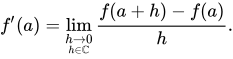
A function , defined on an open set , is said to be differentiable at if the derivative
exists. This implies that the function is continuous at a.
This function f is said to be differentiable on U if it is differentiable at every point of U. In this case, the derivative of f is thus a function from U into
A continuous function is not necessarily differentiable, but a differentiable function is necessarily continuous (at every point where it is differentiable) as is shown below (in the section Differentiability and continuity). A function is said to be continuously differentiable if its derivative is also a continuous function; there exist functions that are differentiable but not continuously differentiable (an example is given in the section Differentiability classes).
The above definition can be extended to define the derivative at boundary points of the domain that also belong to the domain. The derivative of a function defined on a closed subset of the real numbers, evaluated at a boundary point , can be defined as the following one-sided limit, where the argument approaches such that it is always within :
For to remain within , which is a subset of the reals, it follows that this limit will be defined as either


If f is differentiable at a point x0, then f must also be continuous at x0. In particular, any differentiable function must be continuous at every point in its domain. The converse does not hold: a continuous function need not be differentiable. For example, a function with a bend, cusp, or vertical tangent may be continuous, but fails to be differentiable at the location of the anomaly.
Most functions that occur in practice have derivatives at all points or at almost every point. However, a result of Stefan Banach states that the set of functions that have a derivative at some point is a meagre set in the space of all continuous functions.[1] Informally, this means that differentiable functions are very atypical among continuous functions. The first known example of a function that is continuous everywhere but differentiable nowhere is the Weierstrass function.


A function is said to be continuously differentiable if the derivative exists and is itself a continuous function. Although the derivative of a differentiable function never has a jump discontinuity, it is possible for the derivative to have an essential discontinuity. For example, the function is differentiable at 0, since exists. However, for differentiation rules imply which has no limit as Thus, this example shows the existence of a function that is differentiable but not continuously differentiable (i.e., the derivative is not a continuous function). Nevertheless, Darboux's theorem implies that the derivative of any function satisfies the conclusion of the intermediate value theorem.
Similarly to how continuous functions are said to be of class continuously differentiable functions are sometimes said to be of class . A function is of class if the first and second derivative of the function both exist and are continuous. More generally, a function is said to be of class if the first derivatives all exist and are continuous. If derivatives exist for all positive integers the function is smooth or equivalently, of class
A function of several real variables f: Rm → Rn is said to be differentiable at a point x0 if there exists a linear map M: Rm → Rn[Note 1] such that
where ||v|| for a vector v is the norm of it. If a function is differentiable at x0, then all of the partial derivatives exist at x0, and the linear map M is given by Jf ⋅ h, where Jf, the Jacobian matrix for f evaluated at x0 (an n × m matrix in this case), is left-multiplied to a vector h in Rm. A similar formulation of the higher-dimensional derivative is provided by the fundamental increment lemma.
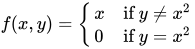
If all the partial derivatives of a function exist in a neighborhood of a point x0 and are continuous at the point x0[Note 2], then the function is differentiable at that point x0;[Note 3] The existence of the partial derivatives (or even of all the directional derivatives) does not guarantee that a function is differentiable at a point. For example, the function f: R2 → R defined by
is not differentiable at (0, 0) while all of the partial derivatives and directional derivatives exist at this point. For a continuous example, the function
is not differentiable at (0, 0), while again, all of the partial derivatives and directional derivatives exist.
In complex analysis, complex-differentiability is defined using the same definition as single-variable real functions. This is allowed because a complex number (typically expressed as ) can be divided by a complex number. So, a function is said to be differentiable at when
This limit exists only if the limit is same regardless of a choice of direction of approaching to . Although this definition looks similar to the differentiability of single-variable real functions, it is a more restrictive condition. A function that is complex-differentiable at a point is automatically differentiable at that point when viewed as a function .[Note 4] This is because complex differentiability implies
where is a linear map as in the definition of the differentiability of higher dimensional spaces above, and the absolute-value norm is used. However, a function that is differentiable as a multi-variable function may not be complex-differentiable, since not every linear map is expressible as multiplication by a complex number.
For example, the complex function corresponds to the 2-variable real function , which is differentiable at every point. This function is not complex-differentiable at any point, since the limit is different depending on the path of . A path along the real axis gives , while a path along the imaginary axis gives .
A function that is complex-differentiable in a neighborhood of a point is called holomorphic at that point. Such a function is necessarily analytic at that point. Conversely, any function that is analytic at a point is also holomorphic at that point.
If M is a differentiable manifold, a real or complex-valued function f on M is said to be differentiable at a point p if it is differentiable with respect to some (or any) coordinate chart defined around p. If M and N are differentiable manifolds, a function f: M → N is said to be differentiable at a point p if it is differentiable with respect to some (or any) coordinate charts defined around p and f(p).
Differentiable computing | |
|---|---|
| General | |
| Hardware | |
| Software libraries | |
| |
Source: Wikipedia. Article content is retrieved live through the MediaWiki API.

In mathematical analysis, a real or complex function of a single variable is differentiable if its derivative exists at each point in its domain. For real-valued functions of a real variable, the graph of a differentiable function has a non-vertical tangent line at each interior point in its domain. A differentiable function is locally approximable by a linear function at each interior point, and does not contain any break, angle, or cusp. If x 0 {\displaystyle x_{0}} is an interior point in the domain of a real function f {\displaystyle f} , then f {\displaystyle f} is said to be differentiable at x 0 {\displaystyle x_{0}} if there exists an L ∈ R {\displaystyle L\in \mathbb {R} } such that for all ϵ > 0 {\displaystyle \epsilon >0} , there exists a δ > 0 {\displaystyle \delta >0} such that for all x ∈ ( x 0 − δ , x 0 ) ∪ ( x 0 , x 0 + δ ) {\displaystyle x\in (x_{0}-\delta ,x_{0})\cup (x_{0},x_{0}+\delta )} , f ( x ) − f ( x 0 ) x − x 0 ∈ ( L − ϵ , L + ϵ ) {\displaystyle {\frac {f(x)-f(x_{0})}{x-x_{0}}}\in (L-\epsilon ,L+\epsilon )} . In other words, the graph of f {\displaystyle f} has a non-vertical tangent line at the point ( x 0 , f ( x 0 ) ) {\displaystyle (x_{0},f(x_{0}))} . f {\displaystyle f} is said to be differentiable on a subset U ⊆ R {\displaystyle U\subseteq \mathbb {R} } if it is differentiable at every point in U {\displaystyle U} . f {\displaystyle f} is said to be continuously differentiable if its derivative is also a continuous function over the domain of f {\textstyle f} . Continuous functions may be nowhere differentiable in their domain, such as the Weierstrass function. Taking successive antiderivatives of such a function allows one to obtain a function that is differentiable only a finite number of times, the finite number being any positive integer. Given a positive integer k {\displaystyle k} , f {\displaystyle f} is said to be of class C k {\displaystyle C^{k}} if its first k {\displaystyle k} derivatives f ′ , f ′ ′ , … , f ( k ) {\textstyle f^{\prime },f^{\prime \prime },\ldots ,f^{(k)}} exist and are continuous over the domain of f {\displaystyle f} . For a multivariable function, as shown here, the differentiability of it is something more complex than the existence of the partial derivatives of it. However, the essence is the same; a function that is locally approximable by a linear map at X 0 {\displaystyle \mathbf {X_{0}} } is said to be differentiable at this point.

In mathematics, the Weierstrass function, named after its discoverer, Karl Weierstrass, is an example of a real-valued function that is continuous everywhere but differentiable nowhere. It is also an example of a fractal curve. The Weierstrass function has historically served the role of a pathological function, being the first published example (1872) specifically concocted to challenge the notion that every continuous function is differentiable except on a set of isolated points. Weierstrass's demonstration that continuity did not imply almost-everywhere differentiability upended mathematics, overturning several proofs that relied on geometric intuition and vague definitions of smoothness. These types of functions were disliked by contemporaries. For instance, Charles Hermite, on finding that one class of function he was working on had such a property, described it as a "lamentable scourge". The functions were difficult to visualize until the arrival of computers in the next century, and the results did not gain wide acceptance until practical applications such as models of Brownian motion necessitated infinitely jagged functions (nowadays known as fractal curves).

In mathematics, a real-valued function is called convex if the line segment between any two distinct points on the graph of the function lies above or on the graph of the function between the two points. Equivalently, a function is convex if its epigraph (the set of points on or above the graph of the function) is a convex set. In simple terms, a convex function graph is shaped like a cup ∪ {\displaystyle \cup } (or a straight line like a linear function), while a concave function's graph is shaped like a cap ∩ {\displaystyle \cap } . A twice-differentiable function of a single variable is convex if and only if its second derivative is nonnegative on its entire domain. Well-known examples of convex functions of a single variable include a linear function f ( x ) = c x {\displaystyle f(x)=cx} (where c {\displaystyle c} is a real number), a quadratic function c x 2 {\displaystyle cx^{2}} ( c {\displaystyle c} as a nonnegative real number) and an exponential function c e x {\displaystyle ce^{x}} ( c {\displaystyle c} as a nonnegative real number). Convex functions play an important role in many areas of mathematics. They are especially important in the study of optimization problems where they are distinguished by a number of convenient properties. For instance, a strictly convex function on an open set has no more than one minimum. Even in infinite-dimensional spaces, under suitable additional hypotheses, convex functions continue to satisfy such properties and as a result, they are the most well-understood functionals in the calculus of variations. In probability theory, a convex function applied to the expected value of a random variable is always bounded above by the expected value of the convex function of the random variable. This result, known as Jensen's inequality, can be used to deduce inequalities such as the arithmetic–geometric mean inequality and Hölder's inequality.

In mathematical analysis, the inverse function theorem gives sufficient conditions for a function to have an inverse function. The essential idea is that if the best linear approximation to the function at a point is invertible, then with sufficient regularity assumptions, the function should also be invertible near that point. In its simplest form, the theorem states that if a real function f is differentiable in an open interval, with a continuous derivative, then in a neighborhood of any point where the derivative is not zero, f has an inverse function. The inverse function is also continuously differentiable, and the inverse function rule expresses its derivative as the multiplicative inverse of the derivative of f. The theorem applies verbatim to complex-valued functions of a complex variable. It generalizes to functions from n-tuples (of real or complex numbers) to n-tuples, and to functions between vector spaces of the same finite dimension, by replacing "derivative" with "Jacobian matrix" and "nonzero derivative" with "nonzero Jacobian determinant". If the function of the theorem belongs to a higher differentiability class, the same is true for the inverse function. There are also versions of the inverse function theorem for holomorphic functions, for differentiable maps between manifolds, for differentiable functions between Banach spaces, and so forth. The theorem was first established by Picard and Goursat using an iterative scheme: the basic idea is to prove a fixed point theorem using the contraction mapping theorem.
Before the 1921 destruction of Tulsa’s Greenwood District, Black residents had created a remarkable center of business and community life. The district included stores, professional offices, entertainment venues and homes owned by Black citizens. Understanding Greenwood means learning what was built—not only what was burned.
MORE →Brown v. Board of Education in 1954.