Civil Rights
Movements, leaders, victories and the continuing fight for equality.

Explore the people, places, events, achievements, struggles and stories that shaped our journey.
Movements, leaders, victories and the continuing fight for equality.
Innovation, patents, science, technology and world-changing contributions.
Pioneers, champions, Negro Leagues, records, activism and excellence.
Meet the people whose lives, choices and achievements shaped the journey.
Black towns, communities, institutions and places where history happened.
Moments that changed communities, movements, institutions and the nation.
In August 1908, a white mob attacked Springfield, Illinois’s Black community, destroying homes and businesses and lynching two Black men. National outrage over the violence helped spur the movement that created the NAACP the following year.
MORE →Reflects the personal views, recollections, and perspective of the author, Mike Davis.
This is a personal recollection on the Move fire on May 13, 1985
 | This article provides insufficient context for those unfamiliar with the subject. (September 2016) |
Directed information is an information theory measure that quantifies the information flow from the random string to the random string . The term directed information was coined by James Massey and is defined as[1]
where is the conditional mutual information .
Directed information has applications to problems where causality plays an important role such as the capacity of channels with feedback,[1][2][3][4] capacity of discrete memoryless networks,[5] capacity of networks with in-block memory,[6] gambling with causal side information,[7] compression with causal side information,[8] real-time control communication settings,[9][10][11] and statistical physics.[12]
The essence of directed information is causal conditioning. The probability of causally conditioned on is defined as[5]
This is similar to the chain rule for conventional conditioning except one conditions on "past" and "present" symbols rather than all symbols . To include "past" symbols only, one can introduce a delay by prepending a constant symbol:
It is common to abuse notation by writing for this expression, although formally all strings should have the same number of symbols.
One may also condition on multiple strings: .
The causally conditioned entropy is defined as:[2]
Similarly, one may causally condition on multiple strings and write .
A decomposition rule for causal conditioning[1] is
This rule shows that any product of gives a joint distribution .
The causal conditioning probability is a probability vector, i.e.,
Directed Information can be written in terms of causal conditioning:[2]
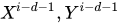
The relation generalizes to three strings: the directed information flowing from to causally conditioned on is
This law, established by James Massey and his son Peter Massey,[13] gives intuition by relating directed information and mutual information. The law states that for any , the following equality holds:
Two alternative forms of this law are[2][14]
where .
Estimating and optimizing the directed information is challenging because it has terms where may be large. In many cases, one is interested in optimizing the limiting average, that is, when grows to infinity termed as a multi-letter expression.
Estimating directed information from samples is a hard problem since the directed information expression does not depend on samples but on the joint distribution which may be unknown. There are several algorithms based on context tree weighting[15] and empirical parametric distributions[16] and using long short-term memory.[17]
Maximizing directed information is a fundamental problem in information theory. For example, given the channel distributions , the objective might be to optimize over the channel input distributions .
There are algorithms to optimize the directed information based on the Blahut-Arimoto,[18] Markov decision process,[19][20][21][22][23] Recurrent neural network,[17] Reinforcement learning.[24] and Graphical methods (the Q-graphs).[25][26][23] For the Blahut-Arimoto algorithm,[18] the main idea is to start with the last mutual information of the directed information expression and go backward. For the Markov decision process,[19][20][21][22] the main ideas is to transform the optimization into an infinite horizon average reward Markov decision process. For a Recurrent neural network,[17] the main idea is to model the input distribution using a Recurrent neural network and optimize the parameters using Gradient descent. For Reinforcement learning,[24] the main idea is to solve the Markov decision process formulation of the capacity using Reinforcement learning tools, which lets one deal with large or even continuous alphabets.
Massey's directed information was motivated by Marko's early work (1966) on developing a theory of bidirectional communication.[27][28] Marko's definition of directed transinformation differs slightly from Massey's in that, at time , one conditions on past symbols only and one takes limits:
Marko defined several other quantities, including:
The total information is usually called an entropy rate. Marko showed the following relations for the problems he was interested in:
He also defined quantities he called residual entropies:
and developed the conservation law and several bounds.
Directed information is related to transfer entropy, which is a truncated version of Marko's directed transinformation .
The transfer entropy at time and with memory is
where one does not include the present symbol or the past symbols before time .
Transfer entropy usually assumes stationarity, i.e., does not depend on the time .

The information matrix (InfoMat) is a matrix-valued representation introduced as a visualization and analysis tool for information transfer in sequential systems. For two sequences and , the InfoMat arranges the conditional mutual information terms into an matrix, capturing the full mutual information decomposition across time. Within this representation, the directed information corresponds to the sum of a triangular sub-matrix, providing a direct visual interpretation of causal information flow. The InfoMat framework unifies directed information, transfer entropy, and related information conservation laws, and enables their interpretation through matrix structure and heatmap visualizations.[29]
Source: Wikipedia. Article content is retrieved live through the MediaWiki API.
Directed information is an information theory measure that quantifies the information flow from the random string X n = ( X 1 , X 2 , … , X n ) {\displaystyle X^{n}=(X_{1},X_{2},\dots ,X_{n})} to the random string Y n = ( Y 1 , Y 2 , … , Y n ) {\displaystyle Y^{n}=(Y_{1},Y_{2},\dots ,Y_{n})} . The term directed information was coined by James Massey and is defined as I ( X n → Y n ) ≜ ∑ i = 1 n I ( X i ; Y i | Y i − 1 ) {\displaystyle I(X^{n}\to Y^{n})\triangleq \sum _{i=1}^{n}I(X^{i};Y_{i}|Y^{i-1})} where I ( X i ; Y i | Y i − 1 ) {\displaystyle I(X^{i};Y_{i}|Y^{i-1})} is the conditional mutual information I ( X 1 , X 2 , . . . , X i ; Y i | Y 1 , Y 2 , . . . , Y i − 1 ) {\displaystyle I(X_{1},X_{2},...,X_{i};Y_{i}|Y_{1},Y_{2},...,Y_{i-1})} . Directed information has applications to problems where causality plays an important role such as the capacity of channels with feedback, capacity of discrete memoryless networks, capacity of networks with in-block memory, gambling with causal side information, compression with causal side information, real-time control communication settings, and statistical physics.
Transfer entropy is a non-parametric statistic measuring the amount of directed (time-asymmetric) transfer of information between two random processes. Transfer entropy from a process X to another process Y is the amount of uncertainty reduced in future values of Y by knowing the past values of X given past values of Y. More specifically, if X t {\displaystyle X_{t}} and Y t {\displaystyle Y_{t}} for t ∈ N {\displaystyle t\in \mathbb {N} } denote two random processes and the amount of information is measured using Shannon's entropy, the transfer entropy can be written as: T X → Y = H ( Y t ∣ Y t − 1 : t − L ) − H ( Y t ∣ Y t − 1 : t − L , X t − 1 : t − L ) , {\displaystyle T_{X\rightarrow Y}=H\left(Y_{t}\mid Y_{t-1:t-L}\right)-H\left(Y_{t}\mid Y_{t-1:t-L},X_{t-1:t-L}\right),} where H(X) is Shannon's entropy of X. The above definition of transfer entropy has been extended by other types of entropy measures such as Rényi entropy. Transfer entropy is conditional mutual information, with the history of the influenced variable Y t − 1 : t − L {\displaystyle Y_{t-1:t-L}} in the condition: T X → Y = I ( Y t ; X t − 1 : t − L ∣ Y t − 1 : t − L ) . {\displaystyle T_{X\rightarrow Y}=I(Y_{t};X_{t-1:t-L}\mid Y_{t-1:t-L}).} Transfer entropy reduces to Granger causality for vector auto-regressive processes. Hence, it is advantageous when the model assumption of Granger causality doesn't hold, for example, analysis of non-linear signals. However, it usually requires more samples for accurate estimation. The probabilities in the entropy formula can be estimated using different approaches (binning, nearest neighbors) or, in order to reduce complexity, using a non-uniform embedding. While it was originally defined for bivariate analysis, transfer entropy has been extended to multivariate forms, either conditioning on other potential source variables or considering transfer from a collection of sources, although these forms require more samples again. Transfer entropy has been used for estimation of functional connectivity of neurons, social influence in social networks and statistical causality between armed conflict events. Transfer entropy is a finite version of the directed information which was defined in 1990 by James Massey as I ( X n → Y n ) = ∑ i = 1 n I ( X i ; Y i | Y i − 1 ) {\displaystyle I(X^{n}\to Y^{n})=\sum _{i=1}^{n}I(X^{i};Y_{i}|Y^{i-1})} , where X n {\displaystyle X^{n}} denotes the vector X 1 , X 2 , . . . , X n {\displaystyle X_{1},X_{2},...,X_{n}} and Y n {\displaystyle Y^{n}} denotes Y 1 , Y 2 , . . . , Y n {\displaystyle Y_{1},Y_{2},...,Y_{n}} . The directed information places an important role in characterizing the fundamental limits (channel capacity) of communication channels with or without feedback and gambling with causal side information.

In mathematics, particularly graph theory, and computer science, a directed acyclic graph (DAG) is a directed graph with no directed cycles. That is, it consists of vertices and edges (also called arcs), with each edge directed from one vertex to another, such that following those directions will never form a closed loop. A directed graph is a DAG if and only if it can be topologically ordered, by arranging the vertices as a linear ordering that is consistent with all edge directions. DAGs have numerous scientific and computational applications, ranging from biology (evolution, family trees, epidemiology) to information science (citation networks) to computation (scheduling). Directed acyclic graphs are also called acyclic directed graphs or acyclic digraphs.
Information theory is the mathematical study of the quantification, storage, and communication of a particular type of mathematically defined information. The field was established and formalized by Claude Shannon in the 1940s, though early contributions were made in the 1920s through the works of Harry Nyquist and Ralph Hartley. Information theory was initially formed in the context of telecommunication but soon found a wide range of other applications. It is now at the intersection of mathematics, statistics and computer science, and has applications in diverse fields ranging from electrical engineering and physics to neurobiology. As a simple example of the concept, if one flips a fair coin and does not yet know the outcome (heads or tails), then one lacks a certain amount of information. After looking at the coin, one gains information about the outcome. For a fair coin, the probability of either heads or tails is 1/2 and the amount of information is expressed as − log 2 ( 1 / 2 ) {\displaystyle -\log _{2}(1/2)} = 1 bit of information. A key concept in information theory is entropy. In Shannon's formulation, entropy is equal to the lack of information about an event. In the above coin flip example, the entropy in the case where you don't know the outcome is 1 bit. When you know the outcome after the coin has landed, the entropy is zero because you have gained one bit. Information theory has been used in a wide range of applications, such as source coding/data compression (e.g. for ZIP files), and channel coding/error detection and correction (e.g. for DSL). Its impact has been crucial to the success of the Voyager missions to deep space, the invention of the compact disc, the feasibility of mobile phones and the development of the Internet and artificial intelligence. The theory has also found applications in other areas, including statistical inference, cryptography, neurobiology, perception, signal processing, linguistics, the evolution and function of molecular codes (bioinformatics), thermal physics, molecular dynamics, black holes, quantum computing, information retrieval, intelligence gathering, plagiarism detection, pattern recognition, anomaly detection, the analysis of music, art creation, imaging system design, study of outer space, the dimensionality of space, and epistemology.
Before the 1921 destruction of Tulsa’s Greenwood District, Black residents had created a remarkable center of business and community life. The district included stores, professional offices, entertainment venues and homes owned by Black citizens. Understanding Greenwood means learning what was built—not only what was burned.
MORE →Shirley Chisholm, elected in 1968.