Civil Rights
Movements, leaders, victories and the continuing fight for equality.

Explore the people, places, events, achievements, struggles and stories that shaped our journey.
Movements, leaders, victories and the continuing fight for equality.
Innovation, patents, science, technology and world-changing contributions.
Pioneers, champions, Negro Leagues, records, activism and excellence.
Meet the people whose lives, choices and achievements shaped the journey.
Black towns, communities, institutions and places where history happened.
Moments that changed communities, movements, institutions and the nation.
In August 1908, a white mob attacked Springfield, Illinois’s Black community, destroying homes and businesses and lynching two Black men. National outrage over the violence helped spur the movement that created the NAACP the following year.
MORE →Reflects the personal views, recollections, and perspective of the author, Mike Davis.
This is a personal recollection on the Move fire on May 13, 1985

In geometry, the director circle of an ellipse or hyperbola (also called the orthoptic circle or Fermat–Apollonius circle) is a circle consisting of all points where two perpendicular tangent lines to the ellipse or hyperbola cross each other.
The director circle of an ellipse circumscribes the minimum bounding box of the ellipse. It has the same center as the ellipse, with radius , where and are the semi-major axis and semi-minor axis of the ellipse. Additionally, it has the property that, when viewed from any point on the circle, the ellipse spans a right angle.[1]
The director circle of a hyperbola has radius , and so, may not exist in the Euclidean plane, but could be a circle with imaginary radius in the complex plane.
The director circle of a circle is a concentric circle having radius times the radius of the original circle.
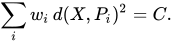
More generally, for any collection of points Pi, weights wi, and constant C, one can define a circle as the locus of points X such that
The director circle of an ellipse is a special case of this more general construction with two points P1 and P2 at the foci of the ellipse, weights w1 = w2 = 1, and C equal to the square of the major axis of the ellipse. The Apollonius circle, the locus of points X such that the ratio of distances of X to two foci P1 and P2 is a fixed constant r, is another special case, with w1 = 1, w2 = –r 2, and C = 0.
In the case of a parabola the director circle degenerates to a straight line, the directrix of the parabola.[2]
Source: Wikipedia. Article content is retrieved live through the MediaWiki API.

In geometry, the director circle of an ellipse or hyperbola (also called the orthoptic circle or Fermat–Apollonius circle) is a circle consisting of all points where two perpendicular tangent lines to the ellipse or hyperbola cross each other.

The London Film Critics' Circle Award for Director of the Year is an annual award given by the London Film Critics' Circle.

The New York Film Critics Circle Award for Best Director is an award given by the New York Film Critics Circle, honoring the finest achievements in filmmaking.

The Upper Saxon Circle (German: Obersächsischer Reichskreis) was an imperial circle of the Holy Roman Empire, created in 1512. The circle was dominated by the electorate of Saxony (the circle's director) and the electorate of Brandenburg. It further comprised the Saxon Ernestine duchies and Pomerania. The Lusatias that fell to Saxony by the 1635 Peace of Prague were never encircled.
Before the 1921 destruction of Tulsa’s Greenwood District, Black residents had created a remarkable center of business and community life. The district included stores, professional offices, entertainment venues and homes owned by Black citizens. Understanding Greenwood means learning what was built—not only what was burned.
MORE →Joe Louis.