Civil Rights
Movements, leaders, victories and the continuing fight for equality.

Explore the people, places, events, achievements, struggles and stories that shaped our journey.
Movements, leaders, victories and the continuing fight for equality.
Innovation, patents, science, technology and world-changing contributions.
Pioneers, champions, Negro Leagues, records, activism and excellence.
Meet the people whose lives, choices and achievements shaped the journey.
Black towns, communities, institutions and places where history happened.
Moments that changed communities, movements, institutions and the nation.
Katherine Johnson’s mathematical calculations helped guide some of America’s most important early space missions while she confronted the racial and gender barriers faced by Black women in twentieth-century America.
MORE →Reflects the personal views, recollections, and perspective of the author, Mike Davis.
This is a personal recollection on the Move fire on May 13, 1985

In mathematics, the Dirichlet beta function (also known as the Catalan beta function) is a special function, closely related to the Riemann zeta function. It is a particular Dirichlet L-function, the L-function for the alternating character of period four.
The Dirichlet beta function is defined as
or, equivalently,
In each case, it is assumed that Re(s) > 0.
Alternatively, the following definition, in terms of the Hurwitz zeta function, is valid in the whole complex s-plane:[1]
Another equivalent definition, in terms of the Lerch transcendent, is:
which is once again valid for all complex values of s.
The Dirichlet beta function can also be written in terms of the polylogarithm function:
Also the series representation of Dirichlet beta function can be formed in terms of the polygamma function
but this formula is only valid at positive integer values of .
It is also the simplest example of a series non-directly related to which can also be factorized as an Euler product, thus leading to the idea of Dirichlet character defining the exact set of Dirichlet series having a factorization over the prime numbers.
At least for Re(s) ≥ 1:
where p≡1 mod 4 are the primes of the form 4n+1 (5,13,17,...) and p≡3 mod 4 are the primes of the form 4n+3 (3,7,11,...). This can be written compactly as
The functional equation extends the beta function to the left side of the complex plane Re(s) ≤ 0. It is given by
where is the gamma function. It was conjectured by Euler in 1749 and proved by Malmsten in 1842.[2]
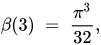
For every odd positive integer , the following equation holds:[3]
where is the n-th Euler Number. This yields:
For the values of the Dirichlet beta function at even positive integers no elementary closed form is known, and no method has yet been found for determining the arithmetic nature of even beta values (similarly to the Riemann zeta function at odd integers greater than 3). The number is known as Catalan's constant.
It has been proven that infinitely many numbers of the form [4] and at least one of the numbers are irrational.[5]
The even beta values may be given in terms of the polygamma functions and the Bernoulli numbers:[6]
We can also express the beta function for positive in terms of the inverse tangent integral:
For every positive integer k:[citation needed]
where is the Euler zigzag number.
| s | approximate value β(s) | OEIS |
|---|---|---|
| 1 | 0.7853981633974483096156608 | A003881 |
| 2 | 0.9159655941772190150546035 | A006752 |
| 3 | 0.9689461462593693804836348 | A153071 |
| 4 | 0.9889445517411053361084226 | A175572 |
| 5 | 0.9961578280770880640063194 | A175571 |
| 6 | 0.9986852222184381354416008 | A175570 |
| 7 | 0.9995545078905399094963465 | A258814 |
| 8 | 0.9998499902468296563380671 | A258815 |
| 9 | 0.9999496841872200898213589 | A258816 |
For negative odd integers, the function is zero:
For every negative even integer it holds:[3]
It further is:
We have:[3]
with being Euler's constant, being the Lemniscate constant and being Catalan's constant. The last identity was derived by Malmsten in 1842.[2]
Source: Wikipedia. Article content is retrieved live through the MediaWiki API.

In mathematics, the Dirichlet beta function (also known as the Catalan beta function) is a special function, closely related to the Riemann zeta function. It is a particular Dirichlet L-function, the L-function for the alternating character of period four.

In mathematics, the Clausen function, introduced by Thomas Clausen (1832), is a transcendental, special function of a single variable. It can be expressed in the form of a definite integral, a trigonometric series, and various other forms. It is intimately connected with the polylogarithm, inverse tangent integral, polygamma function, Riemann zeta function, Dirichlet eta function, and Dirichlet beta function. The Clausen function of order 2 – often referred to as the Clausen function, despite being but one of a class of many – is given by the integral: Cl 2 ( φ ) = − ∫ 0 φ log | 2 sin x 2 | d x {\displaystyle \operatorname {Cl} _{2}(\varphi )=-\int _{0}^{\varphi }\log \left|2\sin {\frac {x}{2}}\right|\,dx} where log denotes the natural logarithm. In the range 0 < φ < 2 π {\displaystyle 0

In mathematics, Catalan's constant G is the alternating sum of the reciprocals of the odd square numbers: G = ∑ n = 0 ∞ ( − 1 ) n ( 2 n + 1 ) 2 = 1 1 2 − 1 3 2 + 1 5 2 − 1 7 2 + 1 9 2 − ⋯ . {\displaystyle G=\sum _{n=0}^{\infty }{\frac {(-1)^{n}}{(2n+1)^{2}}}={\frac {1}{1^{2}}}-{\frac {1}{3^{2}}}+{\frac {1}{5^{2}}}-{\frac {1}{7^{2}}}+{\frac {1}{9^{2}}}-\cdots .} Its numerical value is approximately (sequence A006752 in the OEIS) G = 0.915965594177219015054603514932384110774..., and it is also equal to β(2), where β is the Dirichlet beta function. Catalan's constant was named after Eugène Charles Catalan, who found quickly-converging series for its calculation and published a memoir on it in 1865.
In mathematics, the Leibniz formula for π, named after Gottfried Wilhelm Leibniz, states that π 4 = 1 − 1 3 + 1 5 − 1 7 + 1 9 − ⋯ = ∑ k = 0 ∞ ( − 1 ) k 2 k + 1 , {\displaystyle {\frac {\pi }{4}}=1-{\frac {1}{3}}+{\frac {1}{5}}-{\frac {1}{7}}+{\frac {1}{9}}-\cdots =\sum _{k=0}^{\infty }{\frac {(-1)^{k}}{2k+1}},} an alternating series. It is sometimes called the Madhava–Leibniz series as it was first discovered by the Indian mathematician Madhava of Sangamagrama or his followers in the 14th–15th century (see Madhava series), and was later independently rediscovered by James Gregory in 1671 and Leibniz in 1673. The Taylor series for the inverse tangent function, often called Gregory's series, is arctan x = x − x 3 3 + x 5 5 − x 7 7 + ⋯ = ∑ k = 0 ∞ ( − 1 ) k x 2 k + 1 2 k + 1 . {\displaystyle \arctan x=x-{\frac {x^{3}}{3}}+{\frac {x^{5}}{5}}-{\frac {x^{7}}{7}}+\cdots =\sum _{k=0}^{\infty }{\frac {(-1)^{k}x^{2k+1}}{2k+1}}.} The Leibniz formula is the special case arctan 1 = π/4. It also is the Dirichlet L-series of the non-principal Dirichlet character of modulus 4 evaluated at s = 1, and therefore the value β(1) of the Dirichlet beta function.
Before the 1921 destruction of Tulsa’s Greenwood District, Black residents had created a remarkable center of business and community life. The district included stores, professional offices, entertainment venues and homes owned by Black citizens. Understanding Greenwood means learning what was built—not only what was burned.
MORE →Joe Louis.