Civil Rights
Movements, leaders, victories and the continuing fight for equality.

Explore the people, places, events, achievements, struggles and stories that shaped our journey.
Movements, leaders, victories and the continuing fight for equality.
Innovation, patents, science, technology and world-changing contributions.
Pioneers, champions, Negro Leagues, records, activism and excellence.
Meet the people whose lives, choices and achievements shaped the journey.
Black towns, communities, institutions and places where history happened.
Moments that changed communities, movements, institutions and the nation.
Wilmington, North Carolina once had a thriving Black middle class and an elected interracial government. In 1898 white supremacists used violence to overthrow that government, kill Black residents and drive many others from the city.
MORE →Reflects the personal views, recollections, and perspective of the author, Mike Davis.
This is a personal recollection on the Move fire on May 13, 1985
In mathematics, a nonlinear eigenproblem, sometimes nonlinear eigenvalue problem, is a generalization of the (ordinary) eigenvalue problem to equations that depend nonlinearly on the eigenvalue. Specifically, it refers to equations of the form
where is a vector, and is a matrix-valued function of the number . The number is known as the (nonlinear) eigenvalue, the vector as the (nonlinear) eigenvector, and as the eigenpair. The matrix is singular at an eigenvalue .
In the discipline of numerical linear algebra the following definition is typically used.[1][2][3][4]
Let , and let be a function that maps scalars to matrices. A scalar is called an eigenvalue, and a nonzero vector is called a right eigenvector if . Moreover, a nonzero vector is called a left eigenvector if , where the superscript denotes the Hermitian transpose. The definition of the eigenvalue is equivalent to , where denotes the determinant.[1]
The function is usually required to be a holomorphic function of (in some domain ).
In general, could be a linear map, but most commonly it is a finite-dimensional, usually square, matrix.
Definition: The problem is said to be regular if there exists a such that . Otherwise it is said to be singular.[1][4]
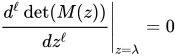
Definition: An eigenvalue is said to have algebraic multiplicity if is the smallest integer such that the th derivative of with respect to , in is nonzero. In formulas that but for .[1][4]
Definition: The geometric multiplicity of an eigenvalue is the dimension of the nullspace of .[1][4]
The following examples are special cases of the nonlinear eigenproblem.
Definition: Let be an eigenpair. A tuple of vectors is called a Jordan chain iffor , where denotes the th derivative of with respect to and evaluated in . The vectors are called generalized eigenvectors, is called the length of the Jordan chain, and the maximal length a Jordan chain starting with is called the rank of .[1][4]
Theorem:[1] A tuple of vectors is a Jordan chain if and only if the function has a root in and the root is of multiplicity at least for , where the vector valued function is defined as
Eigenvector nonlinearities is a related, but different, form of nonlinearity that is sometimes studied. In this case the function maps vectors to matrices, or sometimes hermitian matrices to hermitian matrices.[13][14]
Source: Wikipedia. Article content is retrieved live through the MediaWiki API.
In mathematics, a nonlinear eigenproblem, sometimes nonlinear eigenvalue problem, is a generalization of the (ordinary) eigenvalue problem to equations that depend nonlinearly on the eigenvalue. Specifically, it refers to equations of the form M ( λ ) x = 0 , {\displaystyle M(\lambda )x=0,} where x ≠ 0 {\displaystyle x\neq 0} is a vector, and M {\displaystyle M} is a matrix-valued function of the number λ {\displaystyle \lambda } . The number λ {\displaystyle \lambda } is known as the (nonlinear) eigenvalue, the vector x {\displaystyle x} as the (nonlinear) eigenvector, and ( λ , x ) {\displaystyle (\lambda ,x)} as the eigenpair. The matrix M ( λ ) {\displaystyle M(\lambda )} is singular at an eigenvalue λ {\displaystyle \lambda } .

The finite-difference frequency-domain (FDFD) method is a numerical solution method for problems usually in electromagnetism and sometimes in acoustics, based on finite-difference approximations of the derivative operators in the differential equation being solved. While "FDFD" is a generic term describing all frequency-domain finite-difference methods, the title seems to mostly describe the method as applied to scattering problems. The method shares many similarities to the finite-difference time-domain (FDTD) method, so much so that the literature on FDTD can be directly applied. The method works by transforming Maxwell's equations (or other partial differential equation) for sources and fields at a constant frequency into matrix form A x = b {\displaystyle Ax=b} . The matrix A is derived from the wave equation operator, the column vector x contains the field components, and the column vector b describes the source. The method is capable of incorporating anisotropic materials, but off-diagonal components of the tensor require special treatment. Strictly speaking, there are at least two categories of "frequency-domain" problems in electromagnetism. One is to find the response to a current density J with a constant frequency ω, i.e. of the form J ( x ) e i ω t {\displaystyle \mathbf {J} (\mathbf {x} )e^{i\omega t}} , or a similar time-harmonic source. This frequency-domain response problem leads to an A x = b {\displaystyle Ax=b} system of linear equations as described above. An early description of a frequency-domain response FDTD method to solve scattering problems was published by Christ and Hartnagel (1987). Another is to find the normal modes of a structure (e.g. a waveguide) in the absence of sources: in this case the frequency ω is itself a variable, and one obtains an eigenproblem A x = λ x {\displaystyle Ax=\lambda x} (usually, the eigenvalue λ is ω2). An early description of an FDTD method to solve electromagnetic eigenproblems was published by Albani and Bernardi (1974).
In mathematics, the quadratic eigenvalue problem (QEP), is to find scalar eigenvalues λ {\displaystyle \lambda } , left eigenvectors y {\displaystyle y} and right eigenvectors x {\displaystyle x} such that Q ( λ ) x = 0 and y ∗ Q ( λ ) = 0 , {\displaystyle Q(\lambda )x=0~{\text{ and }}~y^{\ast }Q(\lambda )=0,} where Q ( λ ) = λ 2 M + λ C + K {\displaystyle Q(\lambda )=\lambda ^{2}M+\lambda C+K} , with matrix coefficients M , C , K ∈ C n × n {\displaystyle M,\,C,K\in \mathbb {C} ^{n\times n}} and we require that M ≠ 0 {\displaystyle M\,\neq 0} , (so that we have a nonzero leading coefficient). There are 2 n {\displaystyle 2n} eigenvalues that may be infinite or finite, and possibly zero. This is a special case of a nonlinear eigenproblem. Q ( λ ) {\displaystyle Q(\lambda )} is also known as a quadratic polynomial matrix.
QEP may refer to: Quadrature encoder pulse, in a rotary encoder Query plan or query execution plan, in a database software system Quadratic eigenvalue problem, a special case of nonlinear eigenproblem in mathematics QEP Resources, a defunct American energy company.
Before the 1921 destruction of Tulsa’s Greenwood District, Black residents had created a remarkable center of business and community life. The district included stores, professional offices, entertainment venues and homes owned by Black citizens. Understanding Greenwood means learning what was built—not only what was burned.
MORE →Madam C.J. Walker