Civil Rights
Movements, leaders, victories and the continuing fight for equality.

Explore the people, places, events, achievements, struggles and stories that shaped our journey.
Movements, leaders, victories and the continuing fight for equality.
Innovation, patents, science, technology and world-changing contributions.
Pioneers, champions, Negro Leagues, records, activism and excellence.
Meet the people whose lives, choices and achievements shaped the journey.
Black towns, communities, institutions and places where history happened.
Moments that changed communities, movements, institutions and the nation.
In August 1908, a white mob attacked Springfield, Illinois’s Black community, destroying homes and businesses and lynching two Black men. National outrage over the violence helped spur the movement that created the NAACP the following year.
MORE →Reflects the personal views, recollections, and perspective of the author, Mike Davis.
This is a personal recollection on the Move fire on May 13, 1985
| Exponential | |
|---|---|
 Graph of the exponential function | |
| General information | |
| General definition | |
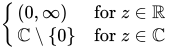
| Domain, codomain and image | |
| Domain | |
| Image | |
| Specific values | |
| At zero | 1 |
| Value at 1 | e |
| Specific features | |
| Fixed point | −Wn(−1) for |
| Related functions | |
| Reciprocal | |
| Inverse | Natural logarithm, Complex logarithm |
| Derivative | |
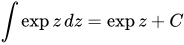
| Antiderivative | |
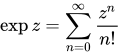
| Series definition | |
| Taylor series | |
In mathematics, the exponential function is the unique real function which maps zero to one and has a derivative everywhere equal to its value. It is denoted or ; the latter is preferred when the argument is a complicated expression.[1][2] It is called exponential because its argument can be seen as an exponent to which a constant number e ≈ 2.718, the base, is raised. There are several other definitions of the exponential function, which are all equivalent although being of very different nature.
The exponential function converts sums to products: . Its inverse function, the natural logarithm, or , converts products to sums: .
The exponential function is occasionally called the natural exponential function, matching the name natural logarithm, for distinguishing it from some other functions that are also commonly called exponential functions. These functions include the functions of the form , which is exponentiation with a fixed base . More generally, and especially in applications, functions of the general form are also called exponential functions. They grow or decay exponentially in that the rate that changes when is increased is proportional to the current value of .
The exponential function can be generalized to accept complex numbers as arguments. This reveals relations between multiplication of complex numbers, rotations in the complex plane, and trigonometry. Euler's formula expresses and summarizes these relations.
The exponential function can be even further generalized to accept other types of arguments, such as matrices and elements of Lie algebras.
The graph of is upward-sloping, and increases faster than every power of .[3] The graph always lies above the x-axis, but becomes arbitrarily close to it for large negative x; thus, the x-axis is a horizontal asymptote. The equation means that the slope of the tangent to the graph at each point is equal to its height (its y-coordinate) at that point.
There are several equivalent definitions of the exponential function, although of very different nature.

The exponential function is the unique differentiable function that equals its derivative, and takes the value 1 for the value 0 of its variable.
This definition requires a uniqueness proof and an existence proof, but it allows an easy derivation of the main properties of the exponential function.
The exponential function is the inverse function of the natural logarithm. That is, for every real number and every positive real number

The exponential function is the sum of the power series[4][5] where is the factorial of n (the product of the n first positive integers). This series is absolutely convergent for every , by the ratio test. This shows that the exponential function is defined for every , and is everywhere the sum of its Maclaurin series.
The exponential satisfies the functional equation and maps the additive identity 0 to the multiplicative identity 1. The same equation is satisfied by other continuous functions that exponentiate their argument with an arbitrary base .[6] Among these functions, the exponential function is characterized by the property that its derivative at 0 is 1.[7]
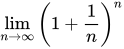
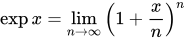
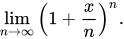
The exponential function is the limit, as the integer n goes to infinity,[8][5]
Reciprocal: The functional equation implies . Therefore for every and
Positiveness: for every real number . This results from the intermediate value theorem, since and, if one would have for some , there would be an such that between and . Since the exponential function equals its derivative, this implies that the exponential function is monotonically increasing.
Extension of exponentiation to positive real bases: Let b be a positive real number. The exponential function and the natural logarithm being the inverse each of the other, one has If n is an integer, the functional equation of the logarithm implies Since the right-most expression is defined if n is any real number, this allows defining for every positive real number b and every real number x: In particular, if b is the Euler's number one has (inverse function) and thus This shows the equivalence of the two notations for the exponential function.
A function is commonly called an exponential function—with an indefinite article—if it has the form , that is, if it is obtained from exponentiation by fixing the base and letting the exponent vary.
More generally and especially in applied contexts, the term exponential function is commonly used for functions of the form . This may be motivated by the fact that, if the values of the function represent quantities, a change of measurement unit changes the value of , and so, it is nonsensical to impose .
These most general exponential functions are the differentiable functions that satisfy the following equivalent characterizations.

The base of an exponential function is the base of the exponentiation that appears in it when written as , namely .[10] The base is in the second characterization, in the third one, and in the last one.
The last characterization is important in empirical sciences, as allowing a direct experimental test whether a function is an exponential function.
Exponential growth or exponential decay—where the variable change is proportional to the variable value—are thus modeled with exponential functions. Examples are unlimited population growth leading to Malthusian catastrophe, continuously compounded interest, and radioactive decay.
If the modeling function has the form or, equivalently, is a solution of the differential equation , the constant is called, depending on the context, the decay constant, disintegration constant,[11] rate constant,[12] or transformation constant.[13]
For proving the equivalence of the above properties, one can proceed as follows.
The two first characterizations are equivalent, since, if and , one has The basic properties of the exponential function (derivative and functional equation) implies immediately the third and the last condition.
Suppose that the third condition is verified, and let be the constant value of Since the quotient rule for derivation implies that and thus that there is a constant such that
If the last condition is verified, let which is independent of . Using , one gets Taking the limit when tends to zero, one gets that the third condition is verified with . It follows therefore that for some and As a byproduct, one gets that is independent of both and .
The earliest occurrence of the exponential function was in Jacob Bernoulli's study of compound interests in 1683.[14] This is this study that led Bernoulli to consider the number now known as Euler's number and denoted .
The exponential function is involved as follows in the computation of continuously compounded interests.
If a principal amount of 1 earns interest at an annual rate of x compounded monthly, then the interest earned each month is x/12 times the current value, so each month the total value is multiplied by (1 + x/12), and the value at the end of the year is (1 + x/12)12. If instead interest is compounded daily, this becomes (1 + x/365)365. Letting the number of time intervals per year grow without bound leads to the limit definition of the exponential function, first given by Leonhard Euler.[8]
Exponential functions occur very often in solutions of differential equations.
The exponential functions can be defined as solutions of differential equations. Indeed, the exponential function is a solution of the simplest possible differential equation, namely . Every other exponential function, of the form , is a solution of the differential equation , and every solution of this differential equation has this form.
The solutions of an equation of the form involve exponential functions in a more sophisticated way, since they have the form where is an arbitrary constant and the integral denotes any antiderivative of its argument.
More generally, the solutions of every linear differential equation with constant coefficients can be expressed in terms of exponential functions and, when they are not homogeneous, antiderivatives. This holds true also for systems of linear differential equations with constant coefficients.


The exponential function can be naturally extended to a complex function, which is a function with the complex numbers as domain and codomain, such that its restriction to the reals is the above-defined exponential function, called real exponential function in what follows. This function is also called the exponential function, and also denoted or . For distinguishing the complex case from the real one, the extended function is also called complex exponential function or simply complex exponential.
Most of the definitions of the exponential function can be used verbatim for definiting the complex exponential function, and the proof of their equivalence is the same as in the real case.
The complex exponential function can be defined in several equivalent ways that are the same as in the real case.
The complex exponential is the unique complex function that equals its complex derivative and takes the value for the argument :
The complex exponential function is the sum of the series This series is absolutely convergent for every complex number . So, the complex exponential is an entire function.
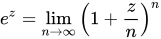
The complex exponential function is the limit
As with the real exponential function (see § Functional equation above), the complex exponential satisfies the functional equation Among complex functions, it is the unique solution which is holomorphic at the point and takes the derivative there.[15]
The complex logarithm is a right-inverse function of the complex exponential: However, since the complex logarithm is a multivalued function, one has and it is difficult to define the complex exponential from the complex logarithm. On the opposite, this is the complex logarithm that is often defined from the complex exponential.
The complex exponential has the following properties: and It is a periodic function of period ; that is This results from Euler's identity and the functional identity.
The complex conjugate of the complex exponential is Its modulus is where denotes the real part of .
Complex exponential and trigonometric functions are strongly related by Euler's formula:
This formula provides the decomposition of complex exponentials into real and imaginary parts:
The trigonometric functions can be expressed in terms of complex exponentials:
In these formulas, are commonly interpreted as real variables, but the formulas remain valid if the variables are interpreted as complex variables. These formulas may be used to define trigonometric functions of a complex variable.[16]


Considering the complex exponential function as a function involving four real variables: the graph of the exponential function is a two-dimensional surface curving through four dimensions.
Starting with a color-coded portion of the domain, the following are depictions of the graph as variously projected into two or three dimensions.


The second image shows how the domain complex plane is mapped into the range complex plane:
The third and fourth images show how the graph in the second image extends into one of the other two dimensions not shown in the second image.
The third image shows the graph extended along the real axis. It shows the graph is a surface of revolution about the axis of the graph of the real exponential function, producing a horn or funnel shape.
The fourth image shows the graph extended along the imaginary axis. It shows that the graph's surface for positive and negative values doesn't really meet along the negative real axis, but instead forms a spiral surface about the axis. Because its values have been extended to ±2π, this image also better depicts the 2π periodicity in the imaginary value.
The function ez is a transcendental function, which means that it is not a root of a polynomial over the field of the rational fractions in fact, this is true for any exponential function with a positive real base not equal to 1.
This follows from the stronger statement that if a1, ..., an are distinct complex numbers, then ea1z, ..., eanz are linearly independent over .
A much more difficult result is that the base e of the natural exponential function is a transcendental number, see the Lindemann–Weierstrass theorem.
The Taylor series definition above is generally efficient for computing (an approximation of) . However, when computing near the argument , the result will be close to 1, and computing the value of the difference with floating-point arithmetic may lead to the loss of (possibly all) significant figures, producing a large relative error, possibly even a meaningless result.
Following a proposal by William Kahan, it may thus be useful to have a dedicated routine, often called expm1, which computes ex − 1 directly, bypassing computation of ex. For example,
one may use the Taylor series:
This was first implemented in 1979 in the Hewlett-Packard HP-41C calculator, and provided by several calculators,[17][18] operating systems (for example Berkeley UNIX 4.3BSD[19]), computer algebra systems, and programming languages (for example C99).[20]
In addition to base e, the IEEE 754-2008 standard defines similar exponential functions near 0 for base 2 and 10: and .
A similar approach has been used for the logarithm; see log1p.
An identity in terms of the hyperbolic tangent, gives a high-precision value for small values of x on systems that do not implement expm1(x).
The exponential function can also be computed with continued fractions.
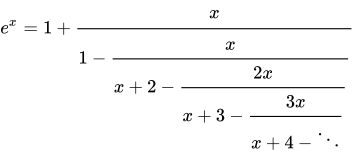
A continued fraction for ex can be obtained via an identity of Euler:
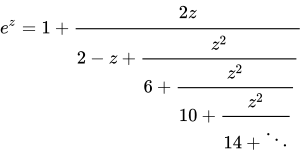
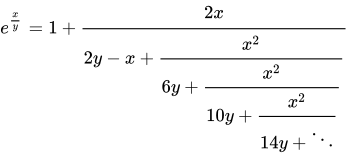
The following generalized continued fraction for ez, also due to Euler,[21] converges more quickly:[22] or, by applying the substitution z = x/y: with a special case for z = 2:
This formula also converges, though more slowly, for z > 2. For example:
The power series definition of the exponential function makes sense for square matrices (for which the function is called the matrix exponential) and more generally in any unital Banach algebra B. In this setting, e0 = 1, and ex is invertible with inverse e−x for any x in B. If xy = yx, then ex + y = exey, but this identity can fail for noncommuting x and y.
Some alternative definitions lead to the same function. For instance, ex can be defined as
Or ex can be defined as fx(1), where fx : R → B is the solution to the differential equation dfx/dt(t) = x fx(t), with initial condition fx(0) = 1; it follows that fx(t) = etx for every t in R.
Given a Lie group G and its associated Lie algebra , the exponential map is a map satisfying similar properties. In fact, since R is the Lie algebra of the Lie group of all positive real numbers under multiplication, the ordinary exponential function for real arguments is a special case of the Lie algebra situation. Similarly, since the Lie group GL(n,R) of invertible n × n matrices has as Lie algebra M(n,R), the space of all n × n matrices, the exponential function for square matrices is a special case of the Lie algebra exponential map.
The identity can fail for Lie algebra elements x and y that do not commute; the Baker–Campbell–Hausdorff formula supplies the necessary correction terms.
Which form to use, or , is determined by the number of characters and the complexity of the argument. The form is appropriate when the argument is short and simple, i.e., , whereas should be used if the argument is more complicated.
{{cite web}}: CS1 maint: location (link)
Berkeley UNIX 4.3BSD introduced the expm1() function in 1987.
Source: Wikipedia. Article content is retrieved live through the MediaWiki API.

In mathematics, the exponential function is the unique real function which maps zero to one and has a derivative everywhere equal to its value. It is denoted e x {\displaystyle e^{x}} or exp x {\displaystyle \exp x} ; the latter is preferred when the argument x {\displaystyle x} is a complicated expression. It is called exponential because its argument can be seen as an exponent to which a constant number e ≈ 2.718, the base, is raised. There are several other definitions of the exponential function, which are all equivalent although being of very different nature. The exponential function converts sums to products: exp ( x + y ) = exp x ⋅ exp y {\displaystyle \exp(x+y)=\exp x\cdot \exp y} . Its inverse function, the natural logarithm, ln {\displaystyle \ln } or log {\displaystyle \log } , converts products to sums: ln ( x ⋅ y ) = ln x + ln y {\displaystyle \ln(x\cdot y)=\ln x+\ln y} . The exponential function is occasionally called the natural exponential function, matching the name natural logarithm, for distinguishing it from some other functions that are also commonly called exponential functions. These functions include the functions of the form f ( x ) = b x {\displaystyle f(x)=b^{x}} , which is exponentiation with a fixed base b {\displaystyle b} . More generally, and especially in applications, functions of the general form f ( x ) = a b x {\displaystyle f(x)=ab^{x}} are also called exponential functions. They grow or decay exponentially in that the rate that f ( x ) {\displaystyle f(x)} changes when x {\displaystyle x} is increased is proportional to the current value of f ( x ) {\displaystyle f(x)} . The exponential function can be generalized to accept complex numbers as arguments. This reveals relations between multiplication of complex numbers, rotations in the complex plane, and trigonometry. Euler's formula e i θ = cos θ + i sin θ {\displaystyle e^{i\theta }=\cos \theta +i\sin \theta } expresses and summarizes these relations. The exponential function can be even further generalized to accept other types of arguments, such as matrices and elements of Lie algebras.

The stretched exponential function f β ( t ) = e − t β {\displaystyle f_{\beta }(t)=e^{-t^{\beta }}} is obtained by inserting a fractional power law into the exponential function. In most applications, it is meaningful only for arguments t between 0 and +∞. With β = 1, the usual exponential function is recovered. With a stretching exponent β between 0 and 1, the graph of log f versus t is characteristically stretched, hence the name of the function. The compressed exponential function (with β > 1) has less practical importance, with the notable exceptions of β = 2, which gives the normal distribution, and of compressed exponential relaxation in the dynamics of amorphous solids. In mathematics, the stretched exponential is also known as the complementary cumulative Weibull distribution. The stretched exponential is also the characteristic function, basically the Fourier transform, of the Lévy symmetric alpha-stable distribution. In physics, the stretched exponential function is often used as a phenomenological description of relaxation in disordered systems. It was first introduced by Rudolf Kohlrausch in 1854 to describe the discharge of a capacitor; thus it is also known as the Kohlrausch function. In 1970, G. Williams and D.C. Watts used the Fourier transform of the stretched exponential to describe dielectric spectra of polymers; in this context, the stretched exponential or its Fourier transform are also called the Kohlrausch–Williams–Watts (KWW) function. The Kohlrausch–Williams–Watts (KWW) function corresponds to the time domain charge response of the main dielectric models, such as the Cole–Cole equation, the Cole–Davidson equation, and the Havriliak–Negami relaxation, for small time arguments. In phenomenological applications, it is often not clear whether the stretched exponential function should be used to describe the differential or the integral distribution function—or neither. In each case, one gets the same asymptotic decay, but a different power law prefactor, which makes fits more ambiguous than for simple exponentials. In a few cases, it can be shown that the asymptotic decay is a stretched exponential, but the prefactor is usually an unrelated power.

A double exponential function is a constant raised to the power of an exponential function. The general formula is f ( x ) = a b x = a ( b x ) {\displaystyle f(x)=a^{b^{x}}=a^{(b^{x})}} (where a > 1 and b > 1), which grows much more quickly than an exponential function. For example, if a = b = 10: f(x) = 1010x f(0) = 10 f(1) = 1010 f(2) = 10100 = googol f(3) = 101000 f(100) = 1010100 = googolplex. Factorials grow faster than exponential functions, but much more slowly than double exponential functions. However, tetration and the Ackermann function grow faster. See Big O notation for a comparison of the rate of growth of various functions. The inverse of the double exponential function is the double logarithm log(log(x)). The complex double exponential function is entire, because it is the composition of two entire functions f ( x ) = a x = e x ln a {\displaystyle f(x)=a^{x}=e^{x\ln a}} and g ( x ) = b x = e x ln b {\displaystyle g(x)=b^{x}=e^{x\ln b}} .
In mathematics, the exponential function can be characterized in many ways. This article presents some common characterizations, discusses why each makes sense, and proves that they are all equivalent. The exponential function occurs naturally in many branches of mathematics. Walter Rudin called it "the most important function in mathematics". It is therefore useful to have multiple ways to define (or characterize) it. Each of the characterizations below may be more or less useful depending on context. The "product limit" characterization of the exponential function was discovered by Leonhard Euler.
Before the 1921 destruction of Tulsa’s Greenwood District, Black residents had created a remarkable center of business and community life. The district included stores, professional offices, entertainment venues and homes owned by Black citizens. Understanding Greenwood means learning what was built—not only what was burned.
MORE →The Greenwood District.