Civil Rights
Movements, leaders, victories and the continuing fight for equality.

Explore the people, places, events, achievements, struggles and stories that shaped our journey.
Movements, leaders, victories and the continuing fight for equality.
Innovation, patents, science, technology and world-changing contributions.
Pioneers, champions, Negro Leagues, records, activism and excellence.
Meet the people whose lives, choices and achievements shaped the journey.
Black towns, communities, institutions and places where history happened.
Moments that changed communities, movements, institutions and the nation.
Mansa Musa was the ruler of the Mali Empire in West Africa. Details recorded here should be sourced; unknown information is left blank.
MORE →Reflects the personal views, recollections, and perspective of the author, Mike Davis.
This is a personal recollection on the Move fire on May 13, 1985

External sorting is a class of sorting algorithms that can handle massive amounts of data. External sorting is required when the data being sorted do not fit into the main memory of a computing device (usually RAM) and instead they must reside in the slower external memory, usually a disk drive. Thus, external sorting algorithms are external memory algorithms and thus applicable in the external memory model of computation.
External sorting algorithms generally fall into two types, distribution sorting, which resembles quicksort, and external merge sort, which resembles merge sort. External merge sort typically uses a hybrid sort-merge strategy. In the sorting phase, chunks of data small enough to fit in main memory are read, sorted, and written out to a temporary file. In the merge phase, the sorted subfiles are combined into a single larger file.
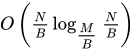
External sorting algorithms can be analyzed in the external memory model. In this model, a cache or internal memory of size M and an unbounded external memory are divided into blocks of size B, and the running time of an algorithm is determined by the number of memory transfers between internal and external memory. Like their cache-oblivious counterparts, asymptotically optimal external sorting algorithms achieve a running time (in Big O notation) of .
One example of external sorting is the external merge sort algorithm, which uses a K-way merge algorithm. It sorts chunks that each fit in RAM, then merges the sorted chunks together.[1][2]
The algorithm first sorts M items at a time and puts the sorted lists back into external memory. It does a -way merge on those sorted lists, recursing if there is not enough main memory to merge efficiently in one pass. During a merge pass, B elements from each sorted list are in internal memory, and the minimum is repeatedly outputted.
For example, for sorting 900 megabytes of data using only 100 megabytes of RAM:
The merge pass is key to making external merge sort work externally. The merge algorithm only makes one pass through each chunk, so chunks do not have to be loaded all at once; rather, sequential parts of the chunk are loaded as needed. And as long as the blocks read are relatively large (like the 10 MB in this example), the reads can be relatively efficient even on media with low random-read performance, like hard drives.
Historically, instead of a sort, sometimes a replacement-selection algorithm[3] was used to perform the initial distribution, to produce on average half as many output chunks of double the length.
The previous example is a two-pass sort: first sort, then merge. The sort ends with a single k-way merge, rather than a series of two-way merge passes as in a typical in-memory merge sort. This is because each merge pass reads and writes every value from and to disk, so reducing the number of passes more than compensates for the additional cost of a k-way merge.
The limitation to single-pass merging is that as the number of chunks increases, memory will be divided into more buffers, so each buffer is smaller. Eventually, the reads become so small that more time is spent on disk seeks than data transfer. A typical magnetic hard disk drive might have a 10 ms access time and 100 MB/s data transfer rate, so each seek takes as much time as transferring 1 MB of data.
Thus, for sorting, say, 50 GB in 100 MB of RAM, using a single 500-way merge pass isn't efficient: we can only read 100 MB / 501 ≈ 200 KB from each chunk at once, so 5/6 of the disk's time is spent seeking. Using two merge passes solves the problem. Then the sorting process might look like this:
Although this requires an additional pass over the data, each read is now 4 MB long, so only 1/5 of the disk's time is spent seeking. The improvement in data transfer efficiency during the merge passes (16.6% to 80% is almost a 5× improvement) more than makes up for the doubled number of merge passes.
Variations include using an intermediate medium like solid-state disk for some stages; the fast temporary storage needn't be big enough to hold the whole dataset, just substantially larger than available main memory. Repeating the example above with 1 GB of temporary SSD storage, the first pass could merge 10×100 MB sorted chunks read from that temporary space to write 50x1 GB sorted chunks to HDD. The high bandwidth and random-read throughput of SSDs help speed the first pass, and the HDD reads for the second pass can then be 2 MB, large enough that seeks will not take up most of the read time. SSDs can also be used as read buffers in a merge phase, allowing fewer larger reads (20MB reads in this example) from HDD storage. Given the lower cost of SSD capacity relative to RAM, SSDs can be an economical tool for sorting large inputs with very limited memory.
Like in-memory sorts, efficient external sorts require O(n log n) time: exponentially growing datasets require linearly increasing numbers of passes that each take O(n) time.[4] Under reasonable assumptions at least 500 GB of data stored on a hard drive can be sorted using 1 GB of main memory before a third pass becomes advantageous, and many times that much data can be sorted before a fourth pass becomes useful.[5]
Main memory size is important. Doubling memory dedicated to sorting halves the number of chunks and the number of reads per chunk, reducing the number of seeks required by about three-quarters. The ratio of RAM to disk storage on servers often makes it convenient to do huge sorts on a cluster of machines[6] rather than on one machine with multiple passes. Media with high random-read performance like solid-state drives (SSDs) also increase the amount that can be sorted before additional passes improve performance.
External distribution sort is analogous to quicksort. The algorithm finds approximately pivots and uses them to divide the N elements into approximately equally sized subarrays, each of whose elements are all smaller than the next, and then recurse until the sizes of the subarrays are less than the block size. When the subarrays are less than the block size, sorting can be done quickly because all reads and writes are done in the cache, and in the external memory model requires operations.
However, finding exactly pivots would not be fast enough to make the external distribution sort asymptotically optimal. Instead, we find slightly fewer pivots. To find these pivots, the algorithm splits the N input elements into chunks, and takes every elements, and recursively uses the median of medians algorithm to find pivots.[7]
There is a duality, or fundamental similarity, between merge- and distribution-based algorithms.[8]
The Sort Benchmark, created by computer scientist Jim Gray, compares external sorting algorithms implemented using finely tuned hardware and software. Winning implementations use several techniques:
Source: Wikipedia. Article content is retrieved live through the MediaWiki API.

External sorting is a class of sorting algorithms that can handle massive amounts of data. External sorting is required when the data being sorted do not fit into the main memory of a computing device (usually RAM) and instead they must reside in the slower external memory, usually a disk drive. Thus, external sorting algorithms are external memory algorithms and thus applicable in the external memory model of computation. External sorting algorithms generally fall into two types, distribution sorting, which resembles quicksort, and external merge sort, which resembles merge sort. External merge sort typically uses a hybrid sort-merge strategy. In the sorting phase, chunks of data small enough to fit in main memory are read, sorted, and written out to a temporary file. In the merge phase, the sorted subfiles are combined into a single larger file.
An internal sort is any data sorting process that takes place entirely within the main memory of a computer. This is possible whenever the data to be sorted is small enough to be completely held in the main memory. The opposite of an internal sort is an external sort, where the data is partially or completely held on external media such as a hard disk. Any reading or writing of data to and from this slower media can slow the sort process considerably. This issue has implications for different sort algorithms. Some common internal sorting algorithms include: Bubble Sort Insertion Sort Quick Sort Heap Sort Radix Sort Selection sort Consider a Bubblesort, where adjacent records are swapped in order to get them into the right order, so that records appear to “bubble” up and down through the dataspace. If this has to be done in chunks, then when we have sorted all the records in chunk 1, we move on to chunk 2, but we find that some of the records in chunk 1 need to “bubble through” chunk 2, and vice versa (i.e., there are records in chunk 2 that belong in chunk 1, and records in chunk 1 that belong in chunk 2 or later chunks). This will cause the chunks to be read and written back to disk many times as records cross over the boundaries between them, resulting in a considerable degradation of performance. If the data can all be held in memory as one large chunk, then this performance hit is avoided. On the other hand, some algorithms handle external sorting rather better. A Merge sort breaks the data up into chunks, sorts the chunks by some other algorithm, such as bubblesort or Quick Sort, and then recombines the chunks two by two so that each recombined chunk is in order. This approach minimizes the number or reads and writes of data-chunks from disk, and is a popular external sort method.
A polyphase merge sort is a variation of a bottom-up merge sort that sorts a list using an initial uneven distribution of sub-lists (runs), primarily used for external sorting, and is more efficient than an ordinary merge sort when there are fewer than eight external working files (such as a tape drive or a file on a hard drive). A polyphase merge sort is not a stable sort.
In computer science, k-way merge algorithms or multiway merges are a specific type of sequence merge algorithms that specialize in taking in k sorted lists and merging them into a single sorted list. These merge algorithms generally refer to merge algorithms that take in a number of sorted lists greater than two. Two-way merges are also referred to as binary merges. The k-way merge is also an external sorting algorithm.
Before the 1921 destruction of Tulsa’s Greenwood District, Black residents had created a remarkable center of business and community life. The district included stores, professional offices, entertainment venues and homes owned by Black citizens. Understanding Greenwood means learning what was built—not only what was burned.
MORE →The Greenwood District.