Civil Rights
Movements, leaders, victories and the continuing fight for equality.

Explore the people, places, events, achievements, struggles and stories that shaped our journey.
Movements, leaders, victories and the continuing fight for equality.
Innovation, patents, science, technology and world-changing contributions.
Pioneers, champions, Negro Leagues, records, activism and excellence.
Meet the people whose lives, choices and achievements shaped the journey.
Black towns, communities, institutions and places where history happened.
Moments that changed communities, movements, institutions and the nation.
Mansa Musa was the ruler of the Mali Empire in West Africa. Details recorded here should be sourced; unknown information is left blank.
MORE →Reflects the personal views, recollections, and perspective of the author, Mike Davis.
This is a personal recollection on the Move fire on May 13, 1985
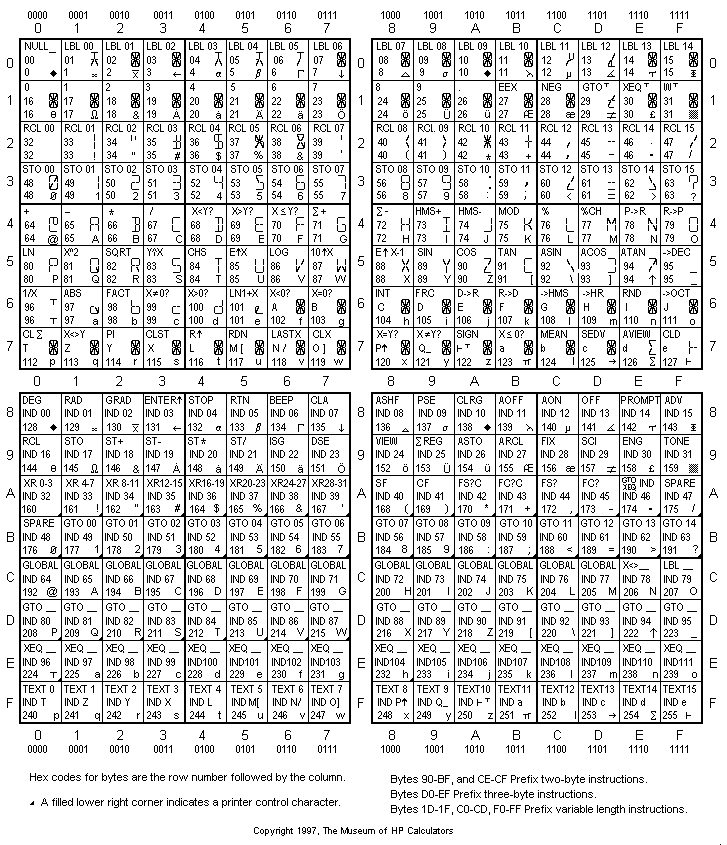
In computing FOCAL character set refers to a group of 8-bit single byte character sets introduced by Hewlett-Packard since 1979. It was used in several RPN calculators supporting the FOCAL programming language, like the HP-41C/CV/CX as well as the later HP-42S,[1][2] which was introduced in 1988[1][2] and produced up to 1995. As such, it is also used by SwissMicros' DM41/L, both introduced in 2015, and is implicitly supported by the DM42, introduced in 2017 (although the later calculator utilizes Free42, which is based on Unicode internally).
The character set is derived from ASCII, but with the control code range and some high bit characters replaced by various special characters.
| 0 | 1 | 2 | 3 | 4 | 5 | 6 | 7 | 8 | 9 | A | B | C | D | E | F | |
|---|---|---|---|---|---|---|---|---|---|---|---|---|---|---|---|---|
| 0x | ‾/♦ | × | x̅/ā | ← | α | β | Γ | ↓ | Δ | σ | ♦ | λ | µ/μ | ∡/∠ | τ | Φ |
| 1x | θ | Ω | δ | Å | å | Ä | ä | Ö | ö | Ü | ü | Æ | æ | ≠ | £/₤ | ▒ |
| 2x | SP | ! | " | # | $ | % | & | ' | ( | ) | * | + | , | - | . | / |
| 3x | 0 | 1 | 2 | 3 | 4 | 5 | 6 | 7 | 8 | 9 | : | ; | < | = | > | ? |
| 4x | @ | A | B | C | D | E | F | G | H | I | J | K | L | M | N | O |
| 5x | P | Q | R | S | T | U | V | W | X | Y | Z | [ | \ | ] | ↑/^ | _ |
| 6x | `/⊤ | a | b | c | d | e | f | g | h | i | j | k | l | m | n | o |
| 7x | p | q | r | s | t | u | v | w | x | y | z | π | | | → | Σ | ⊦[nb 1] |
When Hewlett-Packard introduced the HP-42S in 1988, the FOCAL character set was revised to include more characters, including a number of characters already provided by the HP 82240A infrared thermo printer, which had been introduced in 1986,[6] as part of its extended variant of the 1985 revision of the HP Roman-8 character set,[7][8] although at completely different code points.
There is no code point definition for the euro sign in this character set.
| 0 | 1 | 2 | 3 | 4 | 5 | 6 | 7 | 8 | 9 | A | B | C | D | E | F | |
|---|---|---|---|---|---|---|---|---|---|---|---|---|---|---|---|---|
| 0x | ÷ | × | √ | ∫ | ░ | Σ | ▶[nb 2] | π | ¿ | ≤ | LF/EOT | ≥ | ≠ | ↵ | ↓ | → |
| 1x | ← | µ/μ | £/₤ | ° | Å | Ñ | Ä | ∡/∠ | ᴇ/⏨ | Æ | …/‥ | ␛ | Ö | Ü | ▒ | ■/· |
| 2x | SP | ! | " | # | $ | % | & | ' | ( | ) | * | + | , | - | . | / |
| 3x | 0 | 1 | 2 | 3 | 4 | 5 | 6 | 7 | 8 | 9 | : | ; | < | = | > | ? |
| 4x | @ | A | B | C | D | E | F | G | H | I | J | K | L | M | N | O |
| 5x | P | Q | R | S | T | U | V | W | X | Y | Z | [ | \ | ] | ↑/^ | _ |
| 6x | ` | a | b | c | d | e | f | g | h | i | j | k | l | m | n | o |
| 7x | p | q | r | s | t | u | v | w | x | y | z | { | | | } | ~ | ⊦[nb 1] |
| 8x | ¦? | ¥? | ▓? | ␊ |
Translation from HP-42S character set to the modified HP Roman-8 (supported by HP 82240A etc.) character set:
| 0 | 1 | 2 | 3 | 4 | 5 | 6 | 7 | 8 | 9 | A | B | C | D | E | F | |
|---|---|---|---|---|---|---|---|---|---|---|---|---|---|---|---|---|
| 0x | 0x81 | 0x82 | 0x83 | 0x84 | 0x04 | 0x85 | 0x86 | 0x87 | 0x08 | 0x89 | 0x04 | 0x8A | 0x8B | 0x0D | 0x0E | 0x8D |
| 1x | 0x8E | 0x8F | 0xAF | 0xB3 | 0xA2 | 0xB6 | 0xD8 | 0xA0 | 0x18 | 0xD3 | 0x9B | 0x1B | 0xDA | 0xDB | 0x7F | 0xF2 |
| 7x | 0x70 | 0x71 | 0x72 | 0x73 | 0x74 | 0x75 | 0x76 | 0x77 | 0x78 | 0x79 | 0x7A | 0x7B | 0x7C | 0x7D | 0x7E | 0x94 |
| 8x | 0x80 | 0x81 | 0x82 | 0x83 | 0x84 | 0x85 | 0x86 | 0x87 | 0x88 | 0x89 | 0x90 | 0x8B | 0x8C | 0x8D | 0x8E | 0x8F |
| Early telecommunication | |
|---|---|
| ISO/IEC 8859 |
|
| Bibliographic use | |
| National standards | |
| ISO/IEC 2022 | |
| Code pages | |
| Unicode, ISO/IEC 10646 | |
| TeX typesetting | |
| Control character | |
| Related topics | |
Source: Wikipedia. Article content is retrieved live through the MediaWiki API.
In computing FOCAL character set refers to a group of 8-bit single byte character sets introduced by Hewlett-Packard since 1979. It was used in several RPN calculators supporting the FOCAL programming language, like the HP-41C/CV/CX as well as the later HP-42S, which was introduced in 1988 and produced up to 1995. As such, it is also used by SwissMicros' DM41/L, both introduced in 2015, and is implicitly supported by the DM42, introduced in 2017 (although the later calculator utilizes Free42, which is based on Unicode internally).
HP calculator character set refers to various calculator character sets used in calculators manufactured by Hewlett-Packard. These include: FOCAL character set, a character set used by some calculators supporting the FOCAL programming language between 1979 and 1995 Modified HP Roman-8, a variant of Hewlett-Packard's Roman-8 used on some calculators between 1986 and 2015 RPL character set, a character set used on various Hewlett-Packard RPL calculators between 1989 and 2015 Unicode, a character set used on some new calculators since 2011 (39gII, Prime)
In any narrative, the focal character is the character on whom the audience is meant to place the majority of their interest and attention. They are almost always also the protagonist of the story; however, in cases where the "focal character" and "protagonist" are separate, the focal character's emotions and ambitions are not meant to be empathized with by the audience to as high an extent as the protagonist (this is the main difference between the two character terms). The focal character is mostly created to simply be the "excitement" of the story, though not necessarily the main character about whom the audience is emotionally concerned. The focal character is, more than anyone else, "the person on whom the spotlight focuses; the center of attention; the man whose reactions dominate the screen." For example, in Gaston Leroux's The Phantom of the Opera, the protagonist is Christine Daaé (the audience is concerned mostly with her emotions, aims, and well-being), while the focal character is the "Phantom" (the audience is concerned mostly with the allure of his actions and reactions—though to some degree, later on, his emotions as well). The focal character is also not necessarily the same thing as the viewpoint character, through whose perspective the story is seen. In Sir Arthur Conan Doyle's works of Sherlock Holmes, Watson is the viewpoint character, but the story revolves around Holmes, making him the focal character. In the novel The Great Gatsby by F. Scott Fitzgerald, Nick Carraway is the first-person narrator and protagonist, but his wealthy neighbor Jay Gatsby is the center of the novel's attention, suspense, and intrigue.
The Lotus International Character Set (LICS) is a proprietary single-byte character encoding introduced in 1985 by Lotus Development Corporation. It is based on the 1983 DEC Multinational Character Set (MCS) for VT220 terminals. As such, LICS is also similar to two other descendants of MCS, the ECMA-94 character set of 1985 and the ISO 8859-1 (Latin-1) character set of 1987. LICS was first introduced as the character set of Lotus 1-2-3 Release 2 for DOS in 1985. It is also utilized by 2.01, 2.2, 2.3 and 2.4 as well as by Symphony. It was also utilized in a number of third-party spreadsheet products emulating the file format. LICS was superseded by the Lotus Multi-Byte Character Set (LMBCS) introduced by Lotus 1-2-3 Release 3 in 1989.
Before the 1921 destruction of Tulsa’s Greenwood District, Black residents had created a remarkable center of business and community life. The district included stores, professional offices, entertainment venues and homes owned by Black citizens. Understanding Greenwood means learning what was built—not only what was burned.
MORE →The Greenwood District.