Civil Rights
Movements, leaders, victories and the continuing fight for equality.

Explore the people, places, events, achievements, struggles and stories that shaped our journey.
Movements, leaders, victories and the continuing fight for equality.
Innovation, patents, science, technology and world-changing contributions.
Pioneers, champions, Negro Leagues, records, activism and excellence.
Meet the people whose lives, choices and achievements shaped the journey.
Black towns, communities, institutions and places where history happened.
Moments that changed communities, movements, institutions and the nation.
In August 1908, a white mob attacked Springfield, Illinois’s Black community, destroying homes and businesses and lynching two Black men. National outrage over the violence helped spur the movement that created the NAACP the following year.
MORE →Reflects the personal views, recollections, and perspective of the author, Mike Davis.
This is a personal recollection on the Move fire on May 13, 1985
 First edition | |
| Author | Lois McMaster Bujold |
|---|---|
| Audio read by | Grover Gardner |
| Cover artist | Alan Gutierrez |
| Language | English |
| Series | Vorkosigan Saga |
| Genre | Science fiction |
| Publisher | Baen Books |
| Publication date | April 1988 |
| Publication place | United States |
| Media type | Paperback |
| Pages | 307 |
| Awards | 2014 Prometheus Hall of Fame, 1988 Nebula Award for Best Novel |
| ISBN | 0-671-65398-9 |
| Preceded by | Ethan of Athos |
| Followed by | Brothers in Arms |
| External image | |
|---|---|
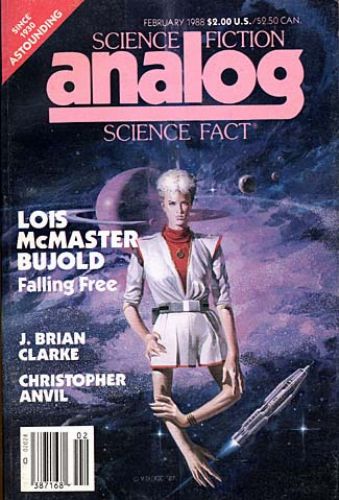
 Analog, FEB 1988, cover art by Vincent Di Fate |
Falling Free is a science fiction novel by American writer Lois McMaster Bujold, part of her Vorkosigan Saga. It was first published as four installments in Analog from December 1987 to February 1988,[1] and was included in the 2007 omnibus Miles, Mutants and Microbes.
The novel is set about 200 years before the birth of Miles Vorkosigan, the protagonist of much of the Vorkosigan series. It deals with the "Quaddies", genetically modified people who have four arms, the second pair situated where legs would normally go. They were intended to be used as a space labor force, superbly adapted to zero-gravity work (where legs would be merely a hindrance). They would not require the special facilities or mandatory time off needed by unmodified humans, whose bodies tend to deteriorate over the long term in weightlessness, and would thus be more efficient (and profitable) for the company that created them.
Legally, the Quaddies are not considered human beings, with their attendant rights, but simply "post-fetal experimental tissue cultures". The company treats them as chattel slaves. They are carefully indoctrinated from childhood to be loyal to the company, and their access to information is tightly controlled; even their children's stories are about working in space. They are the subject of a breeding program, the company choosing who will mate with whom.
Then a new artificial gravity technology renders the Quaddies obsolete practically overnight and a financial drain to the company. Though there are discussions about liquidating them, a powerful company higher-up decides to simply dump them on the planet in an isolated camp as the most cost-effective solution. Bipedal engineer Leo Graf, who had been assigned to teach them construction techniques, instead organizes them for a mass escape to a remote star system.
Bujold has stated in the notes of her reprints that Falling Free was the first half of the intended story. The unwritten, second story was to tell how the Quaddies settled into what would be known as "Quaddiespace". Diplomatic Immunity, published in 2002, revisits the Quaddies in their home system, showing the state of their society some 240 years after its foundation.
Falling Free won the 1988 Nebula Award for Best Novel.[3]
At Reactor, Jo Walton described it as "a very traditional science fiction book in many ways—the best bit is the science," noting that she did not find the romance between Silver and Leo to be "very convincing", and stated that as the book is one of Bujold's earlier works, it is less "technically accomplished" and "definitely (...) minor", but emphasized that minor for Bujold would be major for other writers.[4] The SF Site similarly observed the "general lack of subtlety and finesse that [Bujold] would later develop" and the "rather shallow" characterization, particularly faulting Bruce Van Atta as "just so unrelievedly nasty about everything that it was hard to take him seriously as a threat, because I couldn't imagine Bujold letting him win", but nonetheless praised its "lively dialogue and bright spots of wit".[5]
Source: Wikipedia. Article content is retrieved live through the MediaWiki API.
Falling Free is a science fiction novel by American writer Lois McMaster Bujold, part of her Vorkosigan Saga. It was first published as four installments in Analog from December 1987 to February 1988, and was included in the 2007 omnibus Miles, Mutants and Microbes.
Free Falling (Spanish: Caída libre) is a 2024 Spanish thriller drama film directed by Laura Jou from a screenplay by Bernat Vilaplana starring Belén Rueda alongside Irene Escolar, Ilay Kurelovic, and Manuela Vellés.
In classical mechanics, free fall is any motion of a body where gravity is the only force acting upon it. A freely falling object may not necessarily be falling down in the vertical direction. If the common definition of the word "fall" is used, an object moving upwards is not considered to be falling, but using scientific definitions, if it is subject to only the force of gravity, it is said to be in free fall. The Moon is thus in free fall around the Earth, though its orbital speed keeps it in very far orbit from the Earth's surface. In a roughly uniform gravitational field, gravity acts on each part of a body approximately equally. When there are no other forces, such as the normal force exerted between a body (e.g. an astronaut in orbit) and its surrounding objects, it will result in the sensation of weightlessness, a condition that also occurs when the gravitational field is weak (such as when the body is far away from any source of gravity). The term "free fall" is often used more loosely than in the strict sense defined above. Thus, falling through an atmosphere without a deployed parachute, or lifting device, is also often referred to as free fall. The aerodynamic drag forces in such situations prevent them from producing full weightlessness, and thus a skydiver's "free fall" after reaching terminal velocity produces the sensation of the body's weight being supported on a cushion of air. In the context of general relativity, where gravitation is reduced to a space-time curvature, a body in free fall has no force acting on it.

Free climbing is a form of rock climbing in which the climber can use rock-climbing equipment for their protection, but not as an artificial aid to help them in ascending a climbing route. Free climbing, therefore, cannot use any of the mechanical tools that are widely used in aid climbing to help the climber overcome the obstacles they encounter while ascending a route (e.g., aiders or skyhooks). The development of free climbing was a transformational moment in the history of rock climbing, including the concept and definition of what determined a first free ascent (or FFA) of a climbing route by a climber. Free climbing can be performed in several different rock-climbing formats that vary with the type of climbing protection which the free-climber used. For example, free climbing can be done as lead climbing in either a traditional climbing style (temporary and removable climbing protection) or a sport climbing style (permanently fixed in-situ climbing protection). Free climbing can also be performed as bouldering or as free solo climbing—both of which use no climbing protection whatsoever. Free climbing is sometimes misunderstood as relating only to the formats of free-solo climbing or of solo climbing, which is not correct.
Before the 1921 destruction of Tulsa’s Greenwood District, Black residents had created a remarkable center of business and community life. The district included stores, professional offices, entertainment venues and homes owned by Black citizens. Understanding Greenwood means learning what was built—not only what was burned.
MORE →The Greenwood District.