Civil Rights
Movements, leaders, victories and the continuing fight for equality.

Explore the people, places, events, achievements, struggles and stories that shaped our journey.
Movements, leaders, victories and the continuing fight for equality.
Innovation, patents, science, technology and world-changing contributions.
Pioneers, champions, Negro Leagues, records, activism and excellence.
Meet the people whose lives, choices and achievements shaped the journey.
Black towns, communities, institutions and places where history happened.
Moments that changed communities, movements, institutions and the nation.
Katherine Johnson’s mathematical calculations helped guide some of America’s most important early space missions while she confronted the racial and gender barriers faced by Black women in twentieth-century America.
MORE →Reflects the personal views, recollections, and perspective of the author, Mike Davis.
This is a personal recollection on the Move fire on May 13, 1985
T-norm fuzzy logics are a family of non-classical logics, informally delimited by having a semantics that takes the real unit interval [0, 1] for the system of truth values and functions called t-norms for permissible interpretations of conjunction. They are mainly used in applied fuzzy logic and fuzzy set theory as a theoretical basis for approximate reasoning.
T-norm fuzzy logics belong in broader classes of fuzzy logics and many-valued logics. In order to generate a well-behaved implication, the t-norms are usually required to be left-continuous; logics of left-continuous t-norms further belong in the class of substructural logics, among which they are marked with the validity of the law of prelinearity, (A → B) ∨ (B → A). Both propositional and first-order (or higher-order) t-norm fuzzy logics, as well as their expansions by modal and other operators, are studied. Logics that restrict the t-norm semantics to a subset of the real unit interval (for example, finitely valued Łukasiewicz logics) are usually included in the class as well.
Important examples of t-norm fuzzy logics are monoidal t-norm logic (MTL) of all left-continuous t-norms, basic logic (BL) of all continuous t-norms, product fuzzy logic of the product t-norm, or the nilpotent minimum logic of the nilpotent minimum t-norm. Some independently motivated logics belong among t-norm fuzzy logics, too, for example Łukasiewicz logic (which is the logic of the Łukasiewicz t-norm) or Gödel–Dummett logic (which is the logic of the minimum t-norm).
As members of the family of fuzzy logics, t-norm fuzzy logics primarily aim at generalizing classical two-valued logic by admitting intermediary truth values between 1 (truth) and 0 (falsity) representing degrees of truth of propositions. The degrees are assumed to be real numbers from the unit interval [0, 1]. In propositional t-norm fuzzy logics, propositional connectives are stipulated to be truth-functional, that is, the truth value of a complex proposition formed by a propositional connective from some constituent propositions is a function (called the truth function of the connective) of the truth values of the constituent propositions. The truth functions operate on the set of truth degrees (in the standard semantics, on the [0, 1] interval); thus the truth function of an n-ary propositional connective c is a function Fc: [0, 1]n → [0, 1]. Truth functions generalize truth tables of propositional connectives known from classical logic to operate on the larger system of truth values.
T-norm fuzzy logics impose certain natural constraints on the truth function of conjunction. The truth function of conjunction is assumed to satisfy the following conditions:
These assumptions make the truth function of conjunction a left-continuous t-norm, which explains the name of the family of fuzzy logics (t-norm based). Particular logics of the family can make further assumptions about the behavior of conjunction (for example, Gödel–Dummett logic requires its idempotence) or other connectives (for example, the logic IMTL (involutive monoidal t-norm logic) requires the involutiveness of negation).
All left-continuous t-norms have a unique residuum, that is, a binary function such that for all x, y, and z in [0, 1],
The residuum of a left-continuous t-norm can explicitly be defined as
This ensures that the residuum is the pointwise largest function such that for all x and y,
The latter can be interpreted as a fuzzy version of the modus ponens rule of inference. The residuum of a left-continuous t-norm thus can be characterized as the weakest function that makes the fuzzy modus ponens valid, which makes it a suitable truth function for implication in fuzzy logic. Left-continuity of the t-norm is the necessary and sufficient condition for this relationship between a t-norm conjunction and its residual implication to hold.
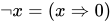
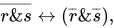
Truth functions of further propositional connectives can be defined by means of the t-norm and its residuum, for instance the residual negation or bi-residual equivalence Truth functions of propositional connectives may also be introduced by additional definitions: the most usual ones are the minimum (which plays a role of another conjunctive connective), the maximum (which plays a role of a disjunctive connective), or the Baaz Delta operator, defined in [0, 1] as if and otherwise. In this way, a left-continuous t-norm, its residuum, and the truth functions of additional propositional connectives determine the truth values of complex propositional formulae in [0, 1].
Formulae that always evaluate to 1 are called tautologies with respect to the given left-continuous t-norm or tautologies. The set of all tautologies is called the logic of the t-norm as these formulae represent the laws of fuzzy logic (determined by the t-norm) that hold (to degree 1) regardless of the truth degrees of atomic formulae. Some formulae are tautologies with respect to a larger class of left-continuous t-norms; the set of such formulae is called the logic of the class. Important t-norm logics are the logics of particular t-norms or classes of t-norms, for example:
It turns out that many logics of particular t-norms and classes of t-norms are axiomatizable. The completeness theorem of the axiomatic system with respect to the corresponding t-norm semantics on [0, 1] is then called the standard completeness of the logic. Besides the standard real-valued semantics on [0, 1], the logics are sound and complete with respect to general algebraic semantics, formed by suitable classes of prelinear commutative bounded integral residuated lattices.
Some particular t-norm fuzzy logics have been introduced and investigated long before the family was recognized (even before the notions of fuzzy logic or t-norm emerged):
A systematic study of particular t-norm fuzzy logics and their classes began with Hájek's (1998) monograph Metamathematics of Fuzzy Logic, which presented the notion of the logic of a continuous t-norm, the logics of the three basic continuous t-norms (Łukasiewicz, Gödel, and product), and the 'basic' fuzzy logic BL of all continuous t-norms (all of them both propositional and first-order). The book also started the investigation of fuzzy logics as non-classical logics with Hilbert-style calculi, algebraic semantics, and metamathematical properties known from other logics (completeness theorems, deduction theorems, complexity, etc.).
Since then, a plethora of t-norm fuzzy logics have been introduced and their metamathematical properties have been investigated. Some of the most important t-norm fuzzy logics were introduced in 2001, by Esteva and Godo (MTL, IMTL, SMTL, NM, WNM),[1] Esteva, Godo, and Montagna (propositional ŁΠ),[6] and Cintula (first-order ŁΠ).[7]
The logical vocabulary of propositional t-norm fuzzy logics standardly comprises the following connectives:
Some propositional t-norm logics add further propositional connectives to the above language, most often the following ones:
Well-formed formulae of propositional t-norm logics are defined from propositional variables (usually countably many) by the above logical connectives, as usual in propositional logics. In order to save parentheses, it is common to use the following order of precedence:
First-order variants of t-norm logics employ the usual logical language of first-order logic with the above propositional connectives and the following quantifiers:
The first-order variant of a propositional t-norm logic is usually denoted by
Algebraic semantics is predominantly used for propositional t-norm fuzzy logics, with three main classes of algebras with respect to which a t-norm fuzzy logic is complete:
Source: Wikipedia. Article content is retrieved live through the MediaWiki API.
T-norm fuzzy logics are a family of non-classical logics, informally delimited by having a semantics that takes the real unit interval [0, 1] for the system of truth values and functions called t-norms for permissible interpretations of conjunction. They are mainly used in applied fuzzy logic and fuzzy set theory as a theoretical basis for approximate reasoning. T-norm fuzzy logics belong in broader classes of fuzzy logics and many-valued logics. In order to generate a well-behaved implication, the t-norms are usually required to be left-continuous; logics of left-continuous t-norms further belong in the class of substructural logics, among which they are marked with the validity of the law of prelinearity, (A → B) ∨ (B → A). Both propositional and first-order (or higher-order) t-norm fuzzy logics, as well as their expansions by modal and other operators, are studied. Logics that restrict the t-norm semantics to a subset of the real unit interval (for example, finitely valued Łukasiewicz logics) are usually included in the class as well. Important examples of t-norm fuzzy logics are monoidal t-norm logic (MTL) of all left-continuous t-norms, basic logic (BL) of all continuous t-norms, product fuzzy logic of the product t-norm, or the nilpotent minimum logic of the nilpotent minimum t-norm. Some independently motivated logics belong among t-norm fuzzy logics, too, for example Łukasiewicz logic (which is the logic of the Łukasiewicz t-norm) or Gödel–Dummett logic (which is the logic of the minimum t-norm).
In mathematics and philosophy, Łukasiewicz logic ( WUUK-ə-SHEV-itch, Polish: [wukaˈɕɛvitʂ]) is a non-classical, many-valued logic. It was originally defined in the early 20th century by Jan Łukasiewicz as a three-valued modal logic; it was later generalized to n-valued (for all finite integers n) as well as infinitely-many-valued (ℵ0-valued) variants, both propositional and first order. The ℵ0-valued version was published in 1930 by Łukasiewicz and Alfred Tarski; consequently it is sometimes called the Łukasiewicz–Tarski logic. It belongs to the classes of t-norm fuzzy logics and substructural logics. Łukasiewicz logic was motivated by Aristotle's suggestion that bivalent logic was not applicable to future contingents, e.g. the statement "There will be a sea battle tomorrow". In other words, statements about the future were neither true nor false, but an intermediate value could be assigned to them, to represent their possibility of becoming true in the future. This article presents the Łukasiewicz(–Tarski) logic in its full generality, i.e. as an infinite-valued logic. For an elementary introduction to the three-valued instantiation Ł3, see three-valued logic.
In mathematical logic, basic fuzzy logic (or shortly BL), the logic of the continuous t-norms, is one of the t-norm fuzzy logics. It belongs to the broader class of substructural logics, or logics of residuated lattices; it extends the logic MTL of all left-continuous t-norms.
In logic, a finite-valued logic (also finitely many-valued logic) is a propositional calculus in which truth values are discrete. Traditionally, in Aristotle's logic, the bivalent logic, also known as binary logic was the norm, as the law of the excluded middle precluded more than two possible values (i.e., "true" and "false") for any proposition. Modern three-valued logic (ternary logic) allows for an additional possible truth value (i.e. "undecided"). The term finitely many-valued logic is typically used to describe many-valued logic having three or more, but not infinite, truth values. The term finite-valued logic encompasses both finitely many-valued logic and bivalent logic. Fuzzy logics, which allow for degrees of values between "true" and "false", are typically not considered forms of finite-valued logic. However, finite-valued logic can be applied in Boolean-valued modeling, description logics, and defuzzification of fuzzy logic. A finite-valued logic is decidable (sure to determine outcomes of the logic when it is applied to propositions) if and only if it has a computational semantics.
Before the 1921 destruction of Tulsa’s Greenwood District, Black residents had created a remarkable center of business and community life. The district included stores, professional offices, entertainment venues and homes owned by Black citizens. Understanding Greenwood means learning what was built—not only what was burned.
MORE →The Greenwood District.

![{\displaystyle *\colon [0,1]^{2}\to [0,1]}](https://wikimedia.org/api/rest_v1/media/math/render/svg/b487119b16546cca8396fbeaca49080b7cd7f0e9)