Civil Rights
Movements, leaders, victories and the continuing fight for equality.

Explore the people, places, events, achievements, struggles and stories that shaped our journey.
Movements, leaders, victories and the continuing fight for equality.
Innovation, patents, science, technology and world-changing contributions.
Pioneers, champions, Negro Leagues, records, activism and excellence.
Meet the people whose lives, choices and achievements shaped the journey.
Black towns, communities, institutions and places where history happened.
Moments that changed communities, movements, institutions and the nation.
In 1968 Shirley Chisholm became the first Black woman elected to the United States Congress. In 1972 she launched a campaign for the Democratic presidential nomination, breaking another political barrier.
MORE →Reflects the personal views, recollections, and perspective of the author, Mike Davis.
This is a personal recollection on the Move fire on May 13, 1985
In population biology and demography, generation time is the average time between two consecutive generations in the lineages of a population, being linked to biological life cycles. In human populations, generation time typically has ranged from 20 to 30 years, with wide variation based on gender and society.[1][2] Historians sometimes use this to date events, by converting generations into years to obtain rough estimates of time.
The existing definitions of generation time fall into two categories: those that treat generation time as a renewal time of the population, and those that focus on the distance between individuals of one generation and the next. Below are the three most commonly used definitions:[3][4]
The net reproductive rate is the number of offspring an individual is expected to produce during its lifetime: means demographic equilibrium. One may then define the generation time as the time it takes for the population to increase by a factor of . For example, in microbiology, a population of cells undergoing exponential growth by mitosis replaces each cell by two daughter cells, so that and is the population doubling time.
If the population grows with exponential growth rate , so that the population size at time is given by then the generation time is given by
Indeed, is such that , i.e. .
This definition is a measure of the distance between generations rather than a renewal time of the population. Since many demographic models are female-based (that is, they only take females into account), this definition is often expressed as a mother-daughter distance (the "average age of mothers at birth of their daughters"). However, it is also possible to define a father-son distance (average age of fathers at the birth of their sons) or not to take sex into account at all in the definition. In age-structured population models, an expression is given by:[3][4]
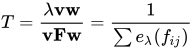
where is the growth rate of the population, is the survivorship function (probability that an individual survives to age ) and the maternity function (birth function, age-specific fertility). For matrix population models, there is a general formula:[5]
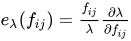
where is the discrete-time growth rate of the population, is its fertility matrix, its reproductive value (row-vector) and its stable stage distribution (column-vector); the are the elasticities of to the fertilities.
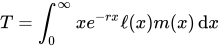
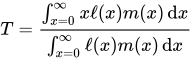
This definition is very similar to the previous one but the population need not be at its stable age distribution. Moreover, it can be computed for different cohorts and thus provides more information about the generation time in the population. This measure is given by:[3][4]
Indeed, the numerator is the sum of the ages at which a member of the cohort reproduces, and the denominator is R0, the average number of offspring it produces.
| Key concepts | |||||||||
|---|---|---|---|---|---|---|---|---|---|
| Measurement and standards |
| ||||||||
| Philosophy of time | |||||||||
| Human experience and use of time | |||||||||
| Time in science |
| ||||||||
| Related | |||||||||
Source: Wikipedia. Article content is retrieved live through the MediaWiki API.
In population biology and demography, generation time is the average time between two consecutive generations in the lineages of a population, being linked to biological life cycles. In human populations, generation time typically has ranged from 20 to 30 years, with wide variation based on gender and society. Historians sometimes use this to date events, by converting generations into years to obtain rough estimates of time.
"Time Squared" is the thirteenth episode of the second season of the American science fiction television series Star Trek: The Next Generation, the 39th episode overall. It originally aired on April 3, 1989, in broadcast syndication. The episode was written by Maurice Hurley from a story by Kurt Michael Bensmiller and directed by Joseph L. Scanlan. Set in the 24th century, the series follows the adventures of the Starfleet crew of the Federation starship Enterprise-D. In this episode, the crew of the Enterprise encounter a double of Captain Picard, apparently from the future.
"Time’s Arrow" is the 26th episode of the fifth season and the first episode of the sixth season of the American science fiction television series Star Trek: The Next Generation. It comprises the 126th and 127th episodes of the series. Set in the 24th century, the series follows the adventures of the Starfleet crew of the Federation starship Enterprise-D. In this episode, an engineering team finds evidence that aliens visited Earth in 19th century San Francisco: Data's severed head, buried five hundred years ago. The second part of the episode was nominated for three Primetime Creative Arts Emmy Awards, winning the award for Outstanding Individual Achievement in Hairstyling for a Series.

Brachionus calyciflorus is a planktonic species of rotifer occurring in freshwater. It is commonly used as a model organism in toxicology, ecology and evolutionary biology. Its advantages include the small size and short generation time (average generation time of B. calyciflorus is around 2.2 days at 24 °C).
Before the 1921 destruction of Tulsa’s Greenwood District, Black residents had created a remarkable center of business and community life. The district included stores, professional offices, entertainment venues and homes owned by Black citizens. Understanding Greenwood means learning what was built—not only what was burned.
MORE →Madam C.J. Walker