Civil Rights
Movements, leaders, victories and the continuing fight for equality.

Explore the people, places, events, achievements, struggles and stories that shaped our journey.
Movements, leaders, victories and the continuing fight for equality.
Innovation, patents, science, technology and world-changing contributions.
Pioneers, champions, Negro Leagues, records, activism and excellence.
Meet the people whose lives, choices and achievements shaped the journey.
Black towns, communities, institutions and places where history happened.
Moments that changed communities, movements, institutions and the nation.
Wilmington, North Carolina once had a thriving Black middle class and an elected interracial government. In 1898 white supremacists used violence to overthrow that government, kill Black residents and drive many others from the city.
MORE →Reflects the personal views, recollections, and perspective of the author, Mike Davis.
This is a personal recollection on the Move fire on May 13, 1985
Gestalt pattern matching,[1] also Ratcliff/Obershelp pattern recognition,[2] is a string-matching algorithm for determining the similarity of two strings. It was developed in 1983 by John W. Ratcliff and John A. Obershelp and published in the Dr. Dobb's Journal in July 1988.[2]
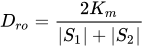
The similarity of two strings and is determined by this formula: twice the number of matching characters divided by the total number of characters of both strings. The matching characters are defined as some longest common substring[3] plus recursively the number of matching characters in the non-matching regions on both sides of the longest common substring:[2][4]
where the similarity metric can take a value between zero and one:
The value of 1 stands for the complete match of the two strings, whereas the value of 0 means there is no match and not even one common letter.
| S1 | W | I | K | I | M | E | D | I | A |
|---|---|---|---|---|---|---|---|---|---|
| S2 | W | I | K | I | M | A | N | I | A |
The longest common substring is WIKIM (light grey) with 5 characters. There is no further substring on the left. The non-matching substrings on the right side are EDIA and ANIA. They again have a longest common substring IA (dark gray) with length 2.
The similarity metric is determined by:
The Ratcliff/Obershelp matching characters can be substantially different from each longest common subsequence of the given strings. For example and have as their only longest common substring, and no common characters right of its occurrence, and likewise left, leading to . However, the longest common subsequence of and is , with a total length of .
The execution time of the algorithm is in a worst case and in an average case. By changing the computing method, the execution time can be improved significantly.[1]
The Python library implementation of the gestalt pattern matching algorithm is not commutative:[5]
For the two strings
and
the metric result for
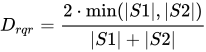
GESTALT P, A, T, E and forGESTALT P, R, A, C, I.[why?]The Python difflib library, which was introduced in version 2.1,[1] implements a similar algorithm that predates the Ratcliff-Obershelp algorithm. Due to the unfavourable runtime behaviour of this similarity metric, three methods have been implemented. Two of them return an upper bound in a faster execution time.[1] The fastest variant only compares the length of the two substrings:[6]
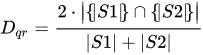
The second upper bound calculates twice the sum of all used characters which occur in divided by the length of both strings but the sequence is ignored.
# Dqr Implementation in Python
import collections


def quick_ratio(s1: str, s2: str) -> float:
    """Return an upper bound on ratio() relatively quickly."""
    length = len(s1) + len(s2)

    if not length:
        return 1.0

    intersect = (collections.Counter(s1) & collections.Counter(s2))
    matches = sum(intersect.values())
    return 2.0 * matches / length
Trivially the following applies:
Source: Wikipedia. Article content is retrieved live through the MediaWiki API.
Gestalt pattern matching, also Ratcliff/Obershelp pattern recognition, is a string-matching algorithm for determining the similarity of two strings. It was developed in 1983 by John W. Ratcliff and John A. Obershelp and published in the Dr. Dobb's Journal in July 1988.
In computer science, pattern matching is the act of checking a given sequence of tokens for the presence of the constituents of some pattern. In contrast to pattern recognition, the match usually must be exact: "either it will or will not be a match." The patterns generally have the form of either sequences or tree structures. Uses of pattern matching include outputting the locations (if any) of a pattern within a token sequence, to output some component of the matched pattern, and to substitute the matching pattern with some other token sequence (i.e., search and replace). Sequence patterns (e.g., a text string) are often described using regular expressions and matched using techniques such as backtracking. Tree patterns are used in some programming languages as a general tool to process data based on its structure, e.g. C#, F#, Haskell, Java, ML, Python, Racket, Ruby, Rust, Scala, Swift and the symbolic mathematics language Mathematica have special syntax for expressing tree patterns and a language construct for conditional execution and value retrieval based on it. Often it is possible to give alternative patterns that are tried one by one, which yields a powerful conditional programming construct. Pattern matching sometimes includes support for guards.
In computer science, compressed pattern matching (abbreviated as CPM) is the process of searching for patterns in compressed data with little or no decompression. Searching in a compressed string is faster than searching an uncompressed string and requires less space.
In psychology and cognitive neuroscience, pattern recognition is a cognitive process that matches information from a stimulus with information retrieved from memory. Pattern recognition occurs when information from the environment is received and entered into short-term memory, causing automatic activation of a specific content of long-term memory. An example of this is learning the alphabet in order. When a carer repeats "A, B, C" multiple times to a child, the child, using pattern recognition, says "C" after hearing "A, B" in order. Recognizing patterns allows anticipation and prediction of what is to come. Making the connection between memories and information perceived is a step in pattern recognition called identification. Pattern recognition requires repetition of experience. Semantic memory, which is used implicitly and subconsciously, is the main type of memory involved in recognition. Pattern recognition is crucial not only to humans, but also to other animals. Even koalas, which possess less-developed thinking abilities, use pattern recognition to find and consume eucalyptus leaves. The human brain has developed more, but holds similarities to the brains of birds and lower mammals. The development of neural networks in the outer layer of the brain in humans has allowed for better processing of visual and auditory patterns. Spatial positioning in the environment, remembering findings, and detecting hazards and resources to increase chances of survival are examples of the application of pattern recognition for humans and animals. There are six main theories of pattern recognition: template matching, prototype-matching, feature analysis, recognition-by-components theory, bottom-up and top-down processing, and Fourier analysis. The application of these theories in everyday life is not mutually exclusive. Pattern recognition allows us to read words, understand language, recognize friends, and even appreciate music. Each of the theories applies to various activities and domains where pattern recognition is observed. Facial, music and language recognition, and seriation are a few of such domains. Facial recognition and seriation occur through encoding visual patterns, while music and language recognition use the encoding of auditory patterns.
Before the 1921 destruction of Tulsa’s Greenwood District, Black residents had created a remarkable center of business and community life. The district included stores, professional offices, entertainment venues and homes owned by Black citizens. Understanding Greenwood means learning what was built—not only what was burned.
MORE →Brown v. Board of Education in 1954.