Civil Rights
Movements, leaders, victories and the continuing fight for equality.

Explore the people, places, events, achievements, struggles and stories that shaped our journey.
Movements, leaders, victories and the continuing fight for equality.
Innovation, patents, science, technology and world-changing contributions.
Pioneers, champions, Negro Leagues, records, activism and excellence.
Meet the people whose lives, choices and achievements shaped the journey.
Black towns, communities, institutions and places where history happened.
Moments that changed communities, movements, institutions and the nation.
In 1968 Shirley Chisholm became the first Black woman elected to the United States Congress. In 1972 she launched a campaign for the Democratic presidential nomination, breaking another political barrier.
MORE →Reflects the personal views, recollections, and perspective of the author, Mike Davis.
This is a personal recollection on the Move fire on May 13, 1985
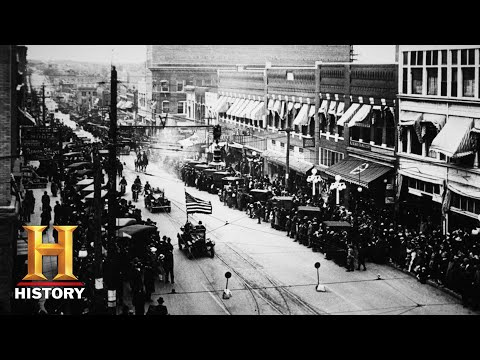
Located in Tulsa, Oklahoma, this residential neighborhood known as Greenwood provided an opportunity for Blacks to ...
The Black Wall Street may refer to: Greenwood District, Tulsa, Oklahoma, a neighborhood containing many African-American businesses in the early 20th Century Tulsa race massacre of 1921, in which a white mob destroyed much of Greenwood Jackson Ward, a thriving African-American business community in Richmond, Virginia Black Wall Street (Durham, North Carolina), Parrish Street, in Durham, North Carolina, an area of successful black-owned businesses The Black Wall Street Records, a record label
The Black Wall Street Times is an African-American newspaper founded in Tulsa, Oklahoma, in 2017. It is named after Tulsa's Greenwood District, which is also known as Black Wall Street.

Greenwood is a historic neighborhood and freedom colony in Tulsa, Oklahoma. As one of the most prominent concentrations of African-American businesses in the United States during the early 20th century, it was popularly known as US "Black Wall Street". It was burned to the ground in the Tulsa race massacre of 1921, in which a local White mob gathered and attacked the area. Between 75 and 300 Black Americans were killed, hundreds more were injured, and the homes of 5,000 were destroyed, leaving them homeless. The massacre was one of the largest in the history of U.S. race relations, destroying the once-thriving Greenwood community. Within ten years of the massacre, surviving residents who chose to remain in Tulsa rebuilt much of the district. They accomplished this despite the opposition of many white Tulsa political and business leaders and punitive rezoning laws enacted to prevent reconstruction. It continued as a vital black community until segregation was overturned by the federal government during the 1950s and 1960s. Desegregation encouraged black citizens to live and shop elsewhere in the city, causing Greenwood to lose much of its original vitality. Since then, city leaders have attempted to encourage other economic development activity nearby.
The family known in the media as the "black McCains" are the living descendants of Isom McCain (1831 – between 1888 and 1890) and Leddie McCain, African-American people enslaved in Teoc, Mississippi, by William Alexander McCain, a cotton plantation owner who was the great-great-grandfather of Senator John McCain. The black McCains trace their surname to this slave ownership and neither claim nor disclaim blood relationship with Senator McCain. Among the black McCains, siblings Lillie McCain (born 1952), of Detroit, and Charles McCain, Jr. (born 1948) and Mary Lou McCain Fluker, of Carrollton, Miissssippi, are the living contemporaries of Senator McCain. Lillie McCain had in the past e-mailed Senator McCain to inform him about the black McCains after she heard him say on Meet the Press that his ancestors owned no slaves. John McCain stated that he had not known about the slaveholding past until it was discovered by reporters during his 2000 presidential campaign. The McCain plantation in Teoc, which was formally named Waverly, consisted of 2,000-acre (8.1 km2) and existed from 1848 until 1952. The plantation had slaves before the American Civil War and sharecroppers afterward; influential blues guitarist Mississippi John Hurt was born on the plantation to one of the latter. According to The Wall Street Journal Atlanta Bureau Chief Douglas Blackmon, who researched the black McCains in 2008, the black McCains "resisted the Ku Klux Klan, led the civil rights movement and voter registration efforts in the 1960s", and "integrated public schools" in Mississippi. Lillie McCain's father Charles "Jack" McCain, a World War II veteran, purchased 120 acres (0.49 km2) of land in Teoc and split it with his cousin, participating in the civil rights movement in the South, working with Stokely Carmichael when he came to Greenwood, Mississippi. Senator John McCain never met any of the black McCains. Lillie McCain said that Senator John McCain was invited to their biannual family reunion functions in Teoc, but according to the 2008 McCain presidential campaign, schedule conflicts had prevented Senator McCain from attending, though the brother of the Senator, Joseph "Joe" McCain, has attended the Teoc reunions. A statement by the McCain 2008 presidential campaign on the subject of the black McCains said: "How the Teoc descendants have served their community, and by extension, their country, is a testament to the power of family, love, compassion, and the human spirit."
This resource is located in Middlesex County, Massachusetts. Areas of significance include: Architecture. Architectural classifications include: Stick Style. The National Historic Places Register Reference Number is 89000702.
This resource is located in Bartow County, Georgia. Areas of significance include: Architecture; Commerce; Transportation. Architectural classifications include: Renaissance; Commercial Victorian Vernacular; 20th Century Commercial; Stripped Classical. The National Historic Places Register Reference Number is 98000249.
This resource is located in Leflore County, Mississippi. Areas of significance include: Architecture; Agriculture; Exploration/Settlement; Ethnic Heritage: Black History; Industry; . The National Historic Places Register Reference Number is 64000408.
This resource is located in Greenwood County, Kansas. Areas of significance include: Commerce. Architectural classifications include: Spanish Colonial Revival. The National Historic Places Register Reference Number is 06000769.
Caption
Caption
Caption
Caption
Before the 1921 destruction of Tulsa’s Greenwood District, Black residents had created a remarkable center of business and community life. The district included stores, professional offices, entertainment venues and homes owned by Black citizens. Understanding Greenwood means learning what was built—not only what was burned.
MORE →The Greenwood District.