Civil Rights
Movements, leaders, victories and the continuing fight for equality.

Explore the people, places, events, achievements, struggles and stories that shaped our journey.
Movements, leaders, victories and the continuing fight for equality.
Innovation, patents, science, technology and world-changing contributions.
Pioneers, champions, Negro Leagues, records, activism and excellence.
Meet the people whose lives, choices and achievements shaped the journey.
Black towns, communities, institutions and places where history happened.
Moments that changed communities, movements, institutions and the nation.
In 1968 Shirley Chisholm became the first Black woman elected to the United States Congress. In 1972 she launched a campaign for the Democratic presidential nomination, breaking another political barrier.
MORE →Reflects the personal views, recollections, and perspective of the author, Mike Davis.
This is a personal recollection on the Move fire on May 13, 1985
In the mathematical study of heat conduction and diffusion, a heat kernel is the fundamental solution to the heat equation on a specified domain with appropriate boundary conditions. It is also one of the main tools in the study of the spectrum of the Laplace operator, and is thus of some auxiliary importance throughout mathematical physics. The heat kernel represents the evolution of temperature in a region whose boundary is held fixed at a particular temperature (typically zero), such that an initial unit of heat energy is placed at a point at time t = 0.

The most well-known heat kernel is the heat kernel of d-dimensional Euclidean space Rd, which has the form of a time-varying Gaussian function,
which is defined for all and .[1] This solves the heat equation
for the unknown function K. Here δ is a Dirac delta distribution, and the limit is taken in the sense of distributions, that is, for every function ϕ in the space C∞
c(Rd) of smooth functions with compact support, we have[2]
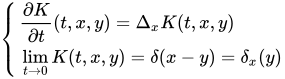
On a more general domain Ω in Rd, such an explicit formula is not generally possible. The next simplest cases of a disc or square involve, respectively, Bessel functions and Jacobi theta functions. Nevertheless, the heat kernel still exists and is smooth for t > 0 on arbitrary domains and indeed on any Riemannian manifold with boundary, provided the boundary is sufficiently regular. More precisely, in these more general domains, the heat kernel is the solution of the initial boundary value problem
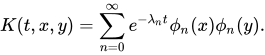
To derive a formal expression for the heat kernel on an arbitrary domain, consider the Dirichlet problem in a connected domain (or manifold with boundary) U. Let λn be the eigenvalues for the Dirichlet problem of the Laplacian[3] Let ϕn denote the associated eigenfunctions, normalized to be orthonormal in L2(U). The inverse Dirichlet Laplacian Δ−1 is a compact and selfadjoint operator, and so the spectral theorem implies that the eigenvalues of Δ satisfy The heat kernel has the following expression: Formally differentiating the series under the sign of the summation shows that this should satisfy the heat equation. However, convergence and regularity of the series are quite delicate.
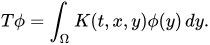
The heat kernel is also sometimes identified with the associated integral transform, defined for compactly supported smooth ϕ by The spectral mapping theorem gives a representation of T in the form the semigroup[4][5]
There are several geometric results on heat kernels on manifolds; say, short-time asymptotics, long-time asymptotics, and upper/lower bounds of Gaussian type.
| Spaces |
| ||||
|---|---|---|---|---|---|
| Theorems | |||||
| Operators | |||||
| Algebras | |||||
| Open problems | |||||
| Applications | |||||
| Advanced topics | |||||
Source: Wikipedia. Article content is retrieved live through the MediaWiki API.
In the mathematical study of heat conduction and diffusion, a heat kernel is the fundamental solution to the heat equation on a specified domain with appropriate boundary conditions. It is also one of the main tools in the study of the spectrum of the Laplace operator, and is thus of some auxiliary importance throughout mathematical physics. The heat kernel represents the evolution of temperature in a region whose boundary is held fixed at a particular temperature (typically zero), such that an initial unit of heat energy is placed at a point at time t = 0.
A heat kernel signature (HKS) is a feature descriptor for use in deformable shape analysis and belongs to the group of spectral shape analysis methods. For each point in the shape, HKS defines its feature vector representing the point's local and global geometric properties. Applications include segmentation, classification, structure discovery, shape matching and shape retrieval. HKS was introduced in 2009 by Jian Sun, Maks Ovsjanikov and Leonidas Guibas. It is based on the heat kernel, which is a fundamental solution to the heat equation. HKS is one of the many recently introduced shape descriptors which are based on the Laplace–Beltrami operator associated with the shape.

James Ritchie Norris (born 29 August 1960) is a mathematician working in probability theory and stochastic analysis. He is the Professor of Stochastic Analysis in the Statistical Laboratory, University of Cambridge. He has made contributions to areas of mathematics connected to probability theory and mathematical analysis, including Malliavin calculus, heat kernel estimates, and mathematical models for coagulation and fragmentation. He was awarded the Rollo Davidson Prize in 1997. Norris was an undergraduate at Hertford College, Oxford where he graduated in 1981. He completed his D.Phil in 1985 at Wolfson College, Oxford under the supervision of David Edwards. He was a research assistant from 1984 to 1985 at the University College of Swansea before moving in 1985 to a lectureship at Cambridge University and a Fellowship of Churchill College, Cambridge. He was appointed Professor of Stochastic Analysis in 2005. He is the director of the Statistical Laboratory, a trustee of the Rollo Davidson Trust and co-director of the Cambridge Centre for Analysis.
The Cole–Hopf transformation is a change of variables that allows to transform a special kind of parabolic partial differential equations (PDEs) with a quadratic nonlinearity into a linear heat equation. In particular, it provides an explicit formula for fairly general solutions of the PDE in terms of the initial datum and the heat kernel. Consider the following PDE: u t − a Δ u + b ‖ ∇ u ‖ 2 = 0 , u ( 0 , x ) = g ( x ) {\displaystyle u_{t}-a\Delta u+b\|\nabla u\|^{2}=0,\quad u(0,x)=g(x)} where x ∈ R n {\displaystyle x\in \mathbb {R} ^{n}} , a , b {\displaystyle a,b} are constants, Δ {\displaystyle \Delta } is the Laplace operator, ∇ {\displaystyle \nabla } is the gradient, and ‖ ⋅ ‖ {\displaystyle \|\cdot \|} is the Euclidean norm in R n {\displaystyle \mathbb {R} ^{n}} . By assuming that w = ϕ ( u ) {\displaystyle w=\phi (u)} , where ϕ ( ⋅ ) {\displaystyle \phi (\cdot )} is an unknown smooth function, we may calculate: w t = ϕ ′ ( u ) u t , Δ w = ϕ ′ ( u ) Δ u + ϕ ″ ( u ) ‖ ∇ u ‖ 2 {\displaystyle w_{t}=\phi '(u)u_{t},\quad \Delta w=\phi '(u)\Delta u+\phi ''(u)\|\nabla u\|^{2}} Which implies that: w t = ϕ ′ ( u ) u t = ϕ ′ ( u ) ( a Δ u − b ‖ ∇ u ‖ 2 ) = a Δ w − ( a ϕ ″ + b ϕ ′ ) ‖ ∇ u ‖ 2 = a Δ w {\displaystyle {\begin{aligned}w_{t}=\phi '(u)u_{t}&=\phi '(u)\left(a\Delta u-b\|\nabla u\|^{2}\right)\\&=a\Delta w-(a\phi ''+b\phi ')\|\nabla u\|^{2}\\&=a\Delta w\end{aligned}}} if we constrain ϕ {\displaystyle \phi } to satisfy a ϕ ″ + b ϕ ′ = 0 {\displaystyle a\phi ''+b\phi '=0} . Then we may transform the original nonlinear PDE into the canonical heat equation by using the transformation: This is the Cole-Hopf transformation. With the transformation, the following initial-value problem can now be solved: w t − a Δ w = 0 , w ( 0 , x ) = e − b g ( x ) / a {\displaystyle w_{t}-a\Delta w=0,\quad w(0,x)=e^{-bg(x)/a}} The unique, bounded solution of this system is: w ( t , x ) = 1 ( 4 π a t ) n / 2 ∫ R n e − ‖ x − y ‖ 2 / 4 a t − b g ( y ) / a d y {\displaystyle w(t,x)={1 \over {(4\pi at)^{n/2}}}\int _{\mathbb {R} ^{n}}e^{-\|x-y\|^{2}/4at-bg(y)/a}dy} Since the Cole–Hopf transformation implies that u = − ( a / b ) log w {\displaystyle u=-(a/b)\log w} , the solution of the original nonlinear PDE is: u ( t , x ) = − a b log [ 1 ( 4 π a t ) n / 2 ∫ R n e − ‖ x − y ‖ 2 / 4 a t − b g ( y ) / a d y ] {\displaystyle u(t,x)=-{a \over {b}}\log \left[{1 \over {(4\pi at)^{n/2}}}\int _{\mathbb {R} ^{n}}e^{-\|x-y\|^{2}/4at-bg(y)/a}dy\right]} The complex form of the Cole–Hopf transformation can be used to transform the Schrödinger equation to the Madelung equation.
Before the 1921 destruction of Tulsa’s Greenwood District, Black residents had created a remarkable center of business and community life. The district included stores, professional offices, entertainment venues and homes owned by Black citizens. Understanding Greenwood means learning what was built—not only what was burned.
MORE →Joe Louis.



![{\displaystyle {\begin{cases}{\frac {\partial K}{\partial t}}(t,x,y)=\Delta _{x}K(t,x,y)&{\text{for all }}t>0{\text{ and }}x,y\in \Omega \\[6pt]\lim _{t\to 0}K(t,x,y)=\delta _{x}(y)&{\text{for all }}x,y\in \Omega \\[6pt]K(t,x,y)=0&x\in \partial \Omega {\text{ or }}y\in \partial \Omega \end{cases}}}](https://wikimedia.org/api/rest_v1/media/math/render/svg/c2b57305e8e43dd3a4bb8e525929a67c1cbc5251)