Civil Rights
Movements, leaders, victories and the continuing fight for equality.

Explore the people, places, events, achievements, struggles and stories that shaped our journey.
Movements, leaders, victories and the continuing fight for equality.
Innovation, patents, science, technology and world-changing contributions.
Pioneers, champions, Negro Leagues, records, activism and excellence.
Meet the people whose lives, choices and achievements shaped the journey.
Black towns, communities, institutions and places where history happened.
Moments that changed communities, movements, institutions and the nation.
Wilmington, North Carolina once had a thriving Black middle class and an elected interracial government. In 1898 white supremacists used violence to overthrow that government, kill Black residents and drive many others from the city.
MORE →Reflects the personal views, recollections, and perspective of the author, Mike Davis.
This is a personal recollection on the Move fire on May 13, 1985
In mathematics, the hypercomplex number is a traditional term for an element of a finite-dimensional unital algebra over the field of real numbers. The study of hypercomplex numbers in the late 19th century forms the basis of modern group representation theory.

In the nineteenth century, number systems called quaternions, tessarines, coquaternions, biquaternions, and octonions became established concepts in mathematical literature, extending the real and complex numbers. The concept of a hypercomplex number covered them all, and called for a discipline to explain and classify them.
The cataloguing project began in 1872 when Benjamin Peirce first published his Linear Associative Algebra, and was carried forward by his son Charles Sanders Peirce.[1] Most significantly, they identified the nilpotent and the idempotent elements as useful hypercomplex numbers for classifications. The Cayley–Dickson construction used involutions to generate complex numbers, quaternions, and octonions out of the real number system. Hurwitz and Frobenius proved theorems that put limits on hypercomplexity: Hurwitz's theorem says finite-dimensional real composition algebras are the reals , the complexes , the quaternions , and the octonions , and the Frobenius theorem says the only real associative division algebras are , , and . In 1958 J. Frank Adams published a further generalization in terms of Hopf invariants on H-spaces that still limits the dimension to 1, 2, 4, or 8.[2]
It was matrix algebra that harnessed the hypercomplex systems. For instance, real matrices were found isomorphic to coquaternions. Soon the matrix paradigm began to explain several others as they were represented by matrices and their operations. In 1907 Joseph Wedderburn showed that associative hypercomplex systems could be represented by square matrices, or direct products of algebras of square matrices.[3][4] From that date the preferred term for a hypercomplex system became associative algebra, as seen in the title of Wedderburn's thesis at University of Edinburgh. Note, however, that non-associative systems like octonions and hyperbolic quaternions represent another type of hypercomplex number.
As Thomas Hawkins[5] explains, the hypercomplex numbers are stepping stones to learning about Lie groups and group representation theory. For instance, in 1929 Emmy Noether wrote on "hypercomplex quantities and representation theory".[6] In 1973 Kantor and Solodovnikov published a textbook on hypercomplex numbers, which was translated in 1989.[7][8]
Karen Parshall has written a detailed exposition of the heyday of hypercomplex numbers,[9] including the role of mathematicians including Theodor Molien[10] and Eduard Study.[11] For the transition to modern algebra, Bartel van der Waerden devotes thirty pages to hypercomplex numbers in his History of Algebra.[12]
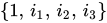
A definition of a hypercomplex number is given by Kantor & Solodovnikov (1989) as an element of a unital, but not necessarily associative or commutative, finite-dimensional algebra over the real numbers. Elements are generated with real number coefficients for a basis . Where possible, it is conventional to choose the basis so that . A technical approach to hypercomplex numbers directs attention first to those of dimension two.
Theorem:[7]: 14, 15 [13][14] Up to isomorphism, there are exactly three 2-dimensional unital algebras over the reals: the ordinary complex numbers, the split-complex numbers, and the dual numbers. In particular, every 2-dimensional unital algebra over the reals is associative and commutative.
Proof: Since the algebra is 2-dimensional, we can pick a basis . Since the algebra is closed under squaring, the non-real basis element squares to a linear combination of and :
for some real numbers and .
Using the common method of completing the square by subtracting and adding the quadratic complement to both sides yields
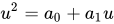
Rewriting the left half of the above equation as and then substituting in new element , where , one obtains
The three cases depend on this real value:
The complex numbers are the only quadratic algebra that is a field. Split algebras such as the split-complex numbers that include non-real roots of 1 also contain idempotents and zero divisors , so such algebras cannot be division algebras. However, these properties can turn out to be very meaningful, for instance in representing a light cone with a null cone.
In a 2004 edition of Mathematics Magazine the 2-dimensional real algebras have been styled the "generalized complex numbers".[15] The idea of cross-ratio of four complex numbers can be extended to the 2-dimensional real algebras.[16]
A Clifford algebra is the unital associative algebra generated over an underlying vector space equipped with a quadratic form. Over the real numbers this is equivalent to being able to define a symmetric scalar product, that can be used to orthogonalise the quadratic form, to give a basis such that:
Imposing closure under multiplication generates a multivector space spanned by a basis of elements, . These can be interpreted as the basis of a hypercomplex number system. Unlike the basis , the remaining basis elements need not anti-commute, depending on how many simple exchanges must be carried out to swap the two factors. So , but .
Putting aside the bases which contain an element such that (i.e. directions in the original space over which the quadratic form was degenerate), the remaining Clifford algebras can be identified by the label , indicating that the algebra is constructed from simple basis elements with , with , and where indicates that this is to be a Clifford algebra over the reals—i.e. coefficients of elements of the algebra are to be real numbers.
These algebras, called geometric algebras, form a systematic set, which turn out to be very useful in physics problems that involve rotations, phases, or spins, notably in classical and quantum mechanics, electromagnetic theory and relativity.
Examples include: the complex numbers , split-complex numbers , quaternions , split-biquaternions , split-quaternions (the natural algebra of two-dimensional Euclidean space); (the natural algebra of three-dimensional Euclidean space, and the algebra of the Pauli matrices); and the spacetime algebra .
The elements of the algebra form an even subalgebra of the algebra , which can be used to parametrise rotations in the larger algebra. There is thus a close connection between complex numbers and rotations in two-dimensional space; between quaternions and rotations in three-dimensional space; between split-complex numbers and (hyperbolic) rotations (Lorentz transformations) in (1+1)-dimensional space, and so on.
Whereas Cayley–Dickson and split-complex constructs with eight or more dimensions are not associative with respect to multiplication, Clifford algebras retain associativity at any number of dimensions.
In 1995 Ian R. Porteous wrote on "The recognition of subalgebras" in his book on Clifford algebras. His Proposition 11.4 summarizes the hypercomplex cases:[17]

All of the Clifford algebras apart from the real numbers, complex numbers and the quaternions contain non-real elements that square to +1; and so cannot be division algebras. A different approach to extending the complex numbers is taken by the Cayley–Dickson construction. This generates number systems of dimension , with bases , where all the non-real basis elements anti-commute and satisfy . In 8 or more dimensions () these algebras are non-associative. In 16 or more dimensions () these algebras also have nonzero zero-divisors.
The first algebras in this sequence include the 4-dimensional quaternions, 8-dimensional octonions, and 16-dimensional sedenions. An algebraic symmetry is lost with each increase in dimensionality: quaternion multiplication is not commutative, octonion multiplication is non-associative, and the norm of sedenions is not multiplicative. After the sedenions are the 32-dimensional trigintaduonions (or 32-nions), the 64-dimensional sexagintaquatronions (or 64-nions), the 128-dimensional centumduodetrigintanions (or 128-nions), the 256-dimensional ducentiquinquagintasexions (or 256-nions), and ad infinitum, as summarized in the table below.[18]
| Name | No. of dimensions |
Dimensions (2n) |
Symbol |
|---|---|---|---|
| real numbers | 1 | 20 | |
| complex numbers | 2 | 21 | |
| quaternions | 4 | 22 | |
| octonions | 8 | 23 | |
| sedenions | 16 | 24 | |
| trigintaduonions | 32 | 25 | |
| sexagintaquatronions | 64 | 26 | |
| centumduodetrigintanions | 128 | 27 | |
| ducentiquinquagintasexions | 256 | 28 |
The Cayley–Dickson construction can be modified by inserting an extra sign at some stages. It then generates the "split algebras" in the collection of composition algebras instead of the division algebras:
Unlike the complex numbers, the split-complex numbers are not algebraically closed, and further contain nontrivial zero divisors and nontrivial idempotents. As with the quaternions, split-quaternions are not commutative, but further contain nilpotents; they are isomorphic to the square matrices of dimension two. Split-octonions are non-associative and contain nilpotents.
The tensor product of any two algebras is another algebra, which can be used to produce many more examples of hypercomplex number systems.
In particular taking tensor products with the complex numbers (considered as algebras over the reals) leads to four-dimensional bicomplex numbers (isomorphic to tessarines ), eight-dimensional biquaternions , and 16-dimensional complex octonions .
Another example is the tensor product of two quaternion algebras (isomorphic to the Clifford algebra and to real matrices ) leading to applications in relativistic physics.[19][20]
More generally, one defines (and its subalgebras) as "hyperquaternion algebras". In particular, yields a quaternionic matrix and its even subalgebra (Dirac algebra).[21][22]

Number systems | |
|---|---|
| Sets of definable numbers | |
| Composition algebras |
|
| Split types | |
| Other hypercomplex | |
| Infinities and infinitesimals | |
| Other types | |
| International | |
|---|---|
| National | |
| Other | |
Source: Wikipedia. Article content is retrieved live through the MediaWiki API.
In mathematics, the hypercomplex number is a traditional term for an element of a finite-dimensional unital algebra over the field of real numbers. The study of hypercomplex numbers in the late 19th century forms the basis of modern group representation theory.

A number is a mathematical object used to count, measure, order and label. The most basic examples are the natural numbers: 1, 2, 3, 4, 5, and so forth. Individual numbers can be represented in spoken or written language with number words, or with dedicated symbols called numerals; for example, "eleven" is a number word and "11" is the corresponding numeral. As only a limited list of symbols can be memorized, a numeral system is used to represent any number in an organized way. The most common representation is the Hindu–Arabic numeral system, a decimal system which can display any non-negative integer using a combination of ten Arabic numeral symbols called digits. Numerals can be used for counting (as with cardinal number of a collection or set), for labelling (as with telephone numbers), for ordering (as with serial numbers), and for codes (as with ISBNs). In common usage, however, a numeral is not clearly distinguished from the number that it represents. In mathematics, the notion of a number has been extended over the centuries to include zero (0), negative numbers such as negative one (−1), rational numbers such as one half ( 1 2 ) {\displaystyle \left({\tfrac {1}{2}}\right)} , real numbers such as the square root of 2 ( 2 ) {\displaystyle \left({\sqrt {2}}\right)} , and pi (π), and complex numbers which extend the real numbers with a square root of −1 (i), and its combinations with real numbers by adding or subtracting its multiples. Calculations with numbers are done with arithmetical operations, the most familiar being addition, subtraction, multiplication, division, and exponentiation. Their study or usage is called arithmetic, a term which may also refer to number theory, the study of the properties of numbers. Viewing the concept of zero as a number required a fundamental shift in philosophy, identifying nothingness with a value. During the 19th century, mathematicians began to develop the various systems now called algebraic structures, which share certain properties of numbers, and may be seen as extending the concept. Some algebraic structures are explicitly referred to as numbers (such as the p-adic numbers and hypercomplex numbers) while others are not, but this is more a matter of convention than a mathematical distinction.
In mathematics, hypercomplex analysis is the extension of complex analysis to the hypercomplex numbers. The first instance is functions of a quaternion variable, where the argument is a quaternion (in this case, the sub-field of hypercomplex analysis is called quaternionic analysis). A second instance involves functions of a motor variable where arguments are split-complex numbers. In mathematical physics, there are hypercomplex systems called Clifford algebras. The study of functions with arguments from a Clifford algebra is called Clifford analysis. A matrix may be considered a hypercomplex number. For example, the study of functions of 2 × 2 real matrices shows that the topology of the space of hypercomplex numbers determines the function theory. Functions such as square root of a matrix, matrix exponential, and logarithm of a matrix are basic examples of hypercomplex analysis. The function theory of diagonalizable matrices is particularly transparent since they have eigendecompositions. Suppose T = ∑ i = 1 N λ i E i {\displaystyle \textstyle T=\sum _{i=1}^{N}\lambda _{i}E_{i}} where the Ei are projections. Then for any polynomial f {\displaystyle f} , f ( T ) = ∑ i = 1 N f ( λ i ) E i . {\displaystyle f(T)=\sum _{i=1}^{N}f(\lambda _{i})E_{i}.} The modern terminology for a "system of hypercomplex numbers" is an algebra over the real numbers, and the algebras used in applications are often Banach algebras since Cauchy sequences can be taken to be convergent. Then the function theory is enriched by sequences and series. In this context the extension of holomorphic functions of a complex variable is developed as the holomorphic functional calculus. Hypercomplex analysis on Banach algebras is called functional analysis.
In mathematics, the octonions are a normed division algebra over the real numbers, a kind of hypercomplex number system. The octonions are usually represented by the capital letter O, using boldface O or blackboard bold O {\displaystyle \mathbb {O} } . Octonions have eight dimensions; twice the number of dimensions of the quaternions, of which they are an extension. They are noncommutative and nonassociative, but satisfy weaker forms of associativity; they are alternative and power associative. Octonions are much less widely studied or used than the quaternions and complex numbers. Octonions are related to exceptional structures in mathematics, among them the exceptional Lie groups. Octonions have applications in fields such as string theory, special relativity and quantum logic. The Cayley–Dickson construction builds the octonions from the quaternions and in turn builds the sedenions from the octonions.
Before the 1921 destruction of Tulsa’s Greenwood District, Black residents had created a remarkable center of business and community life. The district included stores, professional offices, entertainment venues and homes owned by Black citizens. Understanding Greenwood means learning what was built—not only what was burned.
MORE →The Greenwood District.














![{\displaystyle {\text{Cl}}_{q+1,p}^{[0]}(\mathbb {R} )}](https://wikimedia.org/api/rest_v1/media/math/render/svg/cc4fa71280df9d960cb50485967f18bc2fce5103)