Explore the people, places, events, achievements, struggles and stories that shaped our journey.
✊🏾
Civil Rights
Movements, leaders, victories and the continuing fight for equality.
⚙️
Black Inventors
Innovation, patents, science, technology and world-changing contributions.
🏆
Sports
Pioneers, champions, Negro Leagues, records, activism and excellence.
♟️
People
Meet the people whose lives, choices and achievements shaped the journey.
📍
Places
Black towns, communities, institutions and places where history happened.
📜
Events
Moments that changed communities, movements, institutions and the nation.
Enter a person, place, event, or topic.
MY'STORY
The MOVE Fire
This is a personal recollection on the Move fire on May 13, 1985 Philadelphia police fired thousands of rounds at the MOVE house, city officials approved dropping an explosive device on the roof, the resulting fire was allowed to burn, 11 people—including five children—died, and 61 homes were destroyed. Philadelphia City Council later called it a “brutal attack carried out by the City of Philadelphia on its own citizens” and acknowledged that no individual faced criminal consequences for the bombing. One timeline correction worth preserving for the BHP record: the major previous MOVE-police confrontation was August 8, 1978, about seven years before the bombing, not a year or two earlier. Officer James Ramp was killed, other police and firefighters were wounded, nine MOVE members were later convicted, and television cameras recorded police beating Delbert Africa during his arrest. The 1985 MOVE Commission later specifically criticized city planners for failing to adequately use lessons from that 1978 confrontation. And that actually strengthens the point you’re making: 1985 did not happen without precedent or institutional memory. There had already been a deadly confrontation with MOVE, years of conflict, negotiations and police involvement before Osage Avenue.
Katherine Johnson’s mathematical calculations helped guide some of America’s most important early space missions while she confronted the racial and gender barriers faced by Black women in twentieth-century America.
Reflects the personal views, recollections, and perspective of the author, Mike Davis.
The MOVE Fire
This is a personal recollection on the Move fire on May 13, 1985
Philadelphia police fired thousands of rounds at the MOVE house, city officials approved dropping an explosive device on the roof, the resulting fire was allowed to burn, 11 people—including five children—died, and 61 homes were destroyed. Philadelphia City Council later called it a “brutal attack carried out by the City of Philadelphia on its own citizens” and acknowledged that no individual faced criminal consequences for the bombing.
One timeline correction worth preserving for the BHP record: the major previous MOVE-police confrontation was August 8, 1978, about seven years before the bombing, not a year or two earlier. Officer James Ramp was killed, other police and firefighters were wounded, nine MOVE members were later convicted, and television cameras recorded police beating Delbert Africa during his arrest. The 1985 MOVE Commission later specifically criticized city planners for failing to adequately use lessons from that 1978 confrontation.
And that actually strengthens the point you’re making: 1985 did not happen without precedent or institutional memory. There had already been a deadly confrontation with MOVE, years of conflict, negotiations and police involvement before Osage Avenue.
BHP gathered finds from its connected research sources.
Showing the 4
strongest Black History matches.
A hyperfunction on the real line can be conceived of as the 'difference' between one holomorphic function defined on the upper half-plane and another on the lower half-plane. That is, a hyperfunction is specified by a pair (f, g), where f is a holomorphic function on the upper half-plane and g is a holomorphic function on the lower half-plane.
Informally, the hyperfunction is what the difference would be at the real line itself. This difference is not affected by adding the same holomorphic function to both f and g, so if h is a holomorphic function on the whole complex plane, the hyperfunctions (f, g) and (f + h, g + h) are defined to be equivalent.
Since the zeroth cohomology group of any sheaf is simply the global sections of that sheaf, we see that a hyperfunction is a pair of holomorphic functions one each on the upper and lower complex halfplane modulo entire holomorphic functions.
More generally one can define for any open set as the quotient where is any open set with . One can show that this definition does not depend on the choice of giving another reason to think of hyperfunctions as "boundary values" of holomorphic functions.
If f is any holomorphic function on the whole complex plane, then the restriction of f to the real axis is a hyperfunction, represented by either (f, 0) or (0, −f).
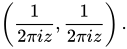
The Dirac delta "function" is represented by This is really a restatement of Cauchy's integral formula. To verify it one can calculate the integration of f just below the real line, and subtract integration of g just above the real line – both from left to right. Note that the hyperfunction can be non-trivial, even if the components are analytic continuation of the same function. Also this can be easily checked by differentiating the Heaviside function.
If g is a continuous function (or more generally a distribution) on the real line with support contained in a bounded interval I, then g corresponds to the hyperfunction (f, −f), where f is a holomorphic function on the complement of I defined by This function f jumps in value by g(x) when crossing the real axis at the point x. The formula for f follows from the previous example by writing g as the convolution of itself with the Dirac delta function.
Using a partition of unity one can write any continuous function (distribution) as a locally finite sum of functions (distributions) with compact support. This can be exploited to extend the above embedding to an embedding
If f is any function that is holomorphic everywhere except for an essential singularity at 0 (for example, e1/z), then is a hyperfunction with support 0 that is not a distribution. If f has a pole of finite order at 0 then is a distribution, so when f has an essential singularity then looks like a "distribution of infinite order" at 0. (Note that distributions always have finite order at any point.)
By definition is a vector space such that addition and multiplication with complex numbers are well-defined. Explicitly:
The obvious restriction maps turn into a sheaf (which is in fact flabby).
Multiplication with real analytic functions and differentiation are well-defined: With these definitions becomes a D-module and the embedding is a morphism of D-modules.
A point is called a holomorphic point of if restricts to a real analytic function in some small neighbourhood of If are two holomorphic points, then integration is well-defined: where are arbitrary curves with The integrals are independent of the choice of these curves because the upper and lower half plane are simply connected.
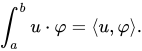
Let be the space of hyperfunctions with compact support. Via the bilinear form one associates to each hyperfunction with compact support a continuous linear function on This induces an identification of the dual space, with A special case worth considering is the case of continuous functions or distributions with compact support: If one considers (or ) as a subset of via the above embedding, then this computes exactly the traditional Lebesgue-integral. Furthermore: If is a distribution with compact support, is a real analytic function, and then Thus this notion of integration gives a precise meaning to formal expressions like which are undefined in the usual sense. Moreover: Because the real analytic functions are dense in is a subspace of . This is an alternative description of the same embedding .
If is a real analytic map between open sets of , then composition with is a well-defined operator from to :
Sato, Mikio (1959), "Theory of Hyperfunctions, I", Journal of the Faculty of Science, University of Tokyo. Sect. 1, Mathematics, Astronomy, Physics, Chemistry, 8 (1): 139–193, hdl:2261/6027, MR0114124
Sato, Mikio (1960), "Theory of Hyperfunctions, II", Journal of the Faculty of Science, University of Tokyo. Sect. 1, Mathematics, Astronomy, Physics, Chemistry, 8 (2): 387–437, hdl:2261/6031, MR0132392
Before the 1921 destruction of Tulsa’s Greenwood District, Black residents had created a remarkable center of business and community life. The district included stores, professional offices, entertainment venues and homes owned by Black citizens. Understanding Greenwood means learning what was built—not only what was burned.
What prosperous Tulsa district became widely known as “Black Wall Street”?
The Greenwood District.
HAVE YOU CHECKED OUT...?
Who Was Shirley Chisholm?
Long before a Black president entered the White House, Shirley Chisholm was breaking national political barriers. She became the first Black woman in Congress and later sought a major party’s presidential nomination. Her campaign placed race, gender and political representation before a national audience.







![{\displaystyle H_{\mathbb {R} }^{1}(\mathbb {C} ,{\mathcal {O}})=\left[H^{0}(\mathbb {C} ^{+},{\mathcal {O}})\oplus H^{0}(\mathbb {C} ^{-},{\mathcal {O}})\right]/H^{0}(\mathbb {C} ,{\mathcal {O}}).}](https://wikimedia.org/api/rest_v1/media/math/render/svg/973e93046c1d3bda18b6090c96598cde598a26a1)













![{\displaystyle {\begin{aligned}h(f_{+},f_{-})&:=(hf_{+},hf_{-})\\[6pt]{\frac {d}{dz}}(f_{+},f_{-})&:=\left({\frac {df_{+}}{dz}},{\frac {df_{-}}{dz}}\right)\end{aligned}}}](https://wikimedia.org/api/rest_v1/media/math/render/svg/4a14e67df7ebbd7d256cacbc70f335d997da735c)



![{\displaystyle \gamma _{\pm }:[0,1]\to \mathbb {C} ^{\pm }}](https://wikimedia.org/api/rest_v1/media/math/render/svg/ca92246a71a816e569d9ea95e296d36ec391639d)