Civil Rights
Movements, leaders, victories and the continuing fight for equality.

Explore the people, places, events, achievements, struggles and stories that shaped our journey.
Movements, leaders, victories and the continuing fight for equality.
Innovation, patents, science, technology and world-changing contributions.
Pioneers, champions, Negro Leagues, records, activism and excellence.
Meet the people whose lives, choices and achievements shaped the journey.
Black towns, communities, institutions and places where history happened.
Moments that changed communities, movements, institutions and the nation.
Mansa Musa was the ruler of the Mali Empire in West Africa. Details recorded here should be sourced; unknown information is left blank.
MORE →Reflects the personal views, recollections, and perspective of the author, Mike Davis.
This is a personal recollection on the Move fire on May 13, 1985
In category theory, a category is Cartesian closed if, roughly speaking, any morphism defined on a product of two objects can be naturally identified with a morphism defined on one of the factors. These categories are particularly important in mathematical logic and the theory of programming, in that their internal language is the simply typed lambda calculus. They are generalized by closed monoidal categories, whose internal language, linear type systems, are suitable for both quantum and classical computation.[1]
Named after René Descartes (1596–1650), French philosopher, mathematician, and scientist, whose formulation of analytic geometry gave rise to the concept of Cartesian product, which was later generalized to the notion of categorical product.
The category C is called Cartesian closed[2] if it satisfies the following three properties:
The first two conditions can be combined to the single requirement that any finite (possibly empty) family of objects of C admit a product in C, because of the natural associativity of the categorical product and because the empty product in a category is the terminal object of that category.
The third condition is equivalent to the requirement that the functor –×Y (i.e. the functor from C to C that maps objects X to X×Y and morphisms φ to φ × idY) has a right adjoint, usually denoted –Y, for all objects Y in C. For locally small categories, this can be expressed by the existence of a bijection between the hom-sets which is natural in X, Y, and Z.[3]
Take care to note that a Cartesian closed category need not have finite limits; only finite products are guaranteed.
If a category has the property that all its slice categories are Cartesian closed, then it is called locally cartesian closed.[4] Note that if C is locally Cartesian closed, it need not actually be Cartesian closed; that happens if and only if C has a terminal object.
For each object Y, the counit of the exponential adjunction is a natural transformation called the (internal) evaluation map. More generally, we can construct the partial application map as the composite
In the particular case of the category Set, these reduce to the ordinary operations:
Evaluating the exponential in one argument at a morphism p : X → Y gives morphisms corresponding to the operation of composition with p. Alternate notations for the operation pZ include p* and p∘-. Alternate notations for the operation Zp include p* and -∘p.
Evaluation maps can be chained as the corresponding arrow under the exponential adjunction is called the (internal) composition map.
In the particular case of the category Set, this is the ordinary composition operation:
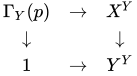
For a morphism p:X → Y, suppose the following pullback square exists, which defines the subobject of XY corresponding to maps whose composite with p is the identity: where the arrow on the right is pY and the arrow on the bottom corresponds to the identity on Y. Then ΓY(p) is called the object of sections of p. It is often abbreviated as ΓY(X).
If ΓY(p) exists for every morphism p with codomain Y, then it can be assembled into a functor ΓY : C/Y → C on the slice category, which is right adjoint to a variant of the product functor: The exponential by Y can be expressed in terms of sections:
Examples of Cartesian closed categories include:
Examples of locally Cartesian closed categories include:
Non-examples of locally Cartesian closed categories include:
In Cartesian closed categories, a "function of two variables" (a morphism f : X×Y → Z) can always be represented as a "function of one variable" (the morphism λf : X → ZY). In computer science applications, this is known as currying; it has led to the realization that simply-typed lambda calculus can be interpreted in any Cartesian closed category.
The Curry–Howard–Lambek correspondence provides a deep isomorphism between intuitionistic logic, simply-typed lambda calculus and Cartesian closed categories.
Certain Cartesian closed categories, the topoi, have been proposed as a general setting for mathematics, instead of traditional set theory.
Computer scientist John Backus has advocated a variable-free notation, or Function-level programming, which in retrospect bears some similarity to the internal language of Cartesian closed categories.[7] CAML is more consciously modelled on Cartesian closed categories.
Let C be a locally Cartesian closed category. Then C has all pullbacks, because the pullback of two arrows with codomain Z is given by the product in C/Z.
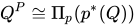
For every arrow p : X → Y, let P denote the corresponding object of C/Y. Taking pullbacks along p gives a functor p* : C/Y → C/X which has both a left and a right adjoint.
The left adjoint is called the dependent sum and is given by composition .
The right adjoint is called the dependent product.
The exponential by P in C/Y can be expressed in terms of the dependent product by the formula .
The reason for these names is because, when interpreting P as a dependent type , the functors and correspond to the type formations and respectively.
In every Cartesian closed category (using exponential notation), (XY)Z and (XZ)Y are isomorphic for all objects X, Y and Z. We write this as the "equation"
One may ask what other such equations are valid in all Cartesian closed categories. It turns out that all of them follow logically from the following axioms (where denotes the terminal object of :[8]
Bicartesian closed categories extend Cartesian closed categories with binary coproducts and an initial object, with products distributing over coproducts. Their equational theory is extended with the following axioms, yielding something similar to Tarski's high school axioms but with a zero:
Note however that the above list is not complete; type isomorphism in the free BCCC is not finitely axiomatizable, and its decidability is still an open problem.[9]
|  | |||||||||||||||||
|
Source: Wikipedia. Article content is retrieved live through the MediaWiki API.
In category theory, a category is Cartesian closed if, roughly speaking, any morphism defined on a product of two objects can be naturally identified with a morphism defined on one of the factors. These categories are particularly important in mathematical logic and the theory of programming, in that their internal language is the simply typed lambda calculus. They are generalized by closed monoidal categories, whose internal language, linear type systems, are suitable for both quantum and classical computation.
Inductive probability attempts to give the probability of future events based on past events. It is the basis for inductive reasoning, and gives the mathematical basis for learning and the perception of patterns. It is a source of knowledge about the world. There are three sources of knowledge: inference, communication, and deduction. Communication relays information found using other methods. Deduction establishes new facts based on existing facts. Inference establishes new facts from data. Its basis is Bayes' theorem. Information describing the world is written in a language. For example, a simple mathematical language of propositions may be chosen. Sentences may be written down in this language as strings of characters. But in the computer it is possible to encode these sentences as strings of bits (1s and 0s). Then the language may be encoded so that the most commonly used sentences are the shortest. This internal language implicitly represents probabilities of statements. Occam's razor says the "simplest theory, consistent with the data is most likely to be correct". The "simplest theory" is interpreted as the representation of the theory written in this internal language. The theory with the shortest encoding in this internal language is most likely to be correct.
Internal colonialism is the uneven effects of economic development on a regional basis, otherwise known as "uneven development", as a result of the exploitation of minority groups within a wider society which leads to political and economic inequalities between regions within a state. This is held to be similar to the relationship between a metropole and a colony, in colonialism proper. The phenomenon leads to the distinct separation of the dominant core from the periphery in an empire. Robert Blauner is regarded as the developer of the theory of internal colonialism. The term was coined to highlight the "blurred" lines between geographically close locations that are clearly different in terms of culture. Some other factors that separate the core from the periphery are language, religion, physical appearance, types and levels of technology, and sexual behavior. The cultural and integrative nature of internal colonialism is understood as a project of modernity and it has been explored by Robert Peckham in relation to the formation of a national modern Greek culture during the nineteenth century, when Greece gained its independence from the Ottoman Empire. The main difference between neocolonialism and internal colonialism is the source of the exploitation. In the former, the control comes from outside the nation-state, while in the latter it comes from within.
In historical linguistics, internal reconstruction is a method of reconstructing an earlier state in a language's history using only evidence internal to the language in question. The comparative method compares variations between languages, such as in sets of cognates, under the assumption that they descend from a single proto-language, but internal reconstruction compares variant forms within a single language under the assumption that they descend from a single, regular form. For example, they could take the form of allomorphs of the same morpheme. The basic premise of internal reconstruction is that a meaning-bearing element that alternates between two or more similar forms in different environments was probably once a single form into which alternation has been introduced by the usual mechanisms of sound change and analogy. Language forms that are reconstructed by internal reconstruction are denoted with the pre- prefix, as in Pre-Old Japanese, like the use of proto- to indicate a language reconstructed by means of the comparative method, as in Proto-Indo-European. (However, the pre- prefix is sometimes used for an unattested prior stage of a language, without reference to internal reconstruction.) It is possible to apply internal reconstruction even to proto-languages reconstructed by the comparative method. For example, performing internal reconstruction on Proto-Mayan would yield Pre-Proto-Mayan. In some cases, it is also desirable to use internal reconstruction to uncover an earlier form of various languages and then submit those pre- languages to the comparative method. Care must be taken, however, because internal reconstruction performed on languages before the comparative method is applied can remove significant evidence of the earlier state of the language and thus reduce the accuracy of the reconstructed proto-language.
Before the 1921 destruction of Tulsa’s Greenwood District, Black residents had created a remarkable center of business and community life. The district included stores, professional offices, entertainment venues and homes owned by Black citizens. Understanding Greenwood means learning what was built—not only what was burned.
MORE →Madam C.J. Walker