Civil Rights
Movements, leaders, victories and the continuing fight for equality.

Explore the people, places, events, achievements, struggles and stories that shaped our journey.
Movements, leaders, victories and the continuing fight for equality.
Innovation, patents, science, technology and world-changing contributions.
Pioneers, champions, Negro Leagues, records, activism and excellence.
Meet the people whose lives, choices and achievements shaped the journey.
Black towns, communities, institutions and places where history happened.
Moments that changed communities, movements, institutions and the nation.
Mansa Musa was the ruler of the Mali Empire in West Africa. Details recorded here should be sourced; unknown information is left blank.
MORE →Reflects the personal views, recollections, and perspective of the author, Mike Davis.
This is a personal recollection on the Move fire on May 13, 1985
 | This article needs more citations. (May 2015) |
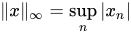
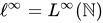
In mathematics, , the (real or complex) vector space of bounded sequences with the supremum norm, and , the vector space of essentially bounded measurable functions with the essential supremum norm, are two closely related Banach spaces. In fact the former is a special case of the latter. As a Banach space they are, respectively, the continuous dual of the Banach spaces of absolutely summable sequences, and of absolutely integrable measurable functions (if the measure space fulfills the conditions of being localizable and therefore semifinite).[1] Pointwise multiplication gives them the structure of a Banach algebra, and in fact they are the standard examples of abelian Von Neumann algebras.
The vector space is a sequence space whose elements are the bounded sequences. The vector space operations, addition and scalar multiplication, are applied coordinate by coordinate. With respect to the norm is a standard example of a Banach space. In fact, can be considered as the space with the largest .
This space is the strong dual space of : indeed, every defines a continuous functional on the space of absolutely summable sequences by component-wise multiplication and summing:
via
By evaluating on we see that every continuous linear functional on arises in this way. i.e.
However, not every continuous linear functional on arises from an absolutely summable series in and hence is not a reflexive Banach space.
is a function space. Its elements are the essentially bounded measurable functions.[2]
More precisely, is defined based on an underlying measure space, Start with the set of all measurable functions from to which are essentially bounded, that is, bounded except on a set of measure zero. Two such functions are identified if they are equal almost everywhere. Denote the resulting set by
For a function in this set, its essential supremum serves as an appropriate norm: This norm is the uniform norm. It is an norm for
The sequence space is a special case of the function space: where the natural numbers are equipped with the counting measure.
One application of and is in economics, particularly in the study of economies with infinitely many commodities.[3] In simple economic models, it is common to assume that there is only a finite number of different commodities, e.g. houses, fruits, cars, etc., so every bundle can be represented by a finite vector, and the consumption set is a vector space with a finite dimension. But in reality, the number of different commodities may be infinite. For example, a "house" is not a single commodity type since the value of a house depends on its location. So the number of different commodities is the number of different locations, which may be considered infinite. In this case, the consumption set is naturally represented by
| Basic concepts | |||
|---|---|---|---|
| L1 spaces | |||
| L2 spaces | |||
| spaces | |||
| Maps | |||
| Inequalities | |||
| Results |
| ||
| Applications & related | |||
Banach space topics | |
|---|---|
| Types of Banach spaces | |
| Banach spaces are: | |
| Function space Topologies | |
| Linear operators | |
| Operator theory | |
| Theorems |
|
| Analysis | |
| Types of sets |
|
| Subsets / set operations | |
| Examples | |
| Applications | |
| Spaces |
| ||||
|---|---|---|---|---|---|
| Theorems | |||||
| Operators | |||||
| Algebras | |||||
| Open problems | |||||
| Applications | |||||
| Advanced topics | |||||
Source: Wikipedia. Article content is retrieved live through the MediaWiki API.
In mathematics, ℓ ∞ {\displaystyle \ell ^{\infty }} , the (real or complex) vector space of bounded sequences with the supremum norm, and L ∞ = L ∞ ( X , Σ , μ ) {\displaystyle L^{\infty }=L^{\infty }(X,\Sigma ,\mu )} , the vector space of essentially bounded measurable functions with the essential supremum norm, are two closely related Banach spaces. In fact the former is a special case of the latter. As a Banach space they are, respectively, the continuous dual of the Banach spaces ℓ 1 {\displaystyle \ell _{1}} of absolutely summable sequences, and L 1 = L 1 ( X , Σ , μ ) {\displaystyle L^{1}=L^{1}(X,\Sigma ,\mu )} of absolutely integrable measurable functions (if the measure space fulfills the conditions of being localizable and therefore semifinite). Pointwise multiplication gives them the structure of a Banach algebra, and in fact they are the standard examples of abelian Von Neumann algebras.

Infinity is something which is boundless, limitless, or endless. It is denoted by ∞, called the infinity symbol. From the time of the ancient Greeks, the philosophical nature of infinity has been the subject of debate. In the 17th century, with the introduction of the infinity symbol and infinitesimal calculus, mathematicians began to work with infinite series and what some mathematicians (including l'Hôpital and Bernoulli) regarded as infinitely small quantities, but infinity continued to be associated with endless processes. As mathematicians struggled with the foundation of calculus, it remained unclear whether infinity could be considered as a number or magnitude and, if so, how this could be done. At the end of the 19th century, Georg Cantor enlarged the mathematical study of infinity by studying infinite sets and infinite numbers, showing that they can be of various sizes. For example, if a line is viewed as the set of all of its points, their infinite number (i.e., the cardinality of the line) is larger than the number of integers. In this usage, infinity is a mathematical concept, and infinite mathematical objects can be studied, manipulated, and used just like any other mathematical object. The mathematical concept of infinity refines and extends the old philosophical concept, in particular by introducing infinitely many different sizes of infinite sets. Among the axioms of Zermelo–Fraenkel set theory, on which most of modern mathematics can be developed, is the axiom of infinity, which guarantees the existence of infinite sets. The mathematical concept of infinity and the manipulation of infinite sets are widely used in mathematics, even in areas such as combinatorics that may seem to have nothing to do with them. In physics and cosmology, it is an open question whether the universe is spatially infinite or not.
The Infinity Gems (originally referred to as Soul Gems and later as Infinity Stones) are six fictional gems appearing in American comic books published by Marvel Comics, named after and embodying various aspects of existence. The gems can grant whoever wields them various powers in accordance to the aspect of existence they represent, and have the potential of turning the wielder into a god-like being when the main six (Mind, Power, Reality, Soul, Space, and Time) are held together. Thus, they are among the most powerful and sought-after items in the Marvel Universe; playing important roles in several storylines, in which they were wielded by characters such as Thanos and Adam Warlock. Some of these stories depict additional Infinity Gems or similar objects. Although the Infinity Gems altogether give their user omnipotence, the Gems only function in the universe they belong to and not in alternate realities. The Infinity Gems have appeared in several media adaptations outside of comics, including the Marvel Cinematic Universe film franchise, where they are called the Infinity Stones and have their colors altered. These changes were later adapted into the comics. In the Marvel Cinematic Universe, the Cosmic Cube is depicted as the Tesseract, a container for the Space Stone; the two artifacts are unrelated in the comics.
Avengers: Infinity War is a 2018 American superhero film based on the Marvel Comics superhero team the Avengers. Produced by Marvel Studios and distributed by Walt Disney Studios Motion Pictures, it is the sequel to The Avengers (2012) and Avengers: Age of Ultron (2015), and the 19th film in the Marvel Cinematic Universe (MCU). Directed by Anthony and Joe Russo and written by Christopher Markus and Stephen McFeely, the film features an ensemble cast including Robert Downey Jr., Chris Hemsworth, Mark Ruffalo, Chris Evans, Scarlett Johansson, Benedict Cumberbatch, Don Cheadle, Tom Holland, Chadwick Boseman, Paul Bettany, Elizabeth Olsen, Anthony Mackie, Sebastian Stan, Danai Gurira, Letitia Wright, Dave Bautista, Zoe Saldaña, Josh Brolin, and Chris Pratt. In the film, the Avengers and the Guardians of the Galaxy attempt to stop Thanos (Brolin) from collecting the six powerful Infinity Stones as part of his quest to kill half of all life in the universe. The film was announced in October 2014 as Avengers: Infinity War – Part 1. The Russo brothers came on board to direct in April 2015, and a month later, Markus and McFeely signed on to write the script for the film, which draws inspiration from Jim Starlin's 1991 comic book The Infinity Gauntlet and Jonathan Hickman's 2013 comic book Infinity. In 2016, Marvel shortened the title to Avengers: Infinity War. Filming began in January 2017 at Pinewood Atlanta Studios in Fayette County, Georgia, with a large cast consisting mostly of actors reprising their roles from previous MCU films, including Brolin as Thanos. The production lasted until July 2017, shooting back-to-back with a direct sequel, Avengers: Endgame (2019). Additional filming took place in Scotland, the Downtown Atlanta area, and New York City. With an estimated budget of $325–400 million, the film is one of the most expensive films ever made. Avengers: Infinity War premiered at the Dolby Theatre in Hollywood, Los Angeles, on April 23, 2018, and was released in the United States on April 27 as part of Phase Three of the MCU. The film received positive reviews from critics, with praise for Brolin's performance and the Russo brothers' direction, as well as the visual effects, action sequences, dark tone, and musical score. It was a major box-office success, becoming the fourth film and the first superhero film to gross over $2 billion worldwide, breaking numerous box office records, and becoming the highest-grossing film of 2018 and the fourth-highest-grossing film at the time of its release both worldwide and in the United States and Canada. It received a nomination for Best Visual Effects at the 91st Academy Awards, among numerous other accolades. The sequel, Avengers: Endgame, was released in April 2019.
Before the 1921 destruction of Tulsa’s Greenwood District, Black residents had created a remarkable center of business and community life. The district included stores, professional offices, entertainment venues and homes owned by Black citizens. Understanding Greenwood means learning what was built—not only what was burned.
MORE →Shirley Chisholm, elected in 1968.