Civil Rights
Movements, leaders, victories and the continuing fight for equality.

Explore the people, places, events, achievements, struggles and stories that shaped our journey.
Movements, leaders, victories and the continuing fight for equality.
Innovation, patents, science, technology and world-changing contributions.
Pioneers, champions, Negro Leagues, records, activism and excellence.
Meet the people whose lives, choices and achievements shaped the journey.
Black towns, communities, institutions and places where history happened.
Moments that changed communities, movements, institutions and the nation.
Wilmington, North Carolina once had a thriving Black middle class and an elected interracial government. In 1898 white supremacists used violence to overthrow that government, kill Black residents and drive many others from the city.
MORE →Reflects the personal views, recollections, and perspective of the author, Mike Davis.
This is a personal recollection on the Move fire on May 13, 1985
| Croatian | |
|---|---|
| hrvatski | |
| Pronunciation | [xř̩ʋaːtskiː] |
| Native to | Croatia, Bosnia and Herzegovina, Hungary (Bácska), Montenegro (Bay of Kotor), Romania (Caraș-Severin County), Serbia (Vojvodina) |
| Region | Southeast Europe |
| Ethnicity | Croats |
| Speakers | L1: 5.1 million (2021–2023)[1] L2: 1.3 million (2012)[2] |
| Latin (Gaj's alphabet) Yugoslav Braille Glagolitic (historical) Bosnian Cyrillic (historical) | |
| Official status | |
Official language in |
|
Recognised minority language in | |
| Regulated by | Institute of Croatian Language and Linguistics |
| Language codes | |
| ISO 639-1 | hr |
| ISO 639-2 | hrv |
| ISO 639-3 | hrv |
| Glottolog | croa1245 |
| Linguasphere | part of 53-AAA-g |
 States and regions which recognize Croatian as (co-)official (dark red) or minority language (light red) | |
 Croatian is not endangered according to the classification system of the UNESCO Atlas of the World's Languages in Danger | |
| Part of a series on |
| Croats |
|---|
 |
| South Slavic languages and dialects |
|---|
Croatian[b] is the standard variety of the Serbo-Croatian language mainly used by Croats.[9] It is the national official language and literary standard of Croatia, one of the official languages of Bosnia and Herzegovina, Montenegro, the Serbian province of Vojvodina, the European Union and a recognized minority language elsewhere in Serbia and other neighbouring countries.
In the mid-18th century, the first attempts to provide a Croatian literary standard began on the basis of the Neo-Shtokavian dialect that served as a supraregional lingua franca – pushing back regional Chakavian, Kajkavian, and Shtokavian vernaculars.[10] The decisive role was played by Croatian Vukovians, who cemented the usage of Ijekavian Neo-Shtokavian as the literary standard in the late 19th and the beginning of the 20th century, in addition to designing a phonological orthography.[11] Croatian is written in Gaj's Latin alphabet.[12]
Besides the Shtokavian dialect, on which Standard Croatian is based, there are two other main supradialects spoken in Croatia, Chakavian and Kajkavian. These supradialects, and the four national standards – Bosnian, Croatian, Montenegrin and Serbian – are usually subsumed under the term "Serbo-Croatian" in English; this term is controversial for native speakers,[13] and names such as "Bosnian-Croatian-Montenegrin-Serbian" (BCMS) are used by linguists and philologists in the 21st century.[14]
In the late medieval period up to the 17th century, the majority of semi-autonomous Croatia was ruled by two domestic dynasties of princes (banovi), the Zrinski and the Frankopan, which were linked by inter-marriage.[15] Toward the 17th century, both of them attempted to unify Croatia both culturally and linguistically, writing in a mixture of all three principal dialects (Chakavian, Kajkavian and Shtokavian), and calling it "Croatian", "Dalmatian", or "Slavonian".[16] Historically, several other names were used as synonyms for Croatian, in addition to Dalmatian and Slavonian, and these were Illyrian (ilirski) and Slavic (slovinski).[17] It is still used now in parts of Istria, which became a crossroads of various mixtures of Chakavian with Ekavian, Ijekavian and Ikavian isoglosses.[18]
The most standardised form (Kajkavian–Ikavian) became the cultivated language of administration and intellectuals from the Istrian peninsula along the Croatian coast, across central Croatia up into the northern valleys of the Drava and the Mura. The cultural apex of this 17th century idiom is represented by the editions of "Adrianskoga mora sirena" ("The Siren of the Adriatic Sea") by Petar Zrinski and "Putni tovaruš" ("Traveling escort") by Katarina Zrinska.[19][20]
However, this first linguistic renaissance in Croatia was halted by the political execution of Petar Zrinski and Fran Krsto Frankopan by the Holy Roman Emperor Leopold I in Vienna in 1671.[21] Subsequently, the Croatian elite in the 18th century gradually abandoned this combined Croatian standard.[22]
The Illyrian movement was a 19th-century pan-South Slavic political and cultural movement in Croatia that had the goal to standardise the regionally differentiated and orthographically inconsistent literary languages in Croatia, and finally merge them into a common South Slavic literary language. Specifically, three major groups of dialects were spoken on Croatian territory, and there had been several literary languages over four centuries. The leader of the Illyrian movement Ljudevit Gaj standardized the Latin alphabet in 1830–1850 and worked to bring about a standardized orthography. Although based in Kajkavian-speaking Zagreb, Gaj supported using the more populous Neo-Shtokavian – a version of Shtokavian that eventually became the predominant dialectal basis of both Croatian and Serbian literary language from the 19th century on.[23][24] Supported by various South Slavic proponents, Neo-Shtokavian was adopted after an Austrian initiative at the Vienna Literary Agreement of 1850,[22] laying the foundation for the unified Serbo-Croatian literary language. The uniform Neo-Shtokavian then became common in the Croatian elite.[22]
In the 1860s, the Zagreb Philological School dominated the Croatian cultural life, drawing upon linguistic and ideological conceptions advocated by the members of the Illyrian movement.[25] While it was dominant over the rival Rijeka Philological School and Zadar Philological Schools, its influence waned with the rise of the Croatian Vukovians (at the end of the 19th century).[26]
Croatian is commonly characterized by the ijekavian pronunciation (see an explanation of yat reflexes), the sole use of the Latin alphabet, and a number of lexical differences in common words that set it apart from standard Serbian.[27] Some differences are absolute, while some appear mainly in the frequency of use.[27] However, as professor John F. Bailyn states, "an examination of all the major 'levels' of language shows that BCS is clearly a single language with a single grammatical system."[28]
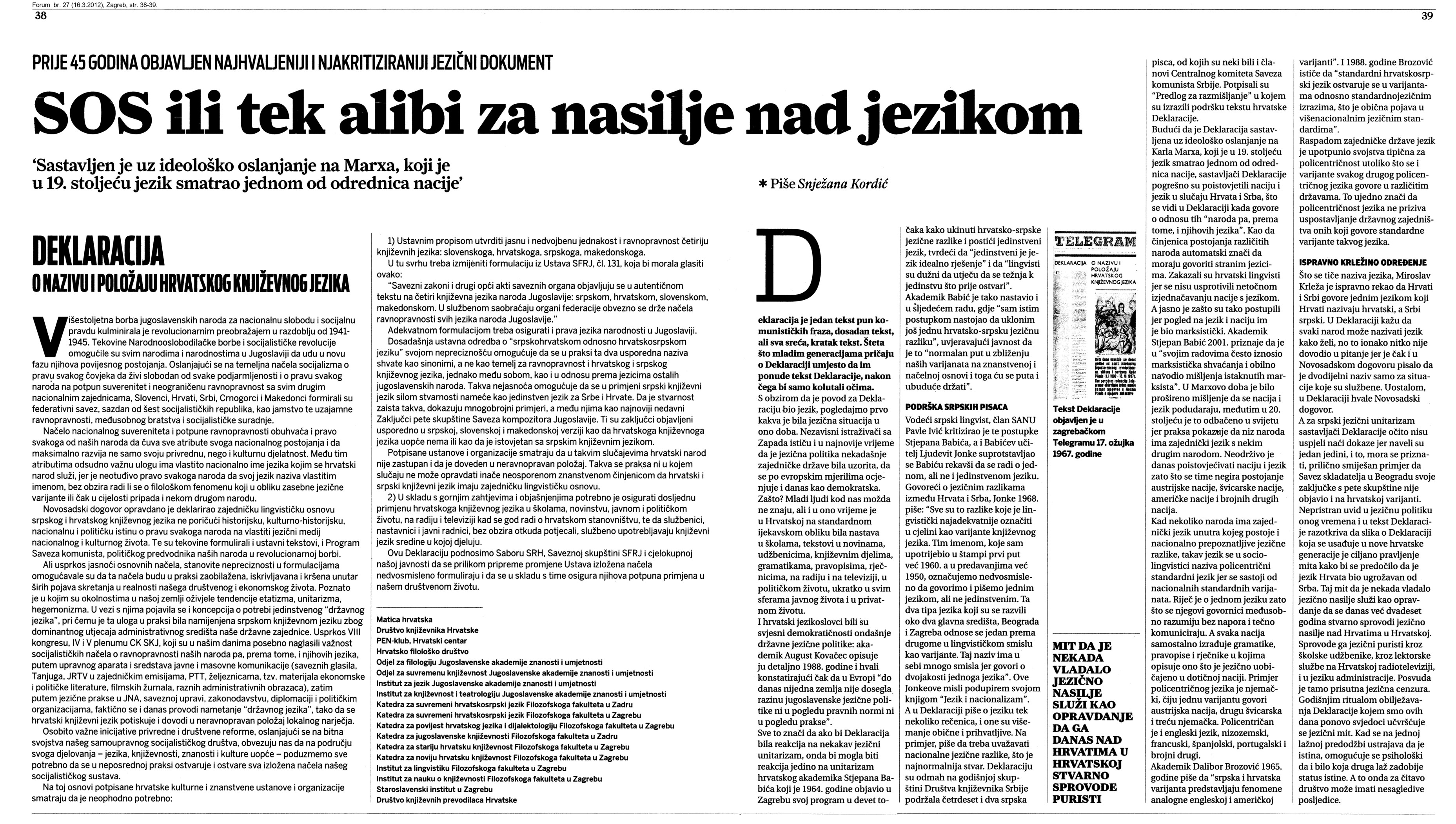
Croatian, although technically a form of Serbo-Croatian, is sometimes considered a distinct language by itself.[13] This is at odds with purely linguistic classifications of languages based on mutual intelligibility (abstand and ausbau languages),[29] which do not allow varieties that are mutually intelligible to be considered separate languages. "There is no doubt of the near 100% mutual intelligibility of (standard) Croatian and (standard) Serbian, as is obvious from the ability of all groups to enjoy each others' films, TV and sports broadcasts, newspapers, rock lyrics etc.", writes Bailyn.[28] Differences between various standard forms of Serbo-Croatian are often exaggerated for political reasons.[30] Most Croatian linguists regard Croatian as a separate language that is considered key to national identity,[31] in the sense that the term Croatian language includes all language forms from the earliest times to the present, in all areas where Croats live, as realized in the speeches of Croatian dialects, in city speeches and jargons, and in the Croatian standard language.[32][33] The issue is sensitive in Croatia as the notion of a separate language being the most important characteristic of a nation is widely accepted, stemming from the 19th-century history of Europe.[34] The 1967 Declaration on the Status and Name of the Croatian Literary Language, in which a group of Croatian authors and linguists demanded greater autonomy for Croatian, is viewed in Croatia as a linguistic policy milestone that was also a general milestone in national politics.[35]
On the 50th anniversary of the Declaration, at the beginning of 2017, a two-day meeting of linguists, writers, journalists and artists from Croatia, Bosnia-Herzegovina, Serbia and Montenegro was organized in Zagreb, at which the text of the Declaration on the Common Language of Croats, Bosniaks, Serbs and Montenegrins was drafted.[36] The new Declaration has received more than ten thousand signatures (not only of intellectuals, but also commonpeople). It stated that in Croatia, Serbia, Bosnia-Herzegovina and Montenegro a common polycentric standard language is used, consisting of several standard varieties, similar to the existing varieties of German, English or Spanish.[37] The aim of the new Declaration was to "stimulate discussion on language without the nationalistic baggage"[38] and to "counter nationalistic divisions".[39]
The terms "Serbo-Croatian", "Serbo-Croat", or "Croato-Serbian", are still used as a cover term for all these forms by foreign scholars, even though the speakers themselves largely do not use it.[27] Within Southeastern Europe, the term has largely been replaced by the ethnopolitical terms Bosnian, Croatian, Montenegrin, and Serbian.[40]
The use of the name "Croatian" for a language has historically been attested to, though not always distinctively. The first printed Croatian literary work is a vernacular Chakavian poem written in 1501 by Marko Marulić, titled "The History of the Holy Widow Judith Composed in Croatian Verses".[41][42] The Croatian–Hungarian Agreement designated Croatian as one of its official languages.[43] Croatian became an official EU language upon accession of Croatia to the European Union on 1 July 2013.[44][45] In 2013, the EU started publishing a Croatian-language version of its official gazette.[46]

Standard Croatian is the official language of the Republic of Croatia[47] and, along with Standard Bosnian and Standard Serbian, one of three official languages of Bosnia and Herzegovina.[3] It is also official in the regions of Burgenland (Austria),[48] Molise (Italy)[49] and Vojvodina (Serbia).[50] Additionally, it has co-official status alongside Romanian in the communes of Carașova[51] and Lupac,[52][53] Romania. In these localities, Croats or Krashovani make up the majority of the population, and education, signage and access to public administration and the justice system are provided in Croatian, alongside Romanian.
Croatian is officially used and taught at all universities in Croatia and at the University of Mostar in Bosnia and Herzegovina. Studies of Croatian language are held in Hungary (Institute of Philosophy at the ELTE Faculty of Humanities in Budapest),[54] Slovakia (Faculty of Philosophy of the Comenius University in Bratislava),[54] Poland (University of Warsaw, Jagiellonian University, University of Silesia in Katowice, University of Wroclaw, Adam Mickiewicz University in Poznan),[55] Germany (University of Regensburg),[56] Australia (Center for Croatian Studies at the Macquarie University),[57] New Zealand (University of Auckland),[58] North Macedonia (Faculty of Philology in Skopje)[59] etc.
The procedure for selecting Croatian language tutors (lektori), in accordance with signed interstate agreements, is carried out by the Ministry of Science, Education and Youth; In addition to teaching, lecturers of the Croatian language and literature also organize lectures by guest lecturers, professors from Croatian universities, writers, directors and other cultural and public figures, and for the purpose of promoting the Croatian language and culture, they organize theatrical performances, Croatian film evenings, cultural days, literary meetings, translation, publishing magazines and other activities that stimulate students' interest in learning the Croatian language.[60] The Ministry is responsible for 34 official exchange teaching centers for Croatian language and literature and three centers for Croatian studies in Australia, Canada and the United Kingdom, which it co-finances. In addition to the aforementioned teaching centers and centers, which include more than 2,000 students in 25 countries, the Ministry fully or partially supports another 40 independent teaching centers that are not under its jurisdiction.[60] The Ministry awards one-semester scholarships to students of the teaching staff for improving their Croatian language skills at Croaticum of the Faculty of Philosophy in Zagreb, the Center for Croatian Studies in the World at the Faculty of Philosophy in Split, and the same faculty in Rijeka. In addition to one-semester scholarships, the Ministry also awards scholarships for shorter scientific stays for the purpose of studying literature, researching, or consulting with professors related to the preparation of scientific papers in the field of Croatian studies.[60]
Croatian embassies hold courses for learning Croatian in Poland,[61] United Kingdom[62] and a few other countries. Extracurricular education of Croatian is held in Germany in Baden-Württemberg, Berlin, Hamburg and Saarland,[63] as well as in North Macedonia in Skopje, Bitola, Štip and Kumanovo.[59] Some Croatian Catholic Missions also hold Croatian language courses (e.g., CCM in Buenos Aires[64]).
There is no regulatory body that determines the proper usage of Croatian. However, in January 2023, the Croatian Parliament passed a law that prescribes the official use of the Croatian language, regulates the establishment of the Council for the Croatian language as a coordinating advisory body whose work will be focused on the protection and development of the Croatian language. State authorities, local and regional self-government entities are obliged to use the Croatian language.[65]
The current standard language is generally laid out in the grammar books and dictionaries used in education, such as the school curriculum prescribed by the Ministry of Education and the university programmes of the Faculty of Philosophy at the four main universities.[citation needed][needs update] In 2013, a Hrvatski pravopis by the Institute of Croatian Language and Linguistics received an official sole seal of approval from the Ministry of Education.
The most prominent recent editions describing the Croatian standard language are:
Also notable are the recommendations of Matica hrvatska, the national publisher and promoter of Croatian heritage, and the Miroslav Krleža Institute of Lexicography, as well as the Croatian Academy of Sciences and Arts.
Numerous representative Croatian linguistic works were published since the independence of Croatia, among them three voluminous monolingual dictionaries of contemporary Croatian.
In 2021, Croatia introduced a new model of linguistic categorisation of the Bunjevac dialect (as part of New-Shtokavian Ikavian dialects of the Shtokavian dialect of the Croatian language) in three sub-branches: Dalmatian (also called Bosnian-Dalmatian), Danubian (also called Bunjevac), and Littoral-Lika.[66][67] Its speakers largely use the Latin alphabet and are living in parts of Bosnia and Herzegovina, different parts of Croatia, southern parts (inc. Budapest) of Hungary as well in the autonomous province Vojvodina of Serbia. The Institute of Croatian Language and Linguistics added the Bunjevac dialect to the List of Protected Intangible Cultural Heritage of the Republic of Croatia on 8 October 2021.[68][69]
The Central State Office for Croats Abroad and the Zagreb Faculty of Philosophy have developed web and mobile application LearnCro for learning the Croatian language, available in English and Spanish which includes 80 interactive teaching units, gamification, cultural content, the ability to work offline and professional support, available via the Google Play and Apple App Store.[70]
Central State Office also organizes online language courses, developed by Croaticum, language centre of the Faculty of Philosophy in Zagreb.[71] The A1 level course was attended by almost 37,000 students from 130 countries in eight years (2018-2025); the most participants came from the United States, Brazil, Argentina, Canada and Australia, all countries with historical Croatian diaspora.[71] The A2 level course was attended by 3,000 students from 96 countries over seven years (2019-2025).[71]
Article 1 of the Universal Declaration of Human Rights in Croatian (2009 Croatian government official translation):
Article 1 of the Universal Declaration of Human Rights in English:

The official language of Croatia is Croatian (Serbo-Croatian). [...] The same language is referred to by different names, Serbian (srpski), Serbo-Croat (in Croatia: hrvatsko-srpski), Bosnian (bosanski), based on political and ethnic grounds. [...] the language that used to be officially called Serbo-Croat has gotten several new ethnically and politically based names. Thus, the names Serbian, Croatian, and Bosnian are politically determined and refer to the same language with possible slight variations.
Serbian, Bosnian, Albanian and Croatian shall also be in the official use.
Podle čl. 3 odst. 2 Statutu Rady je jejich počet 12 a jsou uživateli těchto menšinových jazyků: [...], srbština a ukrajinština
22. § (1) E törvény értelmében nemzetiségek által használt nyelvnek számít [...] a horvát
Because of their mutual intelligibility, Serbian, Croatian, and Bosnian are usually thought of as constituting one language called Serbo-Croatian.
Serbo-Croatian, which features four ethnic variants: Serbian, Croatian, Bosnian, and Montenegrin
The debate about the status of the Serbo-Croatian language and its varieties has recently shifted (again) towards a position which looks at the internal variation within Serbo-Croatian through the prism of linguistic pluricentricity
Bis in die 1990er-Jahre wurde diese Sprache einheitlich offiziell als Serbokroatisch/Kroatoserbisch, inoffiziell als Serbisch und Kroatisch bezeichnet. Den Namen Serbokroatisch verwendete erstmals Jacob Grimm im Vorwort zu seiner Übersetzung der Kleinen Serbischen Grammatik (1824) von Vuk Stefanović Karadžić. Im Jahre 1836 benutzt Jernej Kopitar den Ausdruck "serbochorvatica sive chorvatocoserbica". P. Budmani veröffentlichte 1867 die Grammatica della lingua serbo-croata (illirica), und im Jahre 1877 erschien die Grammaire de la language serbo-croate des Kroaten Dragutin Pančić. Die Sprache, beziehungsweise die Sprachen, die aus dem ehemaligen Serbokroatischen entstanden sind, stellen ein kompliziertes soziolinguistisches Phänomen dar. Diese Komplexität ist gegeben, weil eine genetisch identische Sprache von (1) mehreren Nationen (Serben, Montenegrinen, Kroaten, Muslime/Bosniaken), (2) mehreren Religionen (Orthodoxen, Katholiken, Muslimen) gesprochen wird und weil diese Sprache (3) eine breite dialektologische Gliederung (das Štokavische, das Čakavische, das Kajkavische), (4) verschiedene Aussprachen (das Ekavische, das Ijekavische, das Ikavische) und (5) zwei Schriften (Lateinschrift, Kyrillica) aufweist.
Obwohl das Kroatische sich in den letzten Jahren in einigen Gebieten, vor allem jedoch auf lexikalischer Ebene, verändert hat, sind diese Änderungen noch nicht bedeutend genug, dass der Terminus Ausbausprache gerechtfertigt wäre. Ausserdem können sich Serben, Kroaten, Bosnier und Montenegriner immer noch auf ihren jeweiligen Nationalsprachen unterhalten und problemlos verständigen. Nur schon diese Tatsache zeigt, dass es sich immer noch um eine polyzentrische Sprache mit verschiedenen Varietäten handelt.
{{cite journal}}: CS1 maint: url-status (link)
Bunjevački govori pripadaju novoštokavskom ikavskom dijalektu štokavskoga narječja hrvatskoga jezika.[The Bunjevac dialects belong to the Neo-Shtokavian Ikavian dialect of the Shtokavian branch of the Croatian language]
Razlikuju se tri ogranka Bunjevačkih govora – podunavski, primorsko-lički i dalmatinski, a svi su kulturno bliski prema povijesnim, etnološkim i lingvističkim istraživanjima.[There are three branches of the Bunjevac dialects – the Danubian, the Primorje-Lika, and the Dalmatian – all of which are culturally close, according to historical, ethnological, and linguistic research]
Institut za hrvatski jezik i jezikoslovlje uputio je Ministarstvu kulture RH prijedlog da se bunjevački govor proglasi hrvatskom nematerijalnom kulturnom baštinom, kao važan čin pomoći bunjevačkomu govoru i svim Bunjevcima u Hrvatskoj i inozemstvu.[The Institute for the Croatian Language and Linguistics submitted a proposal to the Ministry of Culture of the Republic of Croatia to declare the Bunjevac dialect part of Croatia’s intangible cultural heritage, as an important act of support for the Bunjevac speech and all Bunjevci in Croatia and abroad]


| |||||||||||||||||
| International | |
|---|---|
| National | |
| Other | |
Source: Wikipedia. Article content is retrieved live through the MediaWiki API.
Language secessionism (also known as linguistic secessionism or linguistic separatism) is an attitude supporting the separation of a language variety from the language to which it has thitherto been considered to belong, in order for the said variety to be considered a distinct language. This attitude was first analyzed in Catalan sociolinguistics but it is attested in other parts of the world.

Serbian is the standard variety of the Serbo-Croatian language mainly used by Serbs. It is the national official language and literary standard of Serbia, one of the official languages in Bosnia-Herzegovina and Kosovo, and a recognized minority language in numerous countries. Serbian is based on the most widespread supradialect of Serbo-Croatian, Shtokavian (more specifically on the dialects of Šumadija-Vojvodina and Eastern Herzegovina), which is also the basis of other Serbo-Croatian standard varieties: Croatian, Bosnian, and Montenegrin. Serbian is a rare example of synchronic digraphia, using both Cyrillic and Latin scripts.

Bosnian is the standard variety of the Serbo-Croatian language mainly used by Bosniaks. It is one of the three official languages of Bosnia and Herzegovina, a co-official language in Montenegro, and an officially recognized minority language in Croatia, Serbia, North Macedonia and Kosovo. Bosnian uses both the Latin and Cyrillic alphabets, with Latin in everyday use. It is notable among the varieties of Serbo-Croatian for a number of Arabic, Persian and Ottoman Turkish loanwords, largely due to the language's interaction with those cultures through Islamic ties. Bosnian is based on the most widespread dialect of Serbo-Croatian, Shtokavian, more specifically on Eastern Herzegovinian, which is also the basis of standard Croatian, Serbian and Montenegrin varieties. Therefore, the Declaration on the Common Language of Croats, Serbs, Bosniaks and Montenegrins was issued in 2017 in Sarajevo. Although the common name for the common language remains 'Serbo-Croatian', newer alternatives such as 'Bosnian-Croatian-Serbian' and 'Bosnian-Croatian-Montenegrin-Serbian' (commonly abbreviated 'BCMS') have been increasingly utilised since the 1990s, especially within diplomatic circles. Informally, the terms naš and naški ('ours / our language') are frequently used to avoid controversies over the naming of these languages.

Croatian is the standard variety of the Serbo-Croatian language mainly used by Croats. It is the national official language and literary standard of Croatia, one of the official languages of Bosnia and Herzegovina, Montenegro, the Serbian province of Vojvodina, the European Union and a recognized minority language elsewhere in Serbia and other neighbouring countries. In the mid-18th century, the first attempts to provide a Croatian literary standard began on the basis of the Neo-Shtokavian dialect that served as a supraregional lingua franca – pushing back regional Chakavian, Kajkavian, and Shtokavian vernaculars. The decisive role was played by Croatian Vukovians, who cemented the usage of Ijekavian Neo-Shtokavian as the literary standard in the late 19th and the beginning of the 20th century, in addition to designing a phonological orthography. Croatian is written in Gaj's Latin alphabet. Besides the Shtokavian dialect, on which Standard Croatian is based, there are two other main supradialects spoken in Croatia, Chakavian and Kajkavian. These supradialects, and the four national standards – Bosnian, Croatian, Montenegrin and Serbian – are usually subsumed under the term "Serbo-Croatian" in English; this term is controversial for native speakers, and names such as "Bosnian-Croatian-Montenegrin-Serbian" (BCMS) are used by linguists and philologists in the 21st century.
Before the 1921 destruction of Tulsa’s Greenwood District, Black residents had created a remarkable center of business and community life. The district included stores, professional offices, entertainment venues and homes owned by Black citizens. Understanding Greenwood means learning what was built—not only what was burned.
MORE →Brown v. Board of Education in 1954.