Civil Rights
Movements, leaders, victories and the continuing fight for equality.

Explore the people, places, events, achievements, struggles and stories that shaped our journey.
Movements, leaders, victories and the continuing fight for equality.
Innovation, patents, science, technology and world-changing contributions.
Pioneers, champions, Negro Leagues, records, activism and excellence.
Meet the people whose lives, choices and achievements shaped the journey.
Black towns, communities, institutions and places where history happened.
Moments that changed communities, movements, institutions and the nation.
Wilmington, North Carolina once had a thriving Black middle class and an elected interracial government. In 1898 white supremacists used violence to overthrow that government, kill Black residents and drive many others from the city.
MORE →Reflects the personal views, recollections, and perspective of the author, Mike Davis.
This is a personal recollection on the Move fire on May 13, 1985
 | This article may be too technical for most readers to understand. (October 2018) |
In cryptography, learning with errors (LWE) is a mathematical problem that is widely used to create secure encryption algorithms.[1] It is based on the idea of representing secret information as a set of equations with errors. In other words, LWE is a way to hide the value of a secret by introducing noise to it.[2] In more technical terms, it refers to the computational problem of inferring a linear -ary function over a finite ring from given samples some of which may be erroneous. The LWE problem is conjectured to be hard to solve,[1] and thus to be useful in cryptography.
More precisely, the LWE problem is defined as follows. Let denote the ring of integers modulo and let denote the set of -vectors over . There exists a certain unknown linear function , and the input to the LWE problem is a sample of pairs , where and , so that with high probability . Furthermore, the deviation from the equality is according to some known noise model. The problem calls for finding the function , or some close approximation thereof, with high probability.
The LWE problem was introduced by Oded Regev in 2005[3] (who won the 2018 Gödel Prize for this work); it is a generalization of the parity learning problem. Regev showed that the LWE problem is as hard to solve as several worst-case lattice problems. Subsequently, the LWE problem has been used as a hardness assumption to create public-key cryptosystems,[3][4] such as the ring learning with errors key exchange by Peikert.[5]
Denote by the additive group on reals modulo one. Let be a fixed vector. Let be a fixed probability distribution over . Denote by the distribution on obtained as follows.
The learning with errors problem is to find , given access to polynomially many samples of choice from .
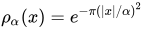
For every , denote by the one-dimensional Gaussian with zero mean and variance , that is, the density function is where , and let be the distribution on obtained by considering modulo one. The version of LWE considered in most of the results would be
The LWE problem described above is the search version of the problem. In the decision version (DLWE), the goal is to distinguish between noisy inner products and uniformly random samples from (practically, some discretized version of it). Regev[3] showed that the decision and search versions are equivalent when is a prime bounded by some polynomial in .
Intuitively, if we have a procedure for the search problem, the decision version can be solved easily: just feed the input samples for the decision problem to the solver for the search problem. Denote the given samples by . If the solver returns a candidate , for all , calculate . If the samples are from an LWE distribution, then the results of this calculation will be distributed according , but if the samples are uniformly random, these quantities will be distributed uniformly as well.
For the other direction, given a solver for the decision problem, the search version can be solved as follows: Recover one coordinate at a time. To obtain the first coordinate, , make a guess , and do the following. Choose a number uniformly at random. Transform the given samples as follows. Calculate . Send the transformed samples to the decision solver.
If the guess was correct, the transformation takes the distribution to itself, and otherwise, since is prime, it takes it to the uniform distribution. So, given a polynomial-time solver for the decision problem that errs with very small probability, since is bounded by some polynomial in , it only takes polynomial time to guess every possible value for and use the solver to see which one is correct.
After obtaining , we follow an analogous procedure for each other coordinate . Namely, we transform our samples the same way, and transform our samples by calculating , where the is in the coordinate.[3]
Peikert[4] showed that this reduction, with a small modification, works for any that is a product of distinct, small (polynomial in ) primes. The main idea is if , for each , guess and check to see if is congruent to , and then use the Chinese remainder theorem to recover .
Regev[3] showed the random self-reducibility of the LWE and DLWE problems for arbitrary and . Given samples from , it is easy to see that are samples from .
So, suppose there was some set such that , and for distributions , with , DLWE was easy.
Then there would be some distinguisher , who, given samples , could tell whether they were uniformly random or from . If we need to distinguish uniformly random samples from , where is chosen uniformly at random from , we could simply try different values sampled uniformly at random from , calculate and feed these samples to . Since comprises a large fraction of , with high probability, if we choose a polynomial number of values for , we will find one such that , and will successfully distinguish the samples.
Thus, no such can exist, meaning LWE and DLWE are (up to a polynomial factor) as hard in the average case as they are in the worst case.
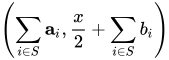
For a n-dimensional lattice , let smoothing parameter denote the smallest such that where is the dual of and is extended to sets by summing over function values at each element in the set. Let denote the discrete Gaussian distribution on of width for a lattice and real . The probability of each is proportional to .
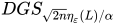
The discrete Gaussian sampling problem (DGS) is defined as follows: An instance of is given by an -dimensional lattice and a number . The goal is to output a sample from . Regev shows that there is a reduction from to for any function .
Regev then shows that there exists an efficient quantum algorithm for given access to an oracle for for integer and such that . This implies the hardness for LWE. Although the proof of this assertion works for any , for creating a cryptosystem, the modulus has to be polynomial in .
Peikert proves[4] that there is a probabilistic polynomial time reduction from the problem in the worst case to solving using samples for parameters , , and .
The LWE problem serves as a versatile problem used in construction of several[3][4][6][7] cryptosystems. In 2005, Regev[3] showed that the decision version of LWE is hard assuming quantum hardness of the lattice problems (for as above) and with ). In 2009, Peikert[4] proved a similar result assuming only the classical hardness of the related problem . The disadvantage of Peikert's result is that it bases itself on a non-standard version of an easier (when compared to SIVP) problem GapSVP.
Regev[3] proposed a public-key cryptosystem based on the hardness of the LWE problem. The cryptosystem as well as the proof of security and correctness are completely classical. The system is characterized by and a probability distribution on . The setting of the parameters used in proofs of correctness and security is
The cryptosystem is then defined by:
The proof of correctness follows from choice of parameters and some probability analysis. The proof of security is by reduction to the decision version of LWE: an algorithm for distinguishing between encryptions (with above parameters) of and can be used to distinguish between and the uniform distribution over
![[icon]](viewer.php?source=wikipedia&q=File%3AWiki%20letter%20w%20cropped.svg&result=0#selected-result) | This section needs expansion. You can help by adding missing information. (December 2009) |
Peikert[4] proposed a system that is secure even against any chosen-ciphertext attack.
The idea of using LWE and Ring LWE for key exchange was proposed and filed at the University of Cincinnati in 2011 by Jintai Ding. The idea comes from the associativity of matrix multiplications, and the errors are used to provide the security. The paper[8] appeared in 2012 after a provisional patent application was filed in 2012.
The security of the protocol is proven based on the hardness of solving the LWE problem. In 2014, Peikert presented a key-transport scheme[9] following the same basic idea of Ding's, where the new idea of sending an additional 1-bit signal for rounding in Ding's construction is also used. The "new hope" implementation[10] selected for Google's post-quantum experiment,[11] uses Peikert's scheme with variation in the error distribution.
A RLWE version of the classic Feige–Fiat–Shamir Identification protocol was created and converted to a digital signature in 2011 by Lyubashevsky. The details of this signature were extended in 2012 by Gunesyu, Lyubashevsky, and Popplemann in 2012 and published in their paper "Practical Lattice Based Cryptography – A Signature Scheme for Embedded Systems." These papers laid the groundwork for a variety of recent signature algorithms some based directly on the ring learning with errors problem and some which are not tied to the same hard RLWE problems.
{{cite book}}: Cite uses deprecated parameter |citeseerx= (help)
{{cite journal}}: CS1 maint: multiple names: authors list (link)
Source: Wikipedia. Article content is retrieved live through the MediaWiki API.
In cryptography, learning with errors (LWE) is a mathematical problem that is widely used to create secure encryption algorithms. It is based on the idea of representing secret information as a set of equations with errors. In other words, LWE is a way to hide the value of a secret by introducing noise to it. In more technical terms, it refers to the computational problem of inferring a linear n {\displaystyle n} -ary function f {\displaystyle f} over a finite ring from given samples y i = f ( x i ) {\displaystyle y_{i}=f(\mathbf {x} _{i})} some of which may be erroneous. The LWE problem is conjectured to be hard to solve, and thus to be useful in cryptography. More precisely, the LWE problem is defined as follows. Let Z q {\displaystyle \mathbb {Z} _{q}} denote the ring of integers modulo q {\displaystyle q} and let Z q n {\displaystyle \mathbb {Z} _{q}^{n}} denote the set of n {\displaystyle n} -vectors over Z q {\displaystyle \mathbb {Z} _{q}} . There exists a certain unknown linear function f : Z q n → Z q {\displaystyle f:\mathbb {Z} _{q}^{n}\rightarrow \mathbb {Z} _{q}} , and the input to the LWE problem is a sample of pairs ( x , y ) {\displaystyle (\mathbf {x} ,y)} , where x ∈ Z q n {\displaystyle \mathbf {x} \in \mathbb {Z} _{q}^{n}} and y ∈ Z q {\displaystyle y\in \mathbb {Z} _{q}} , so that with high probability y = f ( x ) {\displaystyle y=f(\mathbf {x} )} . Furthermore, the deviation from the equality is according to some known noise model. The problem calls for finding the function f {\displaystyle f} , or some close approximation thereof, with high probability. The LWE problem was introduced by Oded Regev in 2005 (who won the 2018 Gödel Prize for this work); it is a generalization of the parity learning problem. Regev showed that the LWE problem is as hard to solve as several worst-case lattice problems. Subsequently, the LWE problem has been used as a hardness assumption to create public-key cryptosystems, such as the ring learning with errors key exchange by Peikert.
Digital signatures are a means to protect digital information from intentional modification and to authenticate the source of digital information. Public key cryptography provides a rich set of different cryptographic algorithms the create digital signatures. However, the primary public key signatures currently in use (RSA and Elliptic Curve Signatures) will become completely insecure if scientists are ever able to build a moderately sized quantum computer. Post quantum cryptography is a class of cryptographic algorithms designed to be resistant to attack by a quantum cryptography. Several post quantum digital signature algorithms based on hard problems in lattices are being created to replace the commonly used RSA and elliptic curve signatures. A subset of these lattice based scheme are based on a problem known as Ring learning with errors. Ring learning with errors based digital signatures are among the post quantum signatures with the smallest public key and signature sizes
In post-quantum cryptography, ring learning with errors (RLWE) is a computational problem which serves as the foundation of new cryptographic algorithms, such as NewHope, designed to protect against cryptanalysis by quantum computers and also to provide the basis for homomorphic encryption. Public-key cryptography relies on construction of mathematical problems that are believed to be hard to solve if no further information is available, but are easy to solve if some information used in the problem construction is known. Some problems of this sort that are currently used in cryptography are at risk of attack if sufficiently large quantum computers can ever be built, so resistant problems are sought. RLWE is more properly called learning with errors over rings and is simply the larger learning with errors (LWE) problem specialized to polynomial rings over finite fields. Because of the presumed difficulty of solving the RLWE problem even on a quantum computer, RLWE based cryptography may form the fundamental base for public-key cryptography in the future just as the integer factorization and discrete logarithm problem have served as the base for public key cryptography since the early 1980s. An important feature of basing cryptography on the ring learning with errors problem is the fact that the solution to the RLWE problem can be used to solve a version of the shortest vector problem (SVP) in a lattice (a polynomial-time reduction from this SVP problem to the RLWE problem has been presented).
In cryptography, a public key exchange algorithm is a cryptographic algorithm which allows two parties to create and share a secret key, which they can use to encrypt messages between themselves. The ring learning with errors key exchange (RLWE-KEX) is one of a new class of public key exchange algorithms that are designed to be secure against an adversary that possesses a quantum computer. This is important because some public key algorithms in use today will be easily broken by a quantum computer if such computers are implemented. RLWE-KEX is one of a set of post-quantum cryptographic algorithms which are based on the difficulty of solving certain mathematical problems involving lattices. Unlike older lattice based cryptographic algorithms, the RLWE-KEX is provably reducible to a known hard problem in lattices.
Before the 1921 destruction of Tulsa’s Greenwood District, Black residents had created a remarkable center of business and community life. The district included stores, professional offices, entertainment venues and homes owned by Black citizens. Understanding Greenwood means learning what was built—not only what was burned.
MORE →Shirley Chisholm, elected in 1968.
















































![{\displaystyle [m]}](https://wikimedia.org/api/rest_v1/media/math/render/svg/b649f5418f2ac84d66063f41319368b0926ccec4)