Civil Rights
Movements, leaders, victories and the continuing fight for equality.

Explore the people, places, events, achievements, struggles and stories that shaped our journey.
Movements, leaders, victories and the continuing fight for equality.
Innovation, patents, science, technology and world-changing contributions.
Pioneers, champions, Negro Leagues, records, activism and excellence.
Meet the people whose lives, choices and achievements shaped the journey.
Black towns, communities, institutions and places where history happened.
Moments that changed communities, movements, institutions and the nation.
Katherine Johnson’s mathematical calculations helped guide some of America’s most important early space missions while she confronted the racial and gender barriers faced by Black women in twentieth-century America.
MORE →Reflects the personal views, recollections, and perspective of the author, Mike Davis.
This is a personal recollection on the Move fire on May 13, 1985
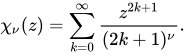
In mathematics, the Legendre chi function (named after Adrien-Marie Legendre) is a special function whose Taylor series is also a Dirichlet series, given by

As such, it resembles the Dirichlet series for the polylogarithm, and, indeed, is trivially expressible as the odd part of the polylogarithm
The Legendre chi function appears as the discrete Fourier transform, with respect to the order ν, of the Hurwitz zeta function, and also of the Euler polynomials, with the explicit relationships given in those articles.
The Legendre chi function is a special case of the Lerch transcendent, and is given by
It takes the special values:
where is the imaginary unit and K is Catalan's constant.[1] Other special values include:
where is the Dirichlet lambda function and is the Dirichlet beta function.[1]
 | This mathematical analysis–related article is a stub. You can help Wikipedia by adding missing information. |
Source: Wikipedia. Article content is retrieved live through the MediaWiki API.

In mathematics, the Legendre chi function (named after Adrien-Marie Legendre) is a special function whose Taylor series is also a Dirichlet series, given by χ ν ( z ) = ∑ k = 0 ∞ z 2 k + 1 ( 2 k + 1 ) ν . {\displaystyle \chi _{\nu }(z)=\sum _{k=0}^{\infty }{\frac {z^{2k+1}}{(2k+1)^{\nu }}}.} As such, it resembles the Dirichlet series for the polylogarithm, and, indeed, is trivially expressible as the odd part of the polylogarithm χ ν ( z ) = 1 2 [ Li ν ( z ) − Li ν ( − z ) ] . {\displaystyle \chi _{\nu }(z)={\frac {1}{2}}\left[\operatorname {Li} _{\nu }(z)-\operatorname {Li} _{\nu }(-z)\right].} The Legendre chi function appears as the discrete Fourier transform, with respect to the order ν, of the Hurwitz zeta function, and also of the Euler polynomials, with the explicit relationships given in those articles. The Legendre chi function is a special case of the Lerch transcendent, and is given by χ ν ( z ) = 2 − ν z Φ ( z 2 , ν , 1 / 2 ) . {\displaystyle \chi _{\nu }(z)=2^{-\nu }z\,\Phi (z^{2},\nu ,1/2).}
Adrien-Marie Legendre (1752–1833) is the eponym of all of the things listed below. 26950 Legendre Associated Legendre polynomials Fourier–Legendre series Gauss–Legendre algorithm Gauss–Legendre method Gauss–Legendre quadrature Legendre (crater) Legendre chi function Legendre duplication formula Legendre–Papoulis filter Legendre form Legendre function Legendre moment Legendre polynomials Legendre pseudospectral method Legendre rational functions Legendre relation Legendre sieve Legendre symbol Legendre transformation Legendre transform (integral transform) Finite Legendre transform Legendre wavelet Legendre–Clebsch condition Legendre–Fenchel transformation Legendre's conjecture Legendre's constant Legendre's differential equation Legendre's equation Legendre's formula Legendrian knot Legendrian submanifold Saccheri–Legendre theorem Legendre's theorem on spherical triangles Legendre's three-square theorem Gamma function–Legendre formula
In mathematics, a Jacobi sum is a type of character sum formed with Dirichlet characters. Simple examples would be Jacobi sums J(χ, ψ) for Dirichlet characters χ, ψ modulo a prime number p, defined by J ( χ , ψ ) = ∑ χ ( a ) ψ ( 1 − a ) , {\displaystyle J(\chi ,\psi )=\sum \chi (a)\psi (1-a)\,,} where the summation runs over all residues a = 2, 3, ..., p − 1 mod p (for which neither a nor 1 − a is 0). Jacobi sums are the analogues for finite fields of the beta function. Such sums were introduced by C. G. J. Jacobi early in the nineteenth century in connection with the theory of cyclotomy. Jacobi sums J can be factored generically into products of powers of Gauss sums g. For example, when the character χψ is nontrivial, J ( χ , ψ ) = g ( χ ) g ( ψ ) g ( χ ψ ) , {\displaystyle J(\chi ,\psi )={\frac {g(\chi )g(\psi )}{g(\chi \psi )}}\,,} analogous to the formula for the beta function in terms of gamma functions. Since the nontrivial Gauss sums g have absolute value p1⁄2, it follows that J(χ, ψ) also has absolute value p1⁄2 when the characters χψ, χ, ψ are nontrivial. Jacobi sums J lie in smaller cyclotomic fields than do the nontrivial Gauss sums g. The summands of J(χ, ψ) for example involve no pth root of unity, but rather involve just values which lie in the cyclotomic field of (p − 1)th roots of unity. Like Gauss sums, Jacobi sums have known prime ideal factorisations in their cyclotomic fields; see Stickelberger's theorem. When χ is the Legendre symbol, J ( χ , χ ) = − χ ( − 1 ) = ( − 1 ) p + 1 2 . {\displaystyle J(\chi ,\chi )=-\chi (-1)=(-1)^{\frac {p+1}{2}}\,.} In general the values of Jacobi sums occur in relation with the local zeta-functions of diagonal forms. The result on the Legendre symbol amounts to the formula p + 1 for the number of points on a conic section that is a projective line over the field of p elements. A paper of André Weil from 1949 very much revived the subject. Indeed, through the Hasse–Davenport relation of the late 20th century, the formal properties of powers of Gauss sums had become current once more. As well as pointing out the possibility of writing down local zeta-functions for diagonal hypersurfaces by means of general Jacobi sums, Weil (1952) demonstrated the properties of Jacobi sums as Hecke characters. This was to become important once the complex multiplication of abelian varieties became established. The Hecke characters in question were exactly those one needs to express the Hasse–Weil L-functions of the Fermat curves, for example. The exact conductors of these characters, a question Weil had left open, were determined in later work.

In mathematics, the beta function, also called the Euler integral of the first kind, is a special function that is closely related to the gamma function and to binomial coefficients. It is defined by the integral B ( z 1 , z 2 ) = ∫ 0 1 t z 1 − 1 ( 1 − t ) z 2 − 1 d t {\displaystyle \mathrm {B} (z_{1},z_{2})=\int _{0}^{1}t^{z_{1}-1}(1-t)^{z_{2}-1}\,dt} where z 1 , z 2 {\displaystyle z_{1},z_{2}} are complex numbers such that ℜ ( z 1 ) > 0 {\displaystyle \Re (z_{1})>0} and ℜ ( z 2 ) > 0 {\displaystyle \Re (z_{2})>0} . The beta function was studied by Leonhard Euler and Adrien-Marie Legendre and was given its name by Jacques Binet; its symbol B {\displaystyle \mathrm {B} } is a Greek capital beta.
Before the 1921 destruction of Tulsa’s Greenwood District, Black residents had created a remarkable center of business and community life. The district included stores, professional offices, entertainment venues and homes owned by Black citizens. Understanding Greenwood means learning what was built—not only what was burned.
MORE →Joe Louis.
![{\displaystyle \chi _{\nu }(z)={\frac {1}{2}}\left[\operatorname {Li} _{\nu }(z)-\operatorname {Li} _{\nu }(-z)\right].}](https://wikimedia.org/api/rest_v1/media/math/render/svg/473961aafa254e0c6ed4568ee2c404996271810b)



![{\displaystyle \chi _{2}(x)+\chi _{2}(1/x)=\left\{{\begin{array}{rcl}{\frac {1}{4}}{\bigl (}\ln ^{2}(x)-\ln ^{2}(-x){\bigr )}&{\text{for}}&|x|>1\\[4pt]{\frac {1}{4}}{\bigl (}\ln ^{2}(1/x)-\ln ^{2}(-1/x){\bigr )}&{\text{for}}&|x|\leq 1\setminus \{0\}\end{array}}\right.}](https://wikimedia.org/api/rest_v1/media/math/render/svg/60592d508c0498e146739af486005b53031bc99f)


