Civil Rights
Movements, leaders, victories and the continuing fight for equality.

Explore the people, places, events, achievements, struggles and stories that shaped our journey.
Movements, leaders, victories and the continuing fight for equality.
Innovation, patents, science, technology and world-changing contributions.
Pioneers, champions, Negro Leagues, records, activism and excellence.
Meet the people whose lives, choices and achievements shaped the journey.
Black towns, communities, institutions and places where history happened.
Moments that changed communities, movements, institutions and the nation.
Mansa Musa was the ruler of the Mali Empire in West Africa. Details recorded here should be sourced; unknown information is left blank.
MORE →Reflects the personal views, recollections, and perspective of the author, Mike Davis.
This is a personal recollection on the Move fire on May 13, 1985
 | This article includes a list of general references but lacks sufficient corresponding inline citations. (February 2025) |
In coding theory, block codes are a large and important family of error-correcting codes that encode data in blocks. There is a vast number of examples for block codes, many of which have a wide range of practical applications. The abstract definition of block codes is conceptually useful because it allows coding theorists, mathematicians, and computer scientists to study the limitations of all block codes in a unified way. Such limitations often take the form of bounds that relate different parameters of the block code to each other, such as its rate and its ability to detect and correct errors.
Examples of block codes are Reed–Solomon codes, Hamming codes, Hadamard codes, Expander codes, Golay codes, Reed–Muller codes and Polar codes. These examples also belong to the class of linear codes, and hence they are called linear block codes. More particularly, these codes are known as algebraic block codes, or cyclic block codes, because they can be generated using Boolean polynomials.
Algebraic block codes are typically hard-decoded using algebraic decoders.[jargon]
The term block code may also refer to any error-correcting code that acts on a block of bits of input data to produce bits of output data . Consequently, the block coder is a memoryless device. Under this definition codes such as turbo codes, terminated convolutional codes and other iteratively decodable codes (turbo-like codes) would also be considered block codes. A non-terminated convolutional encoder would be an example of a non-block (unframed) code, which has memory and is instead classified as a tree code.
This article deals with "algebraic block codes".
Error-correcting codes are used to reliably transmit digital data over unreliable communication channels subject to channel noise. When a sender wants to transmit a possibly very long data stream using a block code, the sender breaks the stream up into pieces of some fixed size. Each such piece is called message and the procedure given by the block code encodes each message individually into a codeword, also called a block in the context of block codes. The sender then transmits all blocks to the receiver, who can in turn use some decoding mechanism to (hopefully) recover the original messages from the possibly corrupted received blocks. The performance and success of the overall transmission depends on the parameters of the channel and the block code.
Formally, a block code is an injective mapping
Here, is a finite and nonempty set and and are integers. The meaning and significance of these three parameters and other parameters related to the code are described below.
The data stream to be encoded is modeled as a string over some alphabet . The size of the alphabet is often written as . If , then the block code is called a binary block code. In many applications it is useful to consider to be a prime power, and to identify with the finite field .
Messages are elements of , that is, strings of length . Hence the number is called the message length or dimension of a block code.
The block length of a block code is the number of symbols in a block. Hence, the elements of are strings of length and correspond to blocks that may be received by the receiver. Hence they are also called received words. If for some message , then is called the codeword of .
The rate of a block code is defined as the ratio between its message length and its block length:
A large rate means that the amount of actual message per transmitted block is high. In this sense, the rate measures the transmission speed and the quantity measures the overhead that occurs due to the encoding with the block code. It is a simple information theoretical fact that the rate cannot exceed since data cannot in general be losslessly compressed. Formally, this follows from the fact that the code is an injective map.
The distance or minimum distance d of a block code is the minimum number of positions in which any two distinct codewords differ, and the relative distance is the fraction . Formally, for received words , let denote the Hamming distance between and , that is, the number of positions in which and differ. Then the minimum distance of the code is defined as
Since any code has to be injective, any two codewords will disagree in at least one position, so the distance of any code is at least . Besides, the distance equals the minimum weight for linear block codes because:[citation needed]
A larger distance allows for more error correction and detection. For example, if we only consider errors that may change symbols of the sent codeword but never erase or add them, then the number of errors is the number of positions in which the sent codeword and the received word differ. A code with distance d allows the receiver to detect up to transmission errors since changing positions of a codeword can never accidentally yield another codeword. Furthermore, if no more than transmission errors occur, the receiver can uniquely decode the received word to a codeword. This is because every received word has at most one codeword at distance . If more than transmission errors occur, the receiver cannot uniquely decode the received word in general as there might be several possible codewords. One way for the receiver to cope with this situation is to use list decoding, in which the decoder outputs a list of all codewords in a certain radius.
The notation describes a block code over an alphabet of size , with a block length , message length , and distance . If the block code is a linear block code, then the square brackets in the notation are used to represent that fact. For binary codes with , the index is sometimes dropped. For maximum distance separable codes, the distance is always , but sometimes the precise distance is not known, non-trivial to prove or state, or not needed. In such cases, the -component may be missing.
Sometimes, especially for non-block codes, the notation is used for codes that contain codewords of length . For block codes with messages of length over an alphabet of size , this number would be .
As mentioned above, there are a vast number of error-correcting codes that are actually block codes. The first error-correcting code was the Hamming(7,4) code, developed by Richard W. Hamming in 1950. This code transforms a message consisting of 4 bits into a codeword of 7 bits by adding 3 parity bits. Hence this code is a block code. It turns out that it is also a linear code and that it has distance 3. In the shorthand notation above, this means that the Hamming(7,4) code is a code.
Reed–Solomon codes are a family of codes with and being a prime power. Rank codes are family of codes with . Hadamard codes are a family of codes with and .
A codeword could be considered as a point in the -dimension space and the code is the subset of . A code has distance means that , there is no other codeword in the Hamming ball centered at with radius , which is defined as the collection of -dimension words whose Hamming distance to is no more than . Similarly, with (minimum) distance has the following properties:


is called family of codes, where is an code with monotonic increasing .
Rate of family of codes C is defined as
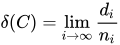
Relative distance of family of codes C is defined as
To explore the relationship between and , a set of lower and upper bounds of block codes are known.
The Singleton bound is that the sum of the rate and the relative distance of a block code cannot be much larger than 1:
In other words, every block code satisfies the inequality . Reed–Solomon codes are non-trivial examples of codes that satisfy the singleton bound with equality.
For , . In other words, .
For the general case, the following Plotkin bounds holds for any with distance d:
For any q-ary code with distance ,
, where , is the q-ary entropy function.
Define .
Let be the maximum number of codewords in a Hamming ball of radius e for any code of distance d.
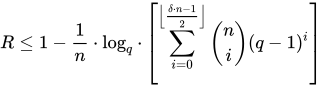
Then we have the Johnson Bound : , if
Block codes are tied to the sphere packing problem which has received some attention over the years. In two dimensions, it is easy to visualize. Take a bunch of pennies flat on the table and push them together. The result is a hexagon pattern like a bee's nest. But block codes rely on more dimensions which cannot easily be visualized. The powerful Golay code used in deep space communications uses 24 dimensions. If used as a binary code (which it usually is), the dimensions refer to the length of the codeword as defined above.
The theory of coding uses the N-dimensional sphere model. For example, how many pennies can be packed into a circle on a tabletop or in 3 dimensions, how many marbles can be packed into a globe. Other considerations enter the choice of a code. For example, hexagon packing into the constraint of a rectangular box will leave empty space at the corners. As the dimensions get larger, the percentage of empty space grows smaller. But at certain dimensions, the packing uses all the space and these codes are the so-called perfect codes. There are very few of these codes.
Another property is the number of neighbors a single codeword may have.[1] Again, consider pennies as an example. First we pack the pennies in a rectangular grid. Each penny will have 4 near neighbors (and 4 at the corners which are farther away). In a hexagon, each penny will have 6 near neighbors. Respectively, in three and four dimensions, the maximum packing is given by the 12-face and 24-cell with 12 and 24 neighbors, respectively. When we increase the dimensions, the number of near neighbors increases very rapidly. In general, the value is given by the kissing numbers.
The result is that the number of ways for noise to make the receiver choose a neighbor (hence an error) grows as well. This is a fundamental limitation of block codes, and indeed all codes. It may be harder to cause an error to a single neighbor, but the number of neighbors can be large enough so the total error probability actually suffers.[1]
Source: Wikipedia. Article content is retrieved live through the MediaWiki API.
In coding theory, block codes are a large and important family of error-correcting codes that encode data in blocks. There is a vast number of examples for block codes, many of which have a wide range of practical applications. The abstract definition of block codes is conceptually useful because it allows coding theorists, mathematicians, and computer scientists to study the limitations of all block codes in a unified way. Such limitations often take the form of bounds that relate different parameters of the block code to each other, such as its rate and its ability to detect and correct errors. Examples of block codes are Reed–Solomon codes, Hamming codes, Hadamard codes, Expander codes, Golay codes, Reed–Muller codes and Polar codes. These examples also belong to the class of linear codes, and hence they are called linear block codes. More particularly, these codes are known as algebraic block codes, or cyclic block codes, because they can be generated using Boolean polynomials. Algebraic block codes are typically hard-decoded using algebraic decoders. The term block code may also refer to any error-correcting code that acts on a block of k {\displaystyle k} bits of input data to produce n {\displaystyle n} bits of output data ( n , k ) {\displaystyle (n,k)} . Consequently, the block coder is a memoryless device. Under this definition codes such as turbo codes, terminated convolutional codes and other iteratively decodable codes (turbo-like codes) would also be considered block codes. A non-terminated convolutional encoder would be an example of a non-block (unframed) code, which has memory and is instead classified as a tree code. This article deals with "algebraic block codes".
In coding theory, a linear code is an error-correcting code for which any linear combination of codewords is also a codeword. Linear codes are traditionally partitioned into block codes and convolutional codes, although turbo codes can be seen as a hybrid of these two types. Linear codes allow for more efficient encoding and decoding algorithms than other codes (cf. syndrome decoding). Linear codes are used in forward error correction and are applied in methods for transmitting symbols (e.g., bits) on a communications channel so that, if errors occur in the communication, some errors can be corrected or detected by the recipient of a message block. The codewords in a linear block code are blocks of symbols that are encoded using more symbols than the original value to be sent. A linear code of length n transmits blocks containing n symbols. For example, the [7,4,3] Hamming code is a linear binary code which represents 4-bit messages using 7-bit codewords. Two distinct codewords differ in at least three bits. As a consequence, up to two errors per codeword can be detected while a single error can be corrected. This code contains 24 = 16 codewords.
Reed–Muller codes are error-correcting codes that are used in wireless communications applications, particularly in deep-space communication. In cryptography, duplicated Reed–Muller codes are concatenated with shortened Reed–Solomon codes in the Hamming Quasi-Cyclic (HQC) key encapsulation mechanism selected by NIST for standardization as an alternative quantum-resistant algorithm. Moreover, the proposed 5G standard relies on the closely related polar codes for error correction in the control channel. Due to their favorable theoretical and mathematical properties, Reed–Muller codes have also been extensively studied in theoretical computer science. For example, they have been shown to asymptotically achieve Shannon capacity on symmetric memoryless channels. Reed–Muller codes generalize the Reed–Solomon codes and the Walsh–Hadamard code. Reed–Muller codes are linear block codes that are locally testable, locally decodable, and list decodable. These properties make them particularly useful in the design of probabilistically checkable proofs. Traditional Reed–Muller codes are binary codes, which means that messages and codewords are binary strings. When r and m are integers with 0 ≤ r ≤ m, the Reed–Muller code with parameters r and m is denoted as RM(r, m). When asked to encode a message consisting of k bits, where k = ∑ i = 0 r ( m i ) {\displaystyle \textstyle k=\sum _{i=0}^{r}{\binom {m}{i}}} holds, the RM(r, m) code produces a codeword consisting of 2m bits. Reed–Muller codes are named after David E. Muller, who discovered the codes in 1954, and Irving S. Reed, who proposed the first efficient decoding algorithm.
In coding theory, group codes are a type of code. Group codes consist of n {\displaystyle n} linear block codes which are subgroups of G n {\displaystyle G^{n}} , where G {\displaystyle G} is a finite Abelian group. A systematic group code C {\displaystyle C} is a code over G n {\displaystyle G^{n}} of order | G | k {\displaystyle \left|G\right|^{k}} defined by n − k {\displaystyle n-k} homomorphisms which determine the parity check bits. The remaining k {\displaystyle k} bits are the information bits themselves.
Before the 1921 destruction of Tulsa’s Greenwood District, Black residents had created a remarkable center of business and community life. The district included stores, professional offices, entertainment venues and homes owned by Black citizens. Understanding Greenwood means learning what was built—not only what was burned.
MORE →Brown v. Board of Education in 1954.