Civil Rights
Movements, leaders, victories and the continuing fight for equality.

Explore the people, places, events, achievements, struggles and stories that shaped our journey.
Movements, leaders, victories and the continuing fight for equality.
Innovation, patents, science, technology and world-changing contributions.
Pioneers, champions, Negro Leagues, records, activism and excellence.
Meet the people whose lives, choices and achievements shaped the journey.
Black towns, communities, institutions and places where history happened.
Moments that changed communities, movements, institutions and the nation.
Katherine Johnson’s mathematical calculations helped guide some of America’s most important early space missions while she confronted the racial and gender barriers faced by Black women in twentieth-century America.
MORE →Reflects the personal views, recollections, and perspective of the author, Mike Davis.
This is a personal recollection on the Move fire on May 13, 1985
In machine learning, a linear classifier makes a classification decision for each object based on a linear combination of its features. A simpler definition is to say that a linear classifier is one whose decision boundaries are linear. Such classifiers work well for practical problems such as document classification, and more generally for problems with many variables (features), reaching accuracy levels comparable to non-linear classifiers while taking less time to train and use.[1]

If the input feature vector to the classifier is a real vector , then the output score is
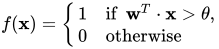
where is a real vector of weights and f is a function that converts the dot product of the two vectors into the desired output. (In other words, is a one-form or linear functional mapping onto R.) The weight vector is learned from a set of labeled training samples. Often f is a threshold function, which maps all values of above a certain threshold to the first class and all other values to the second class; e.g.,
The superscript T indicates the transpose and is a scalar threshold. A more complex f might give the probability that an item belongs to a certain class.
For a two-class classification problem, one can visualize the operation of a linear classifier as splitting a high-dimensional input space with a hyperplane: all points on one side of the hyperplane are classified as "yes", while the others are classified as "no".
A linear classifier is often used in situations where the speed of classification is an issue, since it is often the fastest classifier, especially when is sparse. Also, linear classifiers often work very well when the number of dimensions in is large, as in document classification, where each element in is typically the number of occurrences of a word in a document (see document-term matrix). In such cases, the classifier should be well-regularized.
There are two broad classes of methods for determining the parameters of a linear classifier . They can be generative and discriminative models.[2][3] Methods of the former model joint probability distribution, whereas methods of the latter model conditional density functions . Examples of such algorithms include:
The second set of methods includes discriminative models, which attempt to maximize the quality of the output on a training set. Additional terms in the training cost function can easily perform regularization of the final model. Examples of discriminative training of linear classifiers include:
Note: Despite its name, LDA does not belong to the class of discriminative models in this taxonomy. However, its name makes sense when we compare LDA to the other main linear dimensionality reduction algorithm: principal components analysis (PCA). LDA is a supervised learning algorithm that utilizes the labels of the data, while PCA is an unsupervised learning algorithm that ignores the labels. To summarize, the name is a historical artifact.[5]
Discriminative training often yields higher accuracy than modeling the conditional density functions[citation needed]. However, handling missing data is often easier with conditional density models[citation needed].
All of the linear classifier algorithms listed above can be converted into non-linear algorithms operating on a different input space , using the kernel trick.
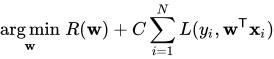
Discriminative training of linear classifiers usually proceeds in a supervised way, by means of an optimization algorithm that is given a training set with desired outputs and a loss function that measures the discrepancy between the classifier's outputs and the desired outputs. Thus, the learning algorithm solves an optimization problem of the form[1]
where
Popular loss functions include the hinge loss (for linear SVMs) and the log loss (for linear logistic regression). If the regularization function R is convex, then the above is a convex problem.[1] Many algorithms exist for solving such problems; popular ones for linear classification include (stochastic) gradient descent, L-BFGS, coordinate descent and Newton methods.
Source: Wikipedia. Article content is retrieved live through the MediaWiki API.
In machine learning, a linear classifier makes a classification decision for each object based on a linear combination of its features. A simpler definition is to say that a linear classifier is one whose decision boundaries are linear. Such classifiers work well for practical problems such as document classification, and more generally for problems with many variables (features), reaching accuracy levels comparable to non-linear classifiers while taking less time to train and use.

Linear discriminant analysis (LDA), normal discriminant analysis (NDA), canonical variates analysis (CVA), or discriminant function analysis is a generalization of Fisher's linear discriminant, a method used in statistics and other fields, to find a linear combination of features that characterizes or separates two or more classes of objects or events. The resulting combination may be used as a linear classifier, or, more commonly, for dimensionality reduction before later classification. LDA is closely related to analysis of variance (ANOVA) and regression analysis, which also attempt to express one dependent variable as a linear combination of other features or measurements. However, ANOVA uses categorical independent variables and a continuous dependent variable, whereas discriminant analysis has continuous independent variables and a categorical dependent variable (i.e. the class label). Logistic regression and probit regression are more similar to LDA than ANOVA is, as they also explain a categorical variable by the values of continuous independent variables. These other methods are preferable in applications where it is not reasonable to assume that the independent variables have a normal distribution, which is a fundamental assumption of the LDA method. LDA is also closely related to principal component analysis (PCA) and factor analysis in that they both look for linear combinations of variables which best explain the data. LDA explicitly attempts to model the difference between the classes of data. PCA, in contrast, does not take into account any difference in class, and factor analysis builds the feature combinations based on similarities rather than differences. Discriminant analysis is also different from factor analysis in that it is not an interdependence technique: a distinction between independent variables and dependent variables (also called criterion variables) must be made. LDA works when the measurements made on independent variables for each observation are continuous quantities. When dealing with categorical independent variables, the equivalent technique is discriminant correspondence analysis. Discriminant analysis is used when groups are known a priori (unlike in cluster analysis). Each case must have a score on one or more quantitative predictor measures, and a score on a group measure. In simple terms, discriminant function analysis is classification - the act of distributing things into groups, classes or categories of the same type.
In statistics, a quadratic classifier is a statistical classifier that uses a quadratic decision surface to separate measurements of two or more classes of objects or events. It is a more general version of the linear classifier.
In machine learning (ML), a margin classifier is a type of classification model which is able to give an associated distance from the decision boundary for each data sample. For instance, if a linear classifier is used, the distance (typically Euclidean, though others may be used) of a sample from the separating hyperplane is the margin of that sample. The notion of margins is important in several ML classification algorithms, as it can be used to bound the generalization error of these classifiers. These bounds are frequently shown using the VC dimension. The generalization error bound in boosting algorithms and support vector machines is particularly prominent.
Before the 1921 destruction of Tulsa’s Greenwood District, Black residents had created a remarkable center of business and community life. The district included stores, professional offices, entertainment venues and homes owned by Black citizens. Understanding Greenwood means learning what was built—not only what was burned.
MORE →The Greenwood District.