Civil Rights
Movements, leaders, victories and the continuing fight for equality.

Explore the people, places, events, achievements, struggles and stories that shaped our journey.
Movements, leaders, victories and the continuing fight for equality.
Innovation, patents, science, technology and world-changing contributions.
Pioneers, champions, Negro Leagues, records, activism and excellence.
Meet the people whose lives, choices and achievements shaped the journey.
Black towns, communities, institutions and places where history happened.
Moments that changed communities, movements, institutions and the nation.
Wilmington, North Carolina once had a thriving Black middle class and an elected interracial government. In 1898 white supremacists used violence to overthrow that government, kill Black residents and drive many others from the city.
MORE →Reflects the personal views, recollections, and perspective of the author, Mike Davis.
This is a personal recollection on the Move fire on May 13, 1985
In mathematics, the term linear function refers to two distinct but related notions:[1]

In calculus, analytic geometry and related areas, a linear function is a polynomial of degree one or less, including the zero polynomial. (The latter is a polynomial with no terms, and it is not considered to have degree zero.)
When the function is of only one variable, it is of the form
where a and b are constants, often real numbers. The graph of such a function of one variable is a nonvertical line. a is frequently referred to as the slope of the line, and b as the intercept.
If a > 0 then the gradient is positive and the graph slopes upwards.
If a < 0 then the gradient is negative and the graph slopes downwards.
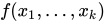
For a function of any finite number of variables, the general formula is
and the graph is a hyperplane of dimension k.
A constant function is also considered linear in this context, as it is a polynomial of degree zero or is the zero polynomial. Its graph, when there is only one variable, is a horizontal line.
In this context, a function that is also a linear map (the other meaning of linear functions, see below) may be referred to as a homogeneous linear function or a linear form. In the context of linear algebra, the polynomial functions of degree 0 or 1 are the scalar-valued affine maps.

In linear algebra, a linear function is a map from a vector space to a vector space (Both spaces are not necessarily different.) over a same field K such that
Here a denotes a constant belonging to the field K of scalars (for example, the real numbers), and x and y are elements of , which might be K itself. Even if the same symbol is used, the operation of addition between x and y (belonging to ) is not necessarily same to the operation of addition between and (belonging to ).
In other terms the linear function preserves vector addition and scalar multiplication.
Some authors use "linear function" only for linear maps that take values in the scalar field;[6] these are more commonly called linear forms.
The "linear functions" of calculus qualify as "linear maps" when (and only when) f(0, ..., 0) = 0, or, equivalently, when the constant b equals zero in the one-degree polynomial above. Geometrically, the graph of the function must pass through the origin.
Source: Wikipedia. Article content is retrieved live through the MediaWiki API.
In mathematics, the term linear function refers to two distinct but related notions: In calculus and related areas, a linear function is a function whose graph is a straight line, that is, a polynomial function of degree zero (a constant polynomial) or one (a linear polynomial). For distinguishing such a linear function from the other concept, the term affine function is often used. In linear algebra, mathematical analysis, and functional analysis, a linear function is a kind of function between vector spaces.

In calculus and related areas of mathematics, a linear function from the real numbers to the real numbers is a function whose graph (in Cartesian coordinates) is a non-vertical line in the plane. The characteristic property of linear functions is that when the input variable is changed, the change in the output is proportional to the change in the input. Linear functions are related to linear equations.
In mathematics, a piecewise linear or segmented function is a real-valued function of a real variable, whose graph is composed of straight-line segments.
In statistics and in machine learning, a linear predictor function is a linear function (linear combination) of a set of coefficients and explanatory variables (independent variables), whose value is used to predict the outcome of a dependent variable. This sort of function usually comes in linear regression, where the coefficients are called regression coefficients. However, they also occur in various types of linear classifiers (e.g. logistic regression, perceptrons, support vector machines, and linear discriminant analysis), as well as in various other models, such as principal component analysis and factor analysis. In many of these models, the coefficients are referred to as "weights".
Before the 1921 destruction of Tulsa’s Greenwood District, Black residents had created a remarkable center of business and community life. The district included stores, professional offices, entertainment venues and homes owned by Black citizens. Understanding Greenwood means learning what was built—not only what was burned.
MORE →The Greenwood District.