Civil Rights
Movements, leaders, victories and the continuing fight for equality.

Explore the people, places, events, achievements, struggles and stories that shaped our journey.
Movements, leaders, victories and the continuing fight for equality.
Innovation, patents, science, technology and world-changing contributions.
Pioneers, champions, Negro Leagues, records, activism and excellence.
Meet the people whose lives, choices and achievements shaped the journey.
Black towns, communities, institutions and places where history happened.
Moments that changed communities, movements, institutions and the nation.
Mansa Musa was the ruler of the Mali Empire in West Africa. Details recorded here should be sourced; unknown information is left blank.
MORE →Reflects the personal views, recollections, and perspective of the author, Mike Davis.
This is a personal recollection on the Move fire on May 13, 1985
 | This article needs more citations. (December 2007) |
In mathematics, the term linear is used in two distinct senses for two different properties:
An example of a linear function is the function defined by that maps the real line to a line in the Euclidean plane R2 that passes through the origin. An example of a linear polynomial in the variables and is
Linearity of a mapping is closely related to proportionality. Examples in physics include the linear relationship of voltage and current in an electrical conductor (Ohm's law), and the relationship of mass and weight. By contrast, more complicated relationships, such as between velocity and kinetic energy, are nonlinear.
Generalized for functions in more than one dimension, linearity means the property of a function of being compatible with addition and scaling, also known as the superposition principle.
Linearity of a polynomial means that its degree is less than two. The use of the term for polynomials stems from the fact that the graph of a polynomial in one variable is a straight line. In the term "linear equation", the word refers to the linearity of the polynomials involved.
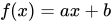
Because a function such as is defined by a linear polynomial in its argument, it is sometimes also referred to as being a "linear function", and the relationship between the argument and the function value may be referred to as a "linear relationship". This is potentially confusing, but usually the intended meaning will be clear from the context.
The word linear comes from Latin linearis, "pertaining to or resembling a line".
In mathematics, a linear map or linear function f(x) is a function that satisfies the two properties:[1]
These properties are known as the superposition principle. In this definition, x is not necessarily a real number, but can in general be an element of any vector space. A more special definition of linear function, not coinciding with the definition of linear map, is used in elementary mathematics (see below).
Additivity alone implies homogeneity for rational α, since implies for any natural number n by mathematical induction, and then implies . The density of the rational numbers in the reals implies that any additive continuous function is homogeneous for any real number α, and is therefore linear.
The concept of linearity can be extended to linear operators. Important examples of linear operators include the derivative considered as a differential operator, and other operators constructed from it, such as del and the Laplacian. When a differential equation can be expressed in linear form, it can generally be solved by breaking the equation up into smaller pieces, solving each of those pieces, and summing the solutions.
In a different usage to the above definition, a polynomial of degree 1 is said to be linear, because the graph of a function of that form is a straight line.[2]
Over the reals, a simple example of a linear equation is given by where m is often called the slope or gradient, and b the y-intercept, which gives the point of intersection between the graph of the function and the y axis.
Note that this usage of the term linear is not the same as in the section above, because linear polynomials over the real numbers do not in general satisfy either additivity or homogeneity. In fact, they do so if and only if the constant term – b in the example – equals 0. If b ≠ 0, the function is called an affine function (see in greater generality affine transformation).
Linear algebra is the branch of mathematics concerned with systems of linear equations.

In Boolean algebra, a linear function is a function for which there exist such that
Note that if , the above function is considered affine in linear algebra (i.e. not linear).
A Boolean function is linear if one of the following holds for the function's truth table:
Another way to express this is that each variable always makes a difference in the truth value of the operation or it never makes a difference.
Negation, Logical biconditional, exclusive or, tautology, and contradiction are linear functions.
In physics, linearity is a property of the differential equations governing many systems; for instance, the Maxwell equations or the diffusion equation.[3]
Linearity of a homogeneous differential equation means that if two functions f and g are solutions of the equation, then any linear combination af + bg is, too.
In instrumentation, linearity means that a given change in an input variable gives the same change in the output of the measurement apparatus: this is highly desirable in scientific work. In general, instruments are close to linear over a certain range, and most useful within that range. In contrast, human senses are highly nonlinear: for instance, the brain completely ignores incoming light unless it exceeds a certain absolute threshold number of photons.
Linear motion traces a straight line trajectory.
In electronics, the linear operating region of a device, for example a transistor, is where an output dependent variable (such as the transistor collector current) is directly proportional to an input dependent variable (such as the base current). This ensures that an analog output is an accurate representation of an input, typically with higher amplitude (amplified). A typical example of linear equipment is a high fidelity audio amplifier, which must amplify a signal without changing its waveform. Others are linear filters, and linear amplifiers in general.
In most scientific and technological, as distinct from mathematical, applications, something may be described as linear if the characteristic is approximately but not exactly a straight line; and linearity may be valid only within a certain operating region—for example, a high-fidelity amplifier may distort a small signal, but sufficiently little to be acceptable (acceptable but imperfect linearity); and may distort very badly if the input exceeds a certain value.[4]
For an electronic device (or other physical device) that converts a quantity to another quantity, Bertram S. Kolts writes:[5][6]
There are three basic definitions for integral linearity in common use: independent linearity, zero-based linearity, and terminal, or end-point, linearity. In each case, linearity defines how well the device's actual performance across a specified operating range approximates a straight line. Linearity is usually measured in terms of a deviation, or non-linearity, from an ideal straight line and it is typically expressed in terms of percent of full scale, or in ppm (parts per million) of full scale. Typically, the straight line is obtained by performing a least-squares fit of the data. The three definitions vary in the manner in which the straight line is positioned relative to the actual device's performance. Also, all three of these definitions ignore any gain, or offset errors that may be present in the actual device's performance characteristics.
 The dictionary definition of linearity at Wiktionary
Source: Wikipedia. Article content is retrieved live through the MediaWiki API.
In mathematics, the term linear is used in two distinct senses for two different properties: linearity of a function (or mapping); linearity of a polynomial. An example of a linear function is the function defined by f ( x ) = ( a x , b x ) {\displaystyle f(x)=(ax,bx)} that maps the real line to a line in the Euclidean plane R2 that passes through the origin. An example of a linear polynomial in the variables X , {\displaystyle X,} Y {\displaystyle Y} and Z {\displaystyle Z} is a X + b Y + c Z + d . {\displaystyle aX+bY+cZ+d.} Linearity of a mapping is closely related to proportionality. Examples in physics include the linear relationship of voltage and current in an electrical conductor (Ohm's law), and the relationship of mass and weight. By contrast, more complicated relationships, such as between velocity and kinetic energy, are nonlinear. Generalized for functions in more than one dimension, linearity means the property of a function of being compatible with addition and scaling, also known as the superposition principle. Linearity of a polynomial means that its degree is less than two. The use of the term for polynomials stems from the fact that the graph of a polynomial in one variable is a straight line. In the term "linear equation", the word refers to the linearity of the polynomials involved. Because a function such as f ( x ) = a x + b {\displaystyle f(x)=ax+b} is defined by a linear polynomial in its argument, it is sometimes also referred to as being a "linear function", and the relationship between the argument and the function value may be referred to as a "linear relationship". This is potentially confusing, but usually the intended meaning will be clear from the context. The word linear comes from Latin linearis, "pertaining to or resembling a line".
In calculus, the derivative of any linear combination of functions equals the same linear combination of the derivatives of the functions; this property is known as linearity of differentiation, the rule of linearity, or the superposition rule for differentiation. It is a fundamental property of the derivative that encapsulates in a single rule two simpler rules of differentiation, the sum rule (the derivative of the sum of two functions is the sum of the derivatives) and the constant factor rule (the derivative of a constant multiple of a function is the same constant multiple of the derivative). Thus it can be said that differentiation is linear, or the differential operator is a linear operator.
A measurement system consists of a sensor, to input the physical parameter that is of interest, and an output to a medium that is suitable for reading by the system that needs to know the value of the parameter. (This could be a device to convert the temperature of the surrounding air or water into the visually readable height of a column of mercury in a small tube, for example; but the conversion could also be made to an electronic encoding of the parameter, for reading by a computer system.) The integral linearity is then a measure of the fidelity of the conversion that is performed by the measuring system. It is the relation of the output to the input over a range expressed as a percentage of the full-scale measurements. Integral linearity is a measure of the device's deviation from ideal linear behaviour. The most common denotation of integral linearity is independent linearity. In the context of a digital-to-analog converter (DAC) or an analog-to-digital converter (ADC), independent linearity is fitted to minimize the deviation with respect to the ideal behaviour with no constraints. Other types of integral linearity place constraints on the symmetry or end points of the linear fit with respect to the actual data. In the case of position sensors, two general types exist. Differences between the two regarding independent linearity essentially relate to the type of mechanical interface - linear or rotary. For rotary position sensors, as a shaft (or in the case of magnetic sensors, a magnet) is turned over a defined mechanical range in a direction causing an increasing response, an output voltage changes from a minimum to maximum value. The variation from an ideal linear relationship as this device is changed from minimum to maximum range end-points is the independent linearity error. It is measured in a practical sense as deviation of output voltage as a percentage of input voltage with the maximum value as the range is traversed, usually being referred to in a device's specifications. The same description holds for linear position sensors except that a straight rod (or magnet) is moved along the length of the sensor or as it extends from the end of a linear position sensor.

Differential nonlinearity (acronym DNL) is a commonly used measure of performance in digital-to-analog (DAC) and analog-to-digital (ADC) converters. It is a term describing the deviation between two analog values corresponding to adjacent input digital values. It is an important specification for measuring error in a digital-to-analog converter (DAC); the accuracy of a DAC is mainly determined by this specification. Ideally, any two adjacent digital codes correspond to output analog voltages that are exactly one Least Significant Bit (LSB) apart. Differential non-linearity is a measure of the worst-case deviation from the ideal 1 LSB step. For example, a DAC with a 1.5 LSB output change for a 1 LSB digital code change exhibits 1⁄2 LSB differential non-linearity. Differential non-linearity may be expressed in fractional bits or as a percentage of full scale. A differential non-linearity greater than 1 LSB may lead to a non-monotonic transfer function in a DAC. It is also known as a missing code. Differential linearity refers to a constant relation between the change in the output and input. For transducers if a change in the input produces a uniform step change in the output the transducer possess differential linearity. Differential linearity is desirable and is inherent to a system such as a single-slope analog-to-digital converter used in nuclear instrumentation.
Before the 1921 destruction of Tulsa’s Greenwood District, Black residents had created a remarkable center of business and community life. The district included stores, professional offices, entertainment venues and homes owned by Black citizens. Understanding Greenwood means learning what was built—not only what was burned.
MORE →The Greenwood District.