q2K BHP
Black History Portal
THE BHP WIRE —
HIDDEN TRUTHS
What's New!
THE JOURNEY THROUGH TIME

Explore Black History

Explore the people, places, events, achievements, struggles and stories that shaped our journey.

✊🏾

Civil Rights

Movements, leaders, victories and the continuing fight for equality.

⚙️

Black Inventors

Innovation, patents, science, technology and world-changing contributions.

🏆

Sports

Pioneers, champions, Negro Leagues, records, activism and excellence.

♟️

People

Meet the people whose lives, choices and achievements shaped the journey.

📍

Places

Black towns, communities, institutions and places where history happened.

📜

Events

Moments that changed communities, movements, institutions and the nation.

Enter a person, place, event, or topic.
MY'STORY

The MOVE Fire

This is a personal recollection on the Move fire on May 13, 1985 Philadelphia police fired thousands of rounds at the MOVE house, city officials approved dropping an explosive device on the roof, the resulting fire was allowed to burn, 11 people—including five children—died, and 61 homes were destroyed. Philadelphia City Council later called it a “brutal attack carried out by the City of Philadelphia on its own citizens” and acknowledged that no individual faced criminal consequences for the bombing. One timeline correction worth preserving for the BHP record: the major previous MOVE-police confrontation was August 8, 1978, about seven years before the bombing, not a year or two earlier. Officer James Ramp was killed, other police and firefighters were wounded, nine MOVE members were later convicted, and television cameras recorded police beating Delbert Africa during his arrest. The 1985 MOVE Commission later specifically criticized city planners for failing to adequately use lessons from that 1978 confrontation. And that actually strengthens the point you’re making: 1985 did not happen without precedent or institutional memory. There had already been a deadly confrontation with MOVE, years of conflict, negotiations and police involvement before Osage Avenue.

MORE →
BLACK FACTS
The Truths They Never Taught You...

The Violence That Helped Spark the NAACP

In August 1908, a white mob attacked Springfield, Illinois’s Black community, destroying homes and businesses and lynching two Black men. National outrage over the violence helped spur the movement that created the NAACP the following year.

MORE →
BHP gathered finds from its connected research sources. Showing the 13 strongest Black History matches.
← BACK TO RESULTS
NMAAHC

The Little Rock Nine

Date
2009; printed 2019
Description
A black-and-white photograph of the Little Rock Nine, by Platon. The photograph depicts the Little Rock Nine in full length, holding hands, and standing in a row in front of the front entrance to the Little Rock Central High School. Standing from left to right is Jefferson Thomas, Minnijean Brown, Gloria Ray, Elizabeth Eckford, Carlotta Walls, Terrence Roberts, Thelma Mothershed, Melba Patillo, and Ernest Green. Thomas, on the far left, is wearing a dark tone, pinstripe suit with a white dress shirt and a patterned tie. He is looking up and to the right into the distance. He has a serious expression on his face. His proper right hand is resting on the front of his proper right thigh and he is holding Brown’s proper right hand with his proper left hand. Brown is wearing a medium tone, ribbed turtleneck shirt under a dark tone cardigan, black pants, and a necklace with a square pendant. She is smiling and looking up and into the distance towards the right. She is holding Eckford’s proper right hand with her proper left hand. Eckford is wearing a dark tone pantsuit, a dark tone blouse, a strand of pearls, and an accent scarf with an abstract black and white pattern. She has a slight smile on her face and is looking into the distance to the left. She is holding Ray’s proper right hand with her proper left hand. Ray is wearing a medium tone poncho with a black swirl pattern and dark tone, loose pants. She has a serious expression on her face and is looking forward into the distance to the left. She is holding Wall’s proper right hand with her proper left hand. Walls is wearing a medium tone, elongated cardigan with three-quarter length sleeves embellished with black beads along the neckline, cuffs, and along the open front edge. The sweater is fastened at the neckline with a single button. She is also wearing a medium tone blouse, dark tone pants, a necklace with a drop pendant, and bangles on both wrists. Her proper left arm is resting at her side. She has a serious expression on her face and is looking forward into the distance. Standing to the right of Walls is Roberts. He is wearing a dark tone suit and a white dress shirt. He is looking at the viewer and has a serious expression on his face. Mothershed is standing directly in front of him and he has both hands under her arms, supporting her, as she leans on her walker. Mothershed is wearing a black jacket with six large white button down the front and medium tone pants. She is looking directly at the viewer with a serious expression on her face. She is grasping the handrails on the metal walker in front of her with both hands. Standing next to her is Patillo. She is wearing a floral pattern jacket over a medium tone cowl neck shirt and an ankle length skirt. She is also wearing wire rimmed glasses, a headband, and a necklace with a teardrop shaped pendant. She is leaning towards Mothershed, looking at the viewer, with a serious expression on her face. She is holding Green’s proper right hand with her proper left hand. Green is standing at the far right side of the group. He is wearing a medium tone suit, a white dress shirt, a diagonally striped tie, and sunglasses. He is looking up and into the distance. The group is standing on a grassy patch in front of the school. Visible behind them are the hedges around the water feature and the steps leading up on either side to the front entrance of the school. Above the group is a cloudy sky. The photograph has a thick white border. The edition number, [5/12], is printed in the bottom left corner. The photographer’s signature and date, [Platon 19], is handwritten in the bottom right corner. Inside the border, at the bottom center, is the photographer’s embossed mark: [PLATON ? / EDITIONED ? / PRINT ?[encircled between two bands of embossed dots]]. The back of the photograph is plain and white.
See more items in
National Museum of African American History and Culture Collection
Classification
Photographs and Still Images
Credit Line
Collection of the Smithsonian National Museum of African American History and Culture, Gift of Platon
Data Source
National Museum of African American History and Culture
Object number
2021.33.1
Type
pigment prints
portraits
Restrictions & Rights
© Platon
Permission required for use. Proper usage is the responsibility of the user.
Medium
pigment on paper
Dimensions
H x W (image): 15 9/16 × 21 1/2 in. (39.5 × 54.6 cm)
H x W (sheet): 20 × 24 in. (50.8 × 61 cm)
H x W (matted): 22 × 28 in. (55.9 × 71.1 cm)
Title
Title • The Little Rock Nine
Record ID
nmaahc_2021.33.1
Museum
NMAAHC
Title Sort
THE LITTLE ROCK NINE
Source
National Museum of African American History and Culture
Metadata Usage
CC0
Date
2000s
Geo Location
City • New York City • State • New York • Country • United States • Continent • North and Central America • City • Little Rock • County • Pulaski County • State • Arkansas
Online Media Type
Images
Online Media Rights
Limited Use

Source: National Museum of African American History and Culture, Smithsonian Institution. Rights and restrictions shown above are supplied by the Smithsonian record.

Wikipedia

Little Rock Nine

The Little Rock Nine were a group of nine African American students enrolled in Little Rock Central High School in 1957. Their enrollment was followed by the Little Rock Crisis, in which the students were initially prevented from entering the racially segregated school by Orval Faubus, the Governor of Arkansas. They then attended after the intervention of President Dwight D. Eisenhower. The U.S. Supreme Court issued its historic decision Brown v. Board of Education on May 17, 1954. Tied to the Fourteenth Amendment to the U.S. Constitution, the decision declared all laws establishing segregated schools to be unconstitutional, and it called for the desegregation of all schools throughout the nation. After the decision, the National Association for the Advancement of Colored People (NAACP) attempted to register black students in previously all-white schools in cities throughout the South. In Little Rock, Arkansas, the school board agreed to comply with the high court's ruling. Virgil Blossom, the Superintendent of Schools, submitted a plan of gradual integration to the school board on May 24, 1955, which the board unanimously approved. The plan would be implemented during the fall of the 1957 school year, which would begin in September 1957. By 1957, the NAACP had registered nine black students to attend the previously all-white Little Rock Central High, selected on the criteria of excellent grades and attendance. Called the "Little Rock Nine", they were Ernest Green (b. 1941), Elizabeth Eckford (b. 1941), Jefferson Thomas (1942–2010), Terrence Roberts (b. 1941), Carlotta Walls LaNier (b. 1942), Minnijean Brown (b. 1941), Gloria Ray Karlmark (b. 1942), Thelma Mothershed (1940–2024), and Melba Pattillo Beals (b. 1941). Later, Ernest Green was the first African American to graduate from Central High School. When integration began on September 4, 1957, the Arkansas National Guard was called in to "preserve the peace". Originally at orders of the governor, they were meant to prevent the black students from entering due to claims that there was "imminent danger of tumult, riot and breach of peace" at the integration. However, President Eisenhower issued Executive Order 10730, which federalized the Arkansas National Guard and ordered them to support the integration on September 23 of that year, after which they protected the African American students.

MORE →
National Archives

Nine From Little Rock

Date: 51380

This film features the nine black students who integrated Central High School in Little Rock, Arkansas in 1957, and describes the individual achievements of these students during the seven years that followed. The program also indicates, through specific cases, the progress of racial integration in the United States. The film received the 1965 Academy Award for Best Documentary (Short Subject). Directed by Charles Guggenheim and produced by Shelby Storck (Guggenheim Productions).

MORE →
No preview image
Wikipedia

Nine from Little Rock

Nine from Little Rock is a 1964 American short documentary film directed by Charles Guggenheim about the Little Rock Nine, the first nine African-American students to attend an all-white Arkansas high school in 1957.

MORE →
Wikipedia

Little Rock Central High School

Little Rock Central High School (LRCH) is an accredited comprehensive public high school in Little Rock, Arkansas, United States. The school was the site of the Little Rock Crisis in 1957 after the U.S. Supreme Court ruled that segregation by race in public schools was unconstitutional three years earlier. This was during the period of heightened activism in the civil rights movement. Central is located at the intersection of Little Rock Nine Way (a section of Park Street, designated in September 2022) and Daisy L. Gatson Bates Drive (formerly 14th Street). Bates was an African-American journalist and state NAACP president who played a key role in bringing about, through the 1957 crisis, the integration of the school. Central can trace its origins to 1869 when the Sherman School operated in a wooden structure at 8th and Sherman streets; it graduated its first class on June 13, 1873. In 1885 the Sherman School was moved to 14th and Scott streets and was named Scott Street School, but was more commonly called City High School. Five years later in 1890, the Peabody School was constructed at West Capitol and Gaines streets. It was named in honor of philanthropist George Peabody from US$200,000 received via the Peabody Education Fund. In 1905, the city founded Little Rock High School at the intersection of 14th and Cumberland streets, and shuttered the Peabody and Scott Street schools to serve as the city's sole public high school. Until 1957, only white students were permitted to be enrolled. In 1927 at a cost of US$1.5 million, the city completed construction on the nation's largest and most expensive high school facility, which remains in use today. In 1953 with the construction of Hall High School, the school was renamed as Little Rock Central High School. It has since been listed on the U.S. National Register of Historic Places and named as a U.S. National Historic Landmark and National Historic Site. Central High School, which covers grades 9 through 12, had an enrollment of 2,476 in school year 2020–2021. It is in the Little Rock School District, and serves sections of Little Rock and the entirety of Cammack Village. Nancy Rousseau was appointed principal in 2002, and retained that position as of 2024.

MORE →
Wikipedia

Little Rock Central High School Desegregation silver dollar

The Little Rock Central High School Desegregation silver dollar is a commemorative coin issued by the United States Mint in 2007. The coin commemorates the desegregation of the Little Rock Central High School in the fall of 1957 when nine African-American students enrolled in the school in compliance with the U.S. Supreme Court decision in Brown v. Board of Education.

MORE →
National Archives

Telegram from Parents of the Little Rock Nine to President Dwight D. Eisenhower

Date: 17368589
MORE →
No preview image
NMAAHC

Photograph of seven of the Little Rock Nine meeting at the home of Daisy Bates

Date: Date

Description

MORE →
No preview image
NMAAHC

The Little Rock Nine

Date: Date

Description

MORE →
YouTube

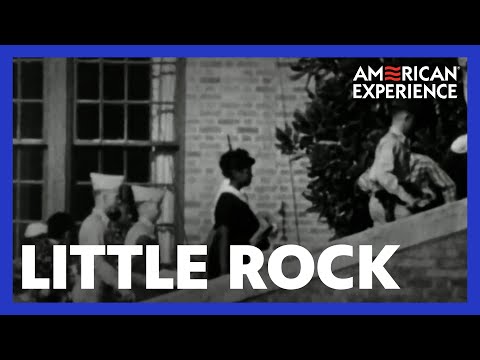
Little Rock | The American Diplomat | American Experience | PBS

Date: 2022-01-24T16:30:10Z

With the events in Little Rock, Arkansas in 1957, America's civil rights struggle and racial violence could be seen by the world.

MORE →
National Archives

Central High, Little Rock

Date: 55034242
MORE →
National Archives

Little Rock Central H.S. 11/6/98

Date: 20761036
MORE →
NMAAHC

Outfit worn by Carlotta Walls to Little Rock Central High School

Date: Date

Caption

MORE →
NMAAHC

Report card for Carlotta Walls from Little Rock Central High School

Date: Date

Description

MORE →
TOPIC OF THE DAY

Greenwood / Black Wall Street

Before the 1921 destruction of Tulsa’s Greenwood District, Black residents had created a remarkable center of business and community life. The district included stores, professional offices, entertainment venues and homes owned by Black citizens. Understanding Greenwood means learning what was built—not only what was burned.

MORE →
TRIVIA QUESTION OF THE DAY

Which heavyweight champion was known as the “Brown Bomber”?

Joe Louis.