Civil Rights
Movements, leaders, victories and the continuing fight for equality.

Explore the people, places, events, achievements, struggles and stories that shaped our journey.
Movements, leaders, victories and the continuing fight for equality.
Innovation, patents, science, technology and world-changing contributions.
Pioneers, champions, Negro Leagues, records, activism and excellence.
Meet the people whose lives, choices and achievements shaped the journey.
Black towns, communities, institutions and places where history happened.
Moments that changed communities, movements, institutions and the nation.
In 1968 Shirley Chisholm became the first Black woman elected to the United States Congress. In 1972 she launched a campaign for the Democratic presidential nomination, breaking another political barrier.
MORE →Reflects the personal views, recollections, and perspective of the author, Mike Davis.
This is a personal recollection on the Move fire on May 13, 1985
In mathematics, loop algebras are certain types of Lie algebras, of particular interest in theoretical physics.
For a Lie algebra over a field , if is the space of Laurent polynomials, then with the inherited bracket
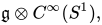
If is a Lie algebra, the tensor product of with C∞(S1), the algebra of (complex) smooth functions over the circle manifold S1 (equivalently, smooth complex-valued periodic functions of a given period),
is an infinite-dimensional Lie algebra with the Lie bracket given by
Here g1 and g2 are elements of and f1 and f2 are elements of C∞(S1).
This isn't precisely what would correspond to the direct product of infinitely many copies of , one for each point in S1, because of the smoothness restriction. Instead, it can be thought of in terms of smooth map from S1 to ; a smooth parametrized loop in , in other words. This is why it is called the loop algebra.
Defining to be the linear subspace the bracket restricts to a product hence giving the loop algebra a -graded Lie algebra structure.
In particular, the bracket restricts to the 'zero-mode' subalgebra .
There is a natural derivation on the loop algebra, conventionally denoted acting as and so can be thought of formally as .
It is required to define affine Lie algebras, which are used in physics, particularly conformal field theory.
Similarly, a set of all smooth maps from S1 to a Lie group G forms an infinite-dimensional Lie group (Lie group in the sense we can define functional derivatives over it) called the loop group. The Lie algebra of a loop group is the corresponding loop algebra.
If is a semisimple Lie algebra, then a nontrivial central extension of its loop algebra gives rise to an affine Lie algebra. Furthermore, this central extension is unique.[1]
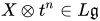
The central extension is given by adjoining a central element , that is, for all , and modifying the bracket on the loop algebra to where is the Killing form.
The central extension is, as a vector space, (in its usual definition, as more generally, can be taken to be an arbitrary field).
Using the language of Lie algebra cohomology, the central extension can be described using a 2-cocycle on the loop algebra. This is the map satisfying Then the extra term added to the bracket is
In physics, the central extension is sometimes referred to as the affine Lie algebra. In mathematics, this is insufficient, and the full affine Lie algebra is the vector space[2] where is the derivation defined above.
On this space, the Killing form can be extended to a non-degenerate form, and so allows a root system analysis of the affine Lie algebra.
Source: Wikipedia. Article content is retrieved live through the MediaWiki API.
In mathematics, loop algebras are certain types of Lie algebras, of particular interest in theoretical physics.

In the theory of Lie groups, Lie algebras and their representation theory, a Lie algebra extension e is an enlargement of a given Lie algebra g by another Lie algebra h. Extensions arise in several ways. There is the trivial extension obtained by taking a direct sum of two Lie algebras. Other types are the split extension and the central extension. Extensions may arise naturally, for instance, when forming a Lie algebra from projective group representations. Such a Lie algebra will contain central charges. Starting with a polynomial loop algebra over finite-dimensional simple Lie algebra and performing two extensions, a central extension and an extension by a derivation, one obtains a Lie algebra which is isomorphic with an untwisted affine Kac–Moody algebra. Using the centrally extended loop algebra one may construct a current algebra in two spacetime dimensions. The Virasoro algebra is the universal central extension of the Witt algebra. Central extensions are needed in physics, because the symmetry group of a quantized system usually is a central extension of the classical symmetry group, and in the same way the corresponding symmetry Lie algebra of the quantum system is, in general, a central extension of the classical symmetry algebra. Kac–Moody algebras have been conjectured to be symmetry groups of a unified superstring theory. The centrally extended Lie algebras play a dominant role in quantum field theory, particularly in conformal field theory, string theory and in M-theory. A large portion towards the end is devoted to background material for applications of Lie algebra extensions, both in mathematics and in physics, in areas where they are actually useful. A parenthetical link, (background material), is provided where it might be beneficial.
In mathematics, an affine Lie algebra is an infinite-dimensional Lie algebra that is constructed in a canonical fashion out of a finite-dimensional simple Lie algebra. Given an affine Lie algebra, one can also form the associated affine Kac-Moody algebra, as described below. From a purely mathematical point of view, affine Lie algebras are interesting because their representation theory, like representation theory of finite-dimensional semisimple Lie algebras, is much better understood than that of general Kac–Moody algebras. As observed by Victor Kac, the character formula for representations of affine Lie algebras implies certain combinatorial identities, the Macdonald identities. Affine Lie algebras play an important role in string theory and two-dimensional conformal field theory due to the way they are constructed: starting from a simple Lie algebra g {\displaystyle {\mathfrak {g}}} , one considers the loop algebra, L g {\displaystyle L{\mathfrak {g}}} , formed by the g {\displaystyle {\mathfrak {g}}} -valued functions on a circle (interpreted as the closed string) with pointwise commutator. The affine Lie algebra g ^ {\displaystyle {\hat {\mathfrak {g}}}} is obtained by adding one extra dimension to the loop algebra and modifying the commutator in a non-trivial way, which physicists call a quantum anomaly (in this case, the anomaly of the WZW model) and mathematicians a central extension. More generally, if σ is an automorphism of the simple Lie algebra g {\displaystyle {\mathfrak {g}}} associated to an automorphism of its Dynkin diagram, the twisted loop algebra L σ g {\displaystyle L_{\sigma }{\mathfrak {g}}} consists of g {\displaystyle {\mathfrak {g}}} -valued functions f on the real line which satisfy the twisted periodicity condition f(x + 2π) = σ f(x). Their central extensions are precisely the twisted affine Lie algebras. The point of view of string theory helps to understand many deep properties of affine Lie algebras, such as the fact that the characters of their representations transform amongst themselves under the modular group.
In representation theory, a Yangian is an infinite-dimensional Hopf algebra, a type of a quantum group. Yangians first appeared in physics in the work of Ludvig Faddeev and his school in the late 1970s and early 1980s concerning the quantum inverse scattering method. The name Yangian was introduced by Vladimir Drinfeld in 1985 in honor of C.N. Yang. Initially, they were considered a convenient tool to generate the solutions of the quantum Yang–Baxter equation. The center of the Yangian can be described by the quantum determinant. The Yangian is a degeneration of the quantum loop algebra (i.e. the quantum affine algebra at vanishing central charge).
Before the 1921 destruction of Tulsa’s Greenwood District, Black residents had created a remarkable center of business and community life. The district included stores, professional offices, entertainment venues and homes owned by Black citizens. Understanding Greenwood means learning what was built—not only what was burned.
MORE →Joe Louis.


![{\displaystyle K[t,t^{-1}]}](https://wikimedia.org/api/rest_v1/media/math/render/svg/b9bf8b31d484ed0d11b27301560bc79c7b10ff33)
![{\displaystyle L{\mathfrak {g}}:={\mathfrak {g}}\otimes K[t,t^{-1}],}](https://wikimedia.org/api/rest_v1/media/math/render/svg/711d03b32f6ba9a09635e45d74df94d0f3222b46)
![{\displaystyle [X\otimes t^{m},Y\otimes t^{n}]=[X,Y]\otimes t^{m+n}.}](https://wikimedia.org/api/rest_v1/media/math/render/svg/4021d701209302e8c53baab46c42ecd367d9396b)
![{\displaystyle [g_{1}\otimes f_{1},g_{2}\otimes f_{2}]=[g_{1},g_{2}]\otimes f_{1}f_{2}.}](https://wikimedia.org/api/rest_v1/media/math/render/svg/258e3496c273ecc9981999c11b9c0d0554b989b5)


![{\displaystyle [\cdot \,,\,\cdot ]:{\mathfrak {g}}_{i}\times {\mathfrak {g}}_{j}\rightarrow {\mathfrak {g}}_{i+j},}](https://wikimedia.org/api/rest_v1/media/math/render/svg/1c8c803d0cc6f1defe72f15455dbd13fb8d381fd)





![{\displaystyle [{\hat {k}},X\otimes t^{n}]=0,}](https://wikimedia.org/api/rest_v1/media/math/render/svg/e7d212b73a852729e3b626c36a2f56dd0c7e2230)
![{\displaystyle [X\otimes t^{m},Y\otimes t^{n}]=[X,Y]\otimes t^{m+n}+mB(X,Y)\delta _{m+n,0}{\hat {k}},}](https://wikimedia.org/api/rest_v1/media/math/render/svg/a6514474c378e780f698ec77aa3450c54bb72ac2)





