Civil Rights
Movements, leaders, victories and the continuing fight for equality.

Explore the people, places, events, achievements, struggles and stories that shaped our journey.
Movements, leaders, victories and the continuing fight for equality.
Innovation, patents, science, technology and world-changing contributions.
Pioneers, champions, Negro Leagues, records, activism and excellence.
Meet the people whose lives, choices and achievements shaped the journey.
Black towns, communities, institutions and places where history happened.
Moments that changed communities, movements, institutions and the nation.
Wilmington, North Carolina once had a thriving Black middle class and an elected interracial government. In 1898 white supremacists used violence to overthrow that government, kill Black residents and drive many others from the city.
MORE →Reflects the personal views, recollections, and perspective of the author, Mike Davis.
This is a personal recollection on the Move fire on May 13, 1985
 | This article includes a list of references, related reading, or external links, but its sources remain unclear because it lacks inline citations. (May 2022) |
Code-excited linear prediction (CELP) is a linear predictive speech coding algorithm originally proposed by Manfred R. Schroeder and Bishnu S. Atal in 1985. At the time, it provided significantly better quality than existing low bit-rate algorithms, such as residual-excited linear prediction (RELP) and linear predictive coding (LPC) vocoders (e.g., FS-1015). Along with its variants, such as algebraic CELP, relaxed CELP, low-delay CELP and vector sum excited linear prediction, it is currently the most widely used speech coding algorithm[citation needed]. It is also used in MPEG-4 Audio speech coding. CELP is commonly used as a generic term for a class of algorithms and not for a particular codec.
The CELP algorithm is based on four main ideas:
The original algorithm as simulated in 1983 by Schroeder and Atal required 150 seconds to encode 1 second of speech when run on a Cray-1 supercomputer. Since then, more efficient ways of implementing the codebooks and improvements in computing capabilities have made it possible to run the algorithm in embedded devices, such as mobile phones.

Before exploring the complex encoding process of CELP we introduce the decoder here. Figure 1 describes a generic CELP decoder. The excitation is produced by summing the contributions from fixed (a.k.a. stochastic or innovation) and adaptive (a.k.a. pitch) codebooks:
where is the fixed (a.k.a. stochastic or innovation) codebook contribution and is the adaptive (pitch) codebook contribution. The fixed codebook is a vector quantization dictionary that is (implicitly or explicitly) hard-coded into the codec. This codebook can be algebraic (ACELP) or be stored explicitly (e.g. Speex). The entries in the adaptive codebook consist of delayed versions of the excitation. This makes it possible to efficiently code periodic signals, such as voiced sounds.
The filter that shapes the excitation has an all-pole model of the form , where is called the prediction filter and is obtained using linear prediction (Levinson–Durbin algorithm). An all-pole filter is used because it is a good representation of the human vocal tract and because it is easy to compute.
The main principle behind CELP is called analysis-by-synthesis (AbS) and means that the encoding (analysis) is performed by perceptually optimizing the decoded (synthesis) signal in a closed loop. In theory, the best CELP stream would be produced by trying all possible bit combinations and selecting the one that produces the best-sounding decoded signal. This is obviously not possible in practice for two reasons: the required complexity is beyond any currently available hardware and the “best sounding” selection criterion implies a human listener.
In order to achieve real-time encoding using limited computing resources, the CELP search is broken down into smaller, more manageable, sequential searches using a simple perceptual weighting function. Typically, the encoding is performed in the following order:
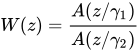
Most (if not all) modern audio codecs attempt to shape the coding noise so that it appears mostly in the frequency regions where the ear cannot detect it. For example, the ear is more tolerant to noise in parts of the spectrum that are louder and vice versa. That's why instead of minimizing the simple quadratic error, CELP minimizes the error for the perceptually weighted domain. The weighting filter W(z) is typically derived from the LPC filter by the use of bandwidth expansion:
where .
Source: Wikipedia. Article content is retrieved live through the MediaWiki API.
Code-excited linear prediction (CELP) is a linear predictive speech coding algorithm originally proposed by Manfred R. Schroeder and Bishnu S. Atal in 1985. At the time, it provided significantly better quality than existing low bit-rate algorithms, such as residual-excited linear prediction (RELP) and linear predictive coding (LPC) vocoders (e.g., FS-1015). Along with its variants, such as algebraic CELP, relaxed CELP, low-delay CELP and vector sum excited linear prediction, it is currently the most widely used speech coding algorithm. It is also used in MPEG-4 Audio speech coding. CELP is commonly used as a generic term for a class of algorithms and not for a particular codec.
G.728 is an ITU-T standard for speech coding operating at 16 kbit/s. It is officially described as Coding of speech at 16 kbit/s using low-delay code excited linear prediction. Technology used is LD-CELP, low-delay code excited linear prediction. Delay of the codec is only 5 samples (0.625 ms). The linear prediction is calculated backwards with a 50th order linear predictive coding filter. The excitation is generated with gain scaled VQ. The standard was finished in 1992 in the form of algorithm exact floating point code. In 1994 a bit exact fixed point codec was released. G.728 passes low bit rate modem signals up to 2400 bit/s. Also network signaling goes through. The complexity of the codec is 30 MIPS. 2 kilobytes of RAM is needed for codebooks. Mean opinion score for G.728 is 3.61. The essence of CELP techniques, which is an analysis-by-synthesis approach to codebook search, is retained in LD-CELP. The LD-CELP however, uses backward adaptation of predictors and gain to achieve an algorithmic delay of 0.625 ms. RealAudio 28.8 is a reduced-bitrate variant of this standard, using 15.2 kbit/s.
Harmonic Vector Excitation Coding, abbreviated as HVXC is a speech coding algorithm specified in MPEG-4 Part 3 (MPEG-4 Audio) standard for very low bit rate speech coding. HVXC supports bit rates of 2 and 4 kbit/s in the fixed and variable bit rate mode and sampling frequency of 8 kHz. It also operates at lower bitrates, such as 1.2-1.7 kbit/s, using a variable bit rate technique. The total algorithmic delay for the encoder and decoder is 36 ms. It was published as subpart 2 of ISO/IEC 14496-3:1999 (MPEG-4 Audio) in 1999. An extended version of HVXC was published in MPEG-4 Audio Version 2 (ISO/IEC 14496-3:1999/Amd 1:2000). MPEG-4 Natural Speech Coding Tool Set uses two algorithms: HVXC and CELP (Code Excited Linear Prediction). HVXC is used at a low bit rate of 2 or 4 kbit/s. Higher bitrates than 4 kbit/s in addition to 3.85 kbit/s are covered by CELP.
Constrained Energy Lapped Transform (CELT) is an open, royalty-free lossy audio compression format and a free software codec with especially low algorithmic delay for use in low-latency audio communication. The algorithms are openly documented and may be used free of software patent restrictions. Development of the format was maintained by the Xiph.Org Foundation (as part of the Ogg codec family) and later coordinated by the Opus working group of the Internet Engineering Task Force (IETF). CELT was meant to bridge the gap between Vorbis and Speex for applications where both high quality audio and low delay are desired. It is suitable for both speech and music. It borrows ideas from the CELP algorithm, but avoids some of its limitations by operating in the frequency domain exclusively. The original stand-alone CELT has been merged into Opus. Therefore, CELT as stand-alone format is now abandoned and obsolete. Development is going on only for its hybridised form as a layer of Opus, integrated with SILK. This article covers the historic, stand-alone format; for the integrated form and its evolution since the integration into Opus see the article on Opus.
Before the 1921 destruction of Tulsa’s Greenwood District, Black residents had created a remarkable center of business and community life. The district included stores, professional offices, entertainment venues and homes owned by Black citizens. Understanding Greenwood means learning what was built—not only what was burned.
MORE →The Greenwood District.

![{\displaystyle e[n]=e_{f}[n]+e_{a}[n]\,}](https://wikimedia.org/api/rest_v1/media/math/render/svg/a73d143a87b39cf54d37364911a2b427f53774ec)
![{\displaystyle e_{f}[n]}](https://wikimedia.org/api/rest_v1/media/math/render/svg/da6cae880892e3cceebf1a6e4688c466b0904a2d)
![{\displaystyle e_{a}[n]}](https://wikimedia.org/api/rest_v1/media/math/render/svg/5006fcfe0a5ffa191978804f946186a83e8d9284)