Civil Rights
Movements, leaders, victories and the continuing fight for equality.

Explore the people, places, events, achievements, struggles and stories that shaped our journey.
Movements, leaders, victories and the continuing fight for equality.
Innovation, patents, science, technology and world-changing contributions.
Pioneers, champions, Negro Leagues, records, activism and excellence.
Meet the people whose lives, choices and achievements shaped the journey.
Black towns, communities, institutions and places where history happened.
Moments that changed communities, movements, institutions and the nation.
In August 1908, a white mob attacked Springfield, Illinois’s Black community, destroying homes and businesses and lynching two Black men. National outrage over the violence helped spur the movement that created the NAACP the following year.
MORE →Reflects the personal views, recollections, and perspective of the author, Mike Davis.
This is a personal recollection on the Move fire on May 13, 1985
 | This article needs more citations. (April 2023) |

Luminance is a photometric measure of the luminous intensity per unit area of light travelling in a given direction.[1] It describes the amount of light that passes through, is emitted from, or is reflected from a particular area, and falls within a given solid angle.
The procedure for conversion from spectral radiance to luminance is standardized by the CIE and ISO.[2]
Brightness is the term for the subjective impression of the objective luminance measurement standard (see Objectivity (science) § Objectivity in measurement for the importance of this contrast).
The SI unit for luminance is candela per square metre (cd/m2). A non-SI term for the same unit is the nit. The unit in the Centimetre–gram–second system of units (CGS) (which predated the SI system) is the stilb, which is equal to one candela per square centimetre or 10 kcd/m2.
Luminance is often used to characterize emission or reflection from flat, diffuse surfaces. Luminance levels indicate how much luminous power could be detected by the human eye looking at a particular surface from a particular angle of view. Luminance is thus an indicator of how bright the surface will appear. In this case, the solid angle of interest is the solid angle subtended by the eye's pupil.
Luminance is used in the video industry to characterize the brightness of displays. A typical computer display emits between 50 and 300 cd/m2. The sun has a luminance of about 1.6×10⁹ cd/m2 at noon.[3]
Luminance is invariant in geometric optics.[4] This means that for an ideal optical system, the luminance at the output is the same as the input luminance.
For real, passive optical systems, the output luminance is at most equal to the input. As an example, if one uses a lens to form an image that is smaller than the source object, the luminous power is concentrated into a smaller area, meaning that the illuminance is higher at the image. The light at the image plane, however, fills a larger solid angle so the luminance comes out to be the same assuming there is no loss at the lens. The image can never be "brighter" than the source.
Retinal damage can occur when the eye is exposed to high luminance. Damage can occur because of local heating of the retina. Photochemical effects can also cause damage, especially at short wavelengths.[5]
The IEC 60825 series gives guidance on safety relating to exposure of the eye to lasers, which are high luminance sources. The IEC 62471 series gives guidance for evaluating the photobiological safety of lamps and lamp systems including luminaires. Specifically it specifies the exposure limits, reference measurement technique and classification scheme for the evaluation and control of photobiological hazards from all electrically powered incoherent broadband sources of optical radiation, including LEDs but excluding lasers, in the wavelength range from 200 nm through 3000 nm. This standard was prepared as Standard CIE S 009:2002 by the International Commission on Illumination.
A luminance meter is a device used in photometry that can measure the luminance in a particular direction and with a particular solid angle. The simplest devices measure the luminance in a single direction while imaging luminance meters measure luminance in a way similar to the way a digital camera records color images.[6]

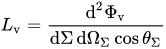
The luminance of a specified point of a light source, in a specified direction, is defined by the mixed partial derivative where
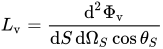
If light travels through a lossless medium, the luminance does not change along a given light ray. As the ray crosses an arbitrary surface S, the luminance is given by where
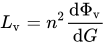
More generally, the luminance along a light ray can be defined as where

The luminance of a reflecting surface is related to the illuminance it receives: where the integral covers all the directions of emission ΩΣ,
In the case of a perfectly diffuse reflector (also called a Lambertian reflector), the luminance is isotropic, per Lambert's cosine law. Then the relationship is simply
A variety of units have been used for luminance, besides the candela per square metre. Luminance is essentially the same as surface brightness, the term used in astronomy. This is measured with a logarithmic scale, magnitudes per square arcsecond (MPSAS).
| cd/m2 (SI unit) ≡ nit ≡ lm/m2/sr |
stilb (sb) (CGS unit) ≡ cd/cm2 |
apostilb (asb) ≡ blondel |
bril | skot (sk) | lambert (L) | foot-lambert (fL) = 1 ⁄ π cd/ft2 | ||||
|---|---|---|---|---|---|---|---|---|---|---|
| 1 cd/m2 | = | 1 | 10−4 | π ≈ 3.142 |
107 π ≈ 3.142×10⁷ |
103 π ≈ 3.142×10³ |
10−4 π ≈ 3.142×10⁻⁴ |
0.30482 π ≈ 0.2919 | ||
| 1 sb | = | 104 | 1 | 104 π ≈ 3.142×10⁴ |
1011 π ≈ 3.142×10¹¹ |
107 π ≈ 3.142×10⁷ |
π ≈ 3.142 |
30.482 π ≈ 2,919 | ||
| 1 asb | = | 1 ⁄ π ≈ 0.3183 |
10−4 ⁄ π ≈ 3.183×10⁻⁵ |
1 | 107 | 103 | 10−4 | 0.30482 ≈ 0.0929 | ||
| 1 bril | = | 10−7 ⁄ π ≈ 3.183×10⁻⁸ |
10−11 ⁄ π ≈ 3.183×10⁻¹² |
10−7 | 1 | 10−4 | 10−11 | 0.30482×10⁻⁷ ≈ 9.29×10⁻⁹ | ||
| 1 sk | = | 10−3 ⁄ π ≈ 3.183×10⁻⁴ |
10−7 ⁄ π ≈ 3.183×10⁻⁸ |
10−3 | 104 | 1 | 10−7 | 0.30482×10⁻³ ≈ 9.29×10⁻⁵ | ||
| 1 L | = | 104 ⁄ π ≈ 3,183 |
1 ⁄ π ≈ 0.3183 |
104 | 1011 | 107 | 1 | 0.30482×10⁴ ≈ 929 | ||
| 1 fL | = | 1 ⁄ 0.30482 ⁄ π ≈ 3.426 |
1 ⁄ 30.482 ⁄ π ≈ 3.426×10⁻⁴ |
1 ⁄ 0.30482 ≈ 10.76 |
107 ⁄ 0.30482 ≈ 1.076×10⁸ |
103 ⁄ 0.30482 ≈ 1.076×10⁴ |
10−4 ⁄ 0.30482 ≈ 1.076×10⁻³ |
1 | ||
| Quantity | Unit | Dimension [nb 1] |
Notes | ||
|---|---|---|---|---|---|
| Name | Symbol[nb 2] | Name | Symbol | ||
| Luminous energy | Qv[nb 3] | lumen second | lm⋅s | T⋅J | The lumen second is sometimes called the talbot. |
| Luminous flux, luminous power | Φv[nb 3] | lumen (= candela steradian) | lm (= cd⋅sr) | J | Luminous energy per unit time |
| Luminous intensity | Iv | candela (= lumen per steradian) | cd (= lm/sr) | J | Luminous flux per unit solid angle |
| Luminance | Lv | candela per square metre | cd/m2 (= lm/(sr⋅m2)) | L−2⋅J | Luminous flux per unit solid angle per unit projected source area. The candela per square metre is sometimes called the nit. |
| Illuminance | Ev | lux (= lumen per square metre) | lx (= lm/m2) | L−2⋅J | Luminous flux incident on a surface |
| Luminous exitance, luminous emittance | Mv | lumen per square metre | lm/m2 | L−2⋅J | Luminous flux emitted from a surface |
| Luminous exposure | Hv | lux second | lx⋅s | L−2⋅T⋅J | Time-integrated illuminance |
| Luminous energy density | ωv | lumen second per cubic metre | lm⋅s/m3 | L−3⋅T⋅J | |
| Luminous efficacy (of radiation) | K | lumen per watt | lm/W | M−1⋅L−2⋅T3⋅J | Ratio of luminous flux to radiant flux |
| Luminous efficacy (of a source) | η[nb 3] | lumen per watt | lm/W | M−1⋅L−2⋅T3⋅J | Ratio of luminous flux to power consumption |
| Luminous efficiency, luminous coefficient | V | 1 | Luminous efficacy normalized by the maximum possible efficacy | ||
| See also: | |||||
Source: Wikipedia. Article content is retrieved live through the MediaWiki API.

Luminance is a photometric measure of the luminous intensity per unit area of light travelling in a given direction. It describes the amount of light that passes through, is emitted from, or is reflected from a particular area, and falls within a given solid angle. The procedure for conversion from spectral radiance to luminance is standardized by the CIE and ISO. Brightness is the term for the subjective impression of the objective luminance measurement standard (see Objectivity (science) § Objectivity in measurement for the importance of this contrast). The SI unit for luminance is candela per square metre (cd/m2). A non-SI term for the same unit is the nit. The unit in the Centimetre–gram–second system of units (CGS) (which predated the SI system) is the stilb, which is equal to one candela per square centimetre or 10 kcd/m2.

Luminance HDR, formerly Qtpfsgui, is graphics software used for the creation and manipulation of high-dynamic-range images. Released under the terms of the GPL, it is available for Linux, Microsoft Windows, and Mac OS X (Intel only). Luminance HDR supports several High Dynamic Range (HDR) as well as Low Dynamic Range (LDR) file formats.

The superyacht Luminance was built by Lürssen of Germany and delivered to its owner, Rinat Akhmetov, a Ukrainian billionaire, in 2024.
Relative luminance Y {\displaystyle Y} follows the photometric definition of luminance L {\displaystyle L} including spectral weighting for human vision, but while luminance L {\displaystyle L} is a measure of light in units such as c d / m 2 {\displaystyle cd/m^{2}} , relative luminance Y {\displaystyle Y} values are normalized as 0.0 to 1.0 (or 1 to 100), with 1.0 (or 100) being a theoretical perfect reflector of 100% reference white. Like the photometric definition, it is related to the luminous flux density in a particular direction, which is radiant flux density weighted by the luminous efficiency function y ¯ ( λ ) {\displaystyle {\overline {y}}(\lambda )} of the CIE Standard Observer. The use of relative values is useful in color or appearance models that describe perception relative to the eye's adaptation state and a reference white. For example, in prepress for print media, the absolute luminance of light reflecting off the print depends on the specific illumination, but a color appearance model using relative luminance can predict the appearance by referencing the given light source.
Before the 1921 destruction of Tulsa’s Greenwood District, Black residents had created a remarkable center of business and community life. The district included stores, professional offices, entertainment venues and homes owned by Black citizens. Understanding Greenwood means learning what was built—not only what was burned.
MORE →Joe Louis.